

Garment manufacturing competitiveness is the ability of a location and its supplier base to deliver the required product, quantity, quality, timing, and compliance outcome at an acceptable total cost and level of risk. It is not the same as having the lowest hourly wage. A wage rate is one input; the more useful question is how much it costs to produce an acceptable garment and deliver it where it must go.
This distinction matters because a low labor-cost rate can be offset by lower productivity, material waste, rework, longer transport, limited process capability, or additional coordination. Apparel Wiki is an independent educational publication, and its Sponsor information does not turn an editorial framework into a factory quote or sourcing guarantee. The comparison below is intended to support project-specific research, not to rank countries or regions universally.
What Garment Manufacturing Competitiveness Means Beyond Wages
When comparing garment manufacturing locations, separate four ideas that are often mixed together. Production cost covers the resources used to make the garment. Delivered cost adds the costs of moving, documenting, and receiving the product at an agreed commercial point. Commercial value concerns whether the product meets the brand’s market, quality, and service requirements. Supply-chain risk concerns the possibility that disruption, inconsistency, delay, or noncompliance will reduce the value of the outcome.
These measures answer different questions. A production location may offer a low sewing labor rate but still produce a higher delivered cost if it requires more labor minutes, has greater rework, depends on imported trims, or involves a longer and less flexible logistics route. Conversely, a location with higher direct labor costs may be commercially appropriate when it provides the required technical skills, material access, development support, or response speed.
Competitiveness is therefore product-specific. A basic, repeatable, high-volume style may reward stable throughput and efficient material use. A small-batch program, complex fit, stretch fabric, delicate construction, bonded detail, embellishment, wash process, or fast-response launch may place more weight on engineering, sample development, process control, and flexibility. A manufacturing location comparison should begin with the product and service requirements rather than with a country label.
Any wage evidence also needs context. The geographic scope, year, currency, labor category, and measurement method should be clear before figures are compared. Research on employment, wages, and working conditions in Asia’s garment sector, for example, treats labor conditions as a broader subject than a single wage number. Without that context, a nominal rate can create a false impression of apparel sourcing competitiveness.
Build the Comparison Around the Cost of an Acceptable Delivered Garment
A more useful model compares the cost per unit of acceptable delivered output. “Acceptable” means that the garment meets the defined product, quality, documentation, and destination requirements. “Delivered” must also be defined: the comparison might be ex-factory, free-on-board, delivered to a distribution point, or another agreed basis. These bases should not be treated as interchangeable.
Relevant cost factors can include labor, fabric and trims, energy, utilities, factory overhead, packaging, quality-related loss, inland transport, freight, duties or taxes where applicable, financing, inspection, testing, and project-specific coordination. Not every project needs every category, but excluded items should be recorded. A wage-only comparison can conceal costs that appear later as material replacement, rework, missed delivery windows, or additional administrative effort.
| Factor | Measurement basis | Evidence | Likely commercial effect | Project-specific caveat |
|---|---|---|---|---|
| Labor | Cost for the required work, not only hourly rate | Comparable quotation or project record | Influences unit cost and capacity use | Minutes and skill mix vary by product |
| Materials | Usable fabric, trims, packaging, and loss | Material records and approved specifications | Can affect yield, consistency, and development speed | Availability and order constraints differ by program |
| Quality loss | Rework, replacement, inspection, and rejected output | Quality reports or trial results | Raises the cost of acceptable garments | Small samples may not represent ongoing production |
| Logistics | Transport, handling, customs, and agreed delivery basis | Route assumptions and shipment records | Changes delivered cost and timing exposure | Route, season, mode, and destination matter |
This framework is an editorial comparison method, not a landed-cost calculation, financial forecast, or supplier quotation. Production, export, retail, and value-added figures also describe different stages or indicators and should not be added into one total without a clear accounting basis.
Evaluate Productivity, Process Capability, and Product Complexity
Productivity matters because the relevant output is acceptable garments, not labor hours purchased. A location may have low nominal wages but require more time to complete the same construction, create more rework, or experience bottlenecks between dependent operations. Useful evidence includes approved samples, production trials, quality records, engineering observations, and comparable project data. A general reputation or country label is not proof of a particular supplier’s capability.
Assess whether the available supplier base can perform the actual route required by the product. Depending on the style, that route may involve preparation, fabric handling, spreading, cutting, sewing, pressing, inspection, packing, testing, washing, printing, embroidery, or other work. This sequence is illustrative rather than universal. Product design, materials, equipment, quality controls, and buyer requirements can change both the order and the dependencies.
Review line balance, operator skill, technical support, sample development, pattern and marker coordination, and the ability to resolve process problems. Consider how information moves from design and development into production, and whether approvals arrive in time for the next operation. For complex garments, engineering support and process discipline may matter more than a small difference in direct labor cost.
Product complexity should be made explicit in the comparison. Stretch fabrics, delicate materials, bonded or technical details, embellishment, wash treatments, and demanding fit requirements can change handling, quality control, learning curves, and rework exposure. Do not assign a universal efficiency percentage or assume that a result from one product applies to another. Separate observed project evidence from common industry practice and from assumptions that still need validation.
Compare Materials, Supply-Chain Connectivity, and Delivery Reliability
A location is only useful when it can support the required flow of materials, information, approvals, finished goods, and returns. Check access to the specific fabrics, trims, packaging, testing, dyeing, washing, printing, embroidery, and finishing services required by the program. Local availability should never be assumed from a broad regional reputation.
Material sourcing can affect development speed, minimum order constraints, color and lot consistency, inspection requirements, and exposure to disruption. Before cutting, confirm controls for shrinkage, usable width, shade or color-lot consistency, and fabric defects because these conditions can affect yield and finished-garment consistency. A sample or preliminary material check does not automatically represent every later batch.
Map the route rather than relying on distance alone. Include supplier-to-supplier movement, inland transport, ports or border crossings, customs interfaces, freight mode, approval cycles, communication cadence, and any required buffer. Transit and disruption effects are conditional: they vary with route, season, order profile, destination, and product. Avoid unsupported average lead times.
Finally, distinguish infrastructure from supplier execution. A location may have relevant transport connections or nearby services, while an individual supplier may still differ in booking discipline, planning, material control, escalation, and documentation. Delivery reliability is produced by geography, logistics, process control, and supplier behavior together. Research on apparel value-chain participation similarly treats connectivity and trade exposure as competitiveness factors alongside labor economics, rather than as substitutes for direct supplier evidence.
Include Quality, Compliance, and Responsible-Production Requirements
A location comparison is incomplete if it measures only the quoted production cost. The relevant question is whether the supplier and supply chain can repeatedly deliver garments that meet the product brief, destination-market requirements, buyer policies, and documented quality expectations. These requirements may include labeling, traceability, restricted-substance controls, labor conditions, environmental practices, safety, testing, inspection, and recordkeeping, but only where they apply to the specific project.
Keep different types of requirements separate. A legal or regulatory obligation is not the same as a buyer code, voluntary standard, certification, or internal brand policy. Each has a different authority, scope, evidence requirement, and consequence. A location should not be described as compliant or noncompliant based only on its country label or on a supplier’s unverified statement. Check current, relevant documentation for the destination market and the actual product.
Quality evidence also needs to go beyond a first sample. Compare how each option controls materials, workmanship, inspection, corrective actions, approvals, and production records. Before cutting, review shrinkage, usable width, shade or color-lot consistency, and fabric defects because these conditions can affect yield and finished-garment consistency. A preliminary material check does not automatically represent every later batch.
For a fair comparison, include the cost and effort of required testing, inspection, documentation, remediation, and quality loss. A lower quotation may not be lower on a comparable basis if one option excludes activities needed to release, sell, or legally distribute the garment. Evidence quality matters as much as the apparent result: distinguish independently verifiable records, project evidence, supplier assertions, and editorial recommendations.

Use a Weighted Comparison Matrix for a Real Sourcing Decision
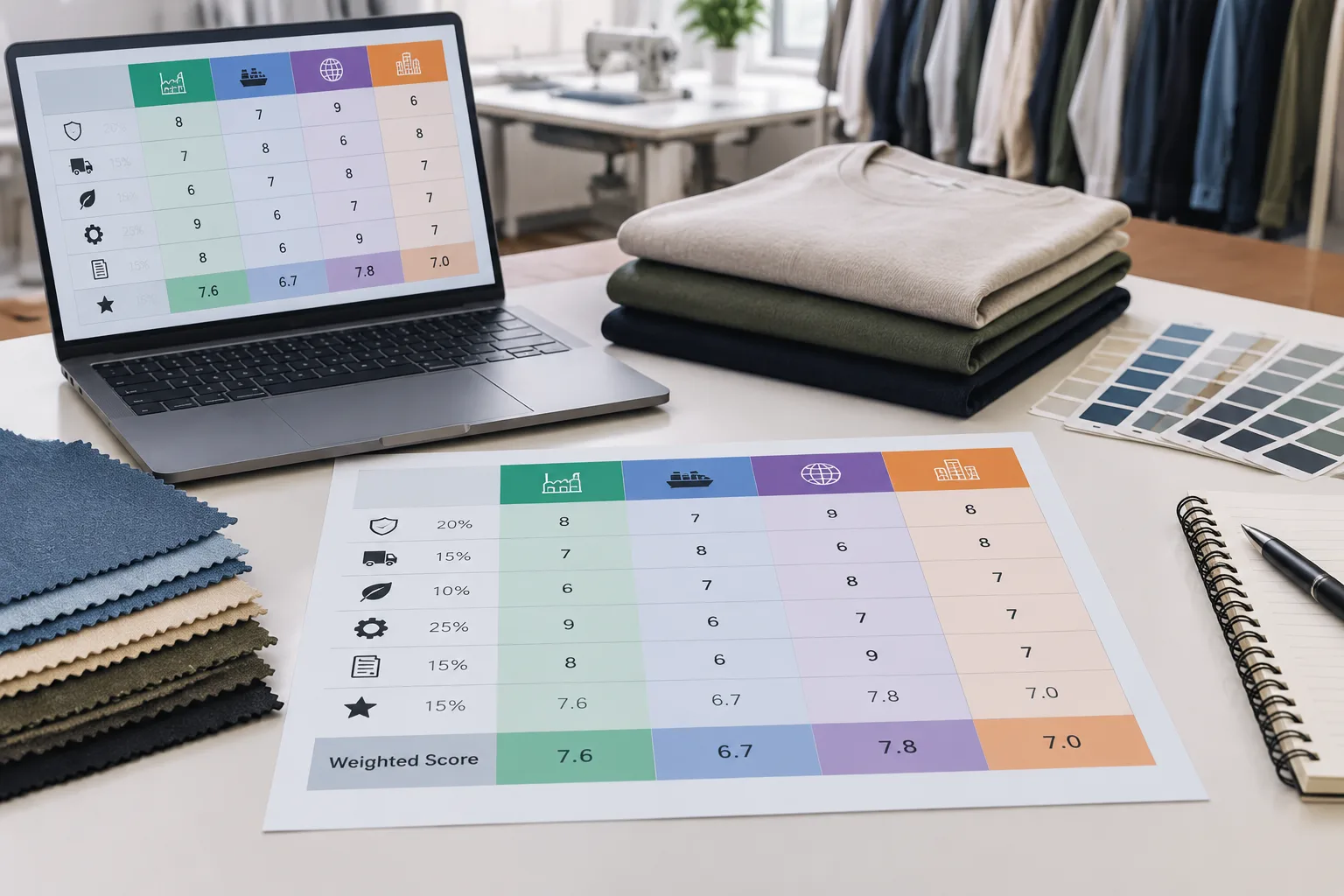
A weighted matrix turns a broad location comparison into a repeatable project decision. Start with non-negotiable requirements: the product’s construction and material needs, destination-market compliance, acceptable quality, delivery window, order profile, and documentation. An option that fails a mandatory requirement should not remain competitive simply because it appears attractive on labor cost.
| Factor | Measurement basis | Evidence | Commercial effect | Project caveat |
|---|---|---|---|---|
| Cost | Comparable delivered basis | Quotation and logistics assumptions | Changes total unit economics | Check included and excluded items |
| Capability | Required product and process route | Samples, trials, and quality records | Affects acceptable output | Do not infer capability from location |
| Reliability | Material, approval, and shipment controls | Project records and logistics plan | Changes buffer and disruption exposure | Route and season affect outcomes |
| Compliance | Applicable legal and buyer requirements | Current verified documentation | Reduces rejection and remediation risk | Requirements vary by market and product |
After defining the evidence, set project-specific weights for cost, quality, speed, flexibility, capability, risk, and any applicable sustainability requirements. Use qualitative ratings or blank fields when the available evidence does not support precise numbers. Record confidence separately from the score so an unsupported estimate cannot appear equivalent to a verified production trial or approved sample.
Then test how the result changes when important assumptions change. Review material sourcing, freight conditions, exchange rates, order volume, rework, delivery requirements, and buffer needs. A hypothetical comparison might consider a basic repeat style, a complex technical style, and a fast-response small-batch program. The point is not to produce an invented winner; it is to show that the relevant weights and evidence can change with the product and commercial model.
Keep a decision record that identifies the evidence date, assumptions, weighting logic, unresolved questions, and validation actions. The Apparel Manufacturing Tools page may support related planning work, but Apparel Wiki is an independent educational publication, not a factory, manufacturer, laboratory, certifier, or sourcing provider. A matrix supports due diligence; it does not replace it.
Recognize the Limits of Location-Level Comparisons Before Making a Commitment
A country or region can offer useful context, but a location-level advantage does not prove that every supplier there has the required skills, equipment, controls, capacity, financial stability, or documentation practices. Separate location risk from supplier risk, product risk, order risk, and buyer-process risk. These layers interact, but they should not be treated as one score without explanation.
The comparison can also change over time. Material prices, freight conditions, exchange rates, policy requirements, demand, available capacity, and inventory may alter the result after the initial review. Update the analysis when the product, order volume, destination, delivery requirement, or sourcing assumptions change. Avoid treating a historical comparison as a permanent ranking.
Before commitment, validate the leading option through a supplier capability review, material and workmanship samples, a documented quotation basis, pilot or trial production where appropriate, quality records, applicable compliance evidence, and a logistics plan. Confirm what remains uncertain and who must provide the evidence. This process produces a more defensible sourcing decision than relying on a country label or wage comparison alone.
Next step: Convert the comparison into a project brief with mandatory requirements, comparable cost boundaries, evidence owners, review dates, and clear approval gates. That brief can then guide supplier discussions and be revised as product and delivery assumptions become more precise.
Why are wages not enough to compare garment manufacturing locations?
Wages are only one input. Productivity, materials, quality loss, logistics, compliance work, rework, coordination, and supplier execution can change the cost and risk of an acceptable delivered garment.
What costs should be included when comparing apparel production countries?
Include relevant labor, materials, energy, overhead, quality-related loss, packaging, inland transport, freight, duties or taxes where applicable, financing, testing, inspection, and documentation. State the comparison basis and exclusions.
How does productivity affect garment manufacturing competitiveness?
Productivity affects how much acceptable output is produced from available labor and process capacity. Assess it through the actual product route, bottlenecks, rework, quality records, and trial evidence rather than a universal percentage.
Should material availability influence the choice of a garment manufacturing location?
Yes, when the product depends on specific fabrics, trims, treatments, or services. Assess availability, order constraints, development speed, lot consistency, inspection, and the movement of materials instead of assuming local supply.
How can a brand compare garment suppliers in different countries fairly?
Use the same product brief, quotation boundaries, evidence requirements, quality expectations, delivery assumptions, and compliance criteria. Then apply project-specific weights and record uncertainty separately from each apparent score.
What quality and compliance evidence should be checked before choosing a production location?
Review applicable legal and buyer requirements, current documentation, material controls, approved samples, inspection and quality records, corrective-action practices, traceability, testing where required, and logistics controls. Supplier assertions should be verified where the decision depends on them.