An inspection charges sensitivity analysis is a structured way to test how changes in inspection-related costs could affect an apparel product, purchase order, shipment, or sourcing program budget. It does not predict the final invoice or guarantee an inspection result. Instead, it shows how the budget behaves under clearly stated assumptions, helping teams decide whether to inspect each shipment, use a sampling arrangement, compare quotations, or hold a contingency allowance.
For Apparel Wiki, this is an educational planning framework rather than a provider quotation or service recommendation. The site is an independent garment-manufacturing knowledge publication, and its editorial work is separate from any sponsor relationship described on the Sponsor page. Actual charges, quality requirements, and acceptance decisions must be confirmed with the buyer, supplier, inspection provider, or applicable authority.
What Is an Inspection Charges Sensitivity Analysis?
In apparel costing, an inspection charge is the amount paid for a defined inspection activity. Depending on the project, the charge may relate to a visit, inspection day, shipment, lot, style, or another agreed basis. A sensitivity analysis takes that charge and tests how its total changes when relevant inputs move. The result is a set of conditional scenarios, such as a planned inspection case, a higher-frequency case, or a case involving additional travel or testing.
This analysis should be distinguished from the broader quality-control budget. The inspection charge may cover the provider’s work, while the wider quality budget may also include internal quality staff, sample preparation, documentation, or other quality activities. Rework, rejection, replacement, expedited transport, claims, chargebacks, lost sales, and compliance testing are separate cost categories unless the decision specifically requires a broader contribution analysis.
The practical output is not a single “correct” inspection cost. It is a view of exposure: which assumptions have the greatest effect, which inputs are uncertain, and when a budget decision should be reviewed. For example, a sourcing team may compare the cost of inspecting every shipment with a sampling arrangement, but the appropriate choice depends on the actual quality plan, product risk, buyer requirements, supplier evidence, and inspection scope.
Set the Cost Boundary Before You Model the Charge
Start with a cost map. List the provider’s quoted fee separately from possible pass-through or additional items, including travel, accommodation, sample handling, laboratory testing, document review, translation, reporting, repeat visits, and other project-specific charges. This is a planning structure, not a claim that every provider invoices these items separately. The quotation or published terms must establish what is included.
Define the unit of analysis before entering figures. An inspection cost per shipment answers a different question from an inspection cost per style, inspection day, lot, unit, purchase order, or program. A large shipment may make the per-unit result appear small even when the total visit charge is material. Conversely, dividing a program charge across too many units can make comparisons misleading.
| Cost layer | Modeling treatment |
|---|---|
| Quoted inspection fee | Include in the baseline using the provider’s stated charging basis. |
| Travel, testing, reporting, or handling | Separate when conditional or excluded; avoid adding them again if already bundled. |
| Reinspection, rework, replacement, or expedited freight | Keep separate unless the decision requires a broader quality-cost or contribution view. |
| Claims, chargebacks, or lost sales | Use only when the commercial analysis has supported assumptions for them. |
Record the currency, tax treatment, payment timing, and quotation status. Mark each amount as fixed, estimated, conditional, or still awaiting confirmation. Also note the quotation date and expiry terms where available. Currency movement or changed shipment plans may require a new review, but they should not be hidden inside an unexplained adjustment.
Double-counting is a common weakness in an inspection cost breakdown. If a quotation already includes travel, reporting, or testing, do not add those components again as though they were independent costs. Likewise, do not automatically place rework inside the inspection fee. Rework may be a downstream operating cost triggered by a result, not part of the inspection provider’s charge.
Identify the Variables That Can Move the Inspection Budget
Select variables because they reflect the project, not because they are easy to change in a spreadsheet. Common inspection cost drivers include inspection frequency, shipment or order volume, number of styles, inspection locations, inspection duration, travel distance, testing scope, sample availability, and the possibility of a follow-up inspection. The applicable provider terms and buyer quality plan should confirm the charging basis for each one.
Separate controllable decisions from uncertain operating inputs. Inspection timing, scope, visit consolidation, and the number of shipments presented for inspection may be planning choices. Shipment consolidation, travel requirements, supplier readiness, sample availability, and findings that lead to a follow-up visit may be less certain. Labeling the difference helps the team decide whether to change the plan or improve the information supporting the assumption.
Costs can behave differently depending on their basis. A provider may quote a fixed project amount, a per-visit or per-day charge, a per-lot or per-unit amount, or a pass-through cost that depends on an outside service. These are conditional categories for modeling, not universal invoicing rules. Confirm whether a change in volume affects the charge, the inspection duration, the number of visits, or none of them.
Operational consequences belong in the model only when they are relevant to the decision and supported by project evidence. A failed result may lead to rework, delay, repeat inspection, or a changed shipment plan, but the analysis should not assume that outcome automatically occurs. Keep the inspection charge visible, then show related consequences in a separate layer when their probability and amount can be reasonably documented.
Build the Baseline and Run One-Variable Sensitivity Tests
First define the baseline period and unit of analysis. Enter the current or quoted inspection charge, every included cost component, the currency, the inspection scope, and the shipment or order period. Then calculate the baseline total. Where useful, also calculate inspection cost per inspected unit or per shipped unit, but preserve the chosen denominator and state whether the units were actually inspected or merely shipped.
Next, change one input at a time. Use clearly labeled lower, base, and higher assumptions for variables such as inspection frequency, shipment volume, duration, travel, testing scope, or repeat visits. Holding the other inputs constant reveals which variable has the greatest effect on the budget. It also makes an assumption error easier to find than a combined scenario in which several figures change at once.
| Test | Input changed | Output to compare |
|---|---|---|
| Frequency test | Number of inspection visits or shipments | Total inspection spend and cost per shipment |
| Scope test | Testing, reporting, or inspection duration | Quoted charge and any conditional additions |
| Volume test | Units, lots, styles, or shipment size | Cost per inspected unit and total program cost |
| Follow-up test | Additional visit after a conditional failed result | Revised budget, clearly separated from the baseline |
A simple sensitivity table or ranked list can show which assumptions move the result most. A tornado-style chart is optional; the important discipline is consistency. Keep the same currency, period, denominator, and cost boundary across every scenario. Treat all unquoted values as hypothetical planning assumptions, and replace them with provider quotations or internal records before using the analysis for a live sourcing decision.
Compare Combined Scenarios for Budget and Cash Decisions
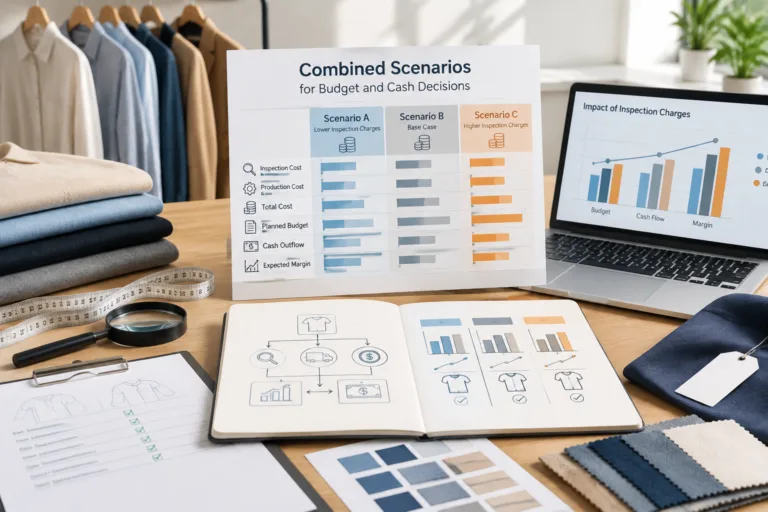
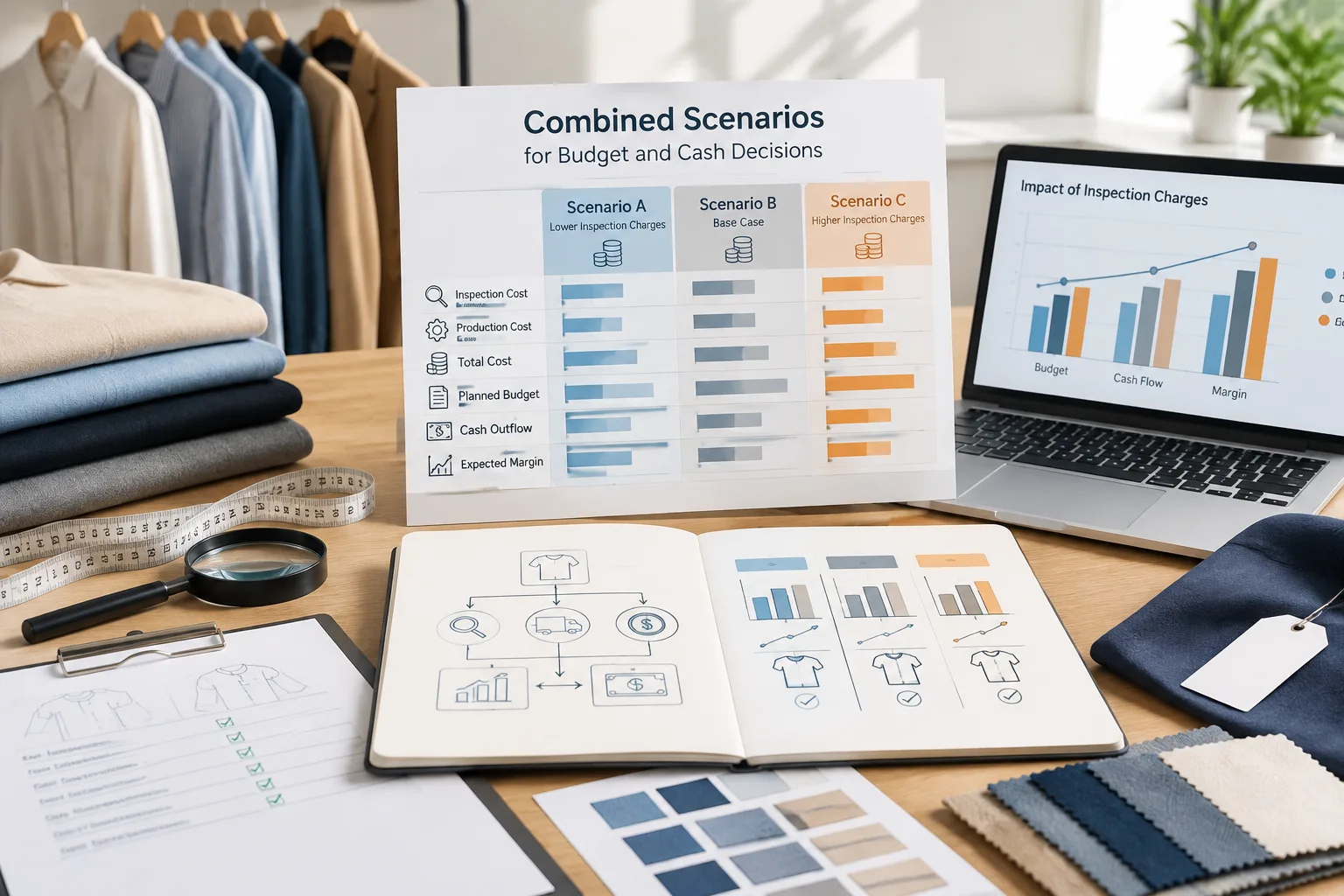
One-variable tests show which assumptions move the result, but sourcing decisions often involve several changes at once. A scenario matrix can compare a planned inspection arrangement with alternatives such as higher inspection frequency, longer travel, broader testing scope, or a repeat visit after a conditional failed result. Keep each row clearly labeled as an assumption for planning, not a predicted outcome.
For each scenario, compare the total inspection spend using the same currency, period, and denominator established in Part 1. Where the model supports it, also show cost per inspected unit, cost per shipped unit, or cost per shipment. Do not switch between these measures without labeling the change. A per-shipped-unit result can look lower than a per-inspected-unit result simply because the populations are different.
Cash timing deserves its own column. A charge may be payable before shipment, after a report, or when a repeat visit is arranged, depending on the agreed terms. Record payment timing only from the relevant quotation, contract, or internal payment process. If a quality issue could create rework, replacement, expedited freight, or another downstream cost, keep that exposure separate unless its amount and treatment are supported by the project model.
Use a decision trigger rather than a universal recommendation. For example, a projected scenario that exceeds the approved inspection allowance might prompt the team to request a revised quotation, consolidate visits, clarify testing scope, or review the shipment plan. It should not automatically prompt a reduction in inspection. Product risk, buyer requirements, supplier history, and verified quality evidence remain part of the decision.
Evaluate Inspection Quotations and Model Quality Trade-Offs
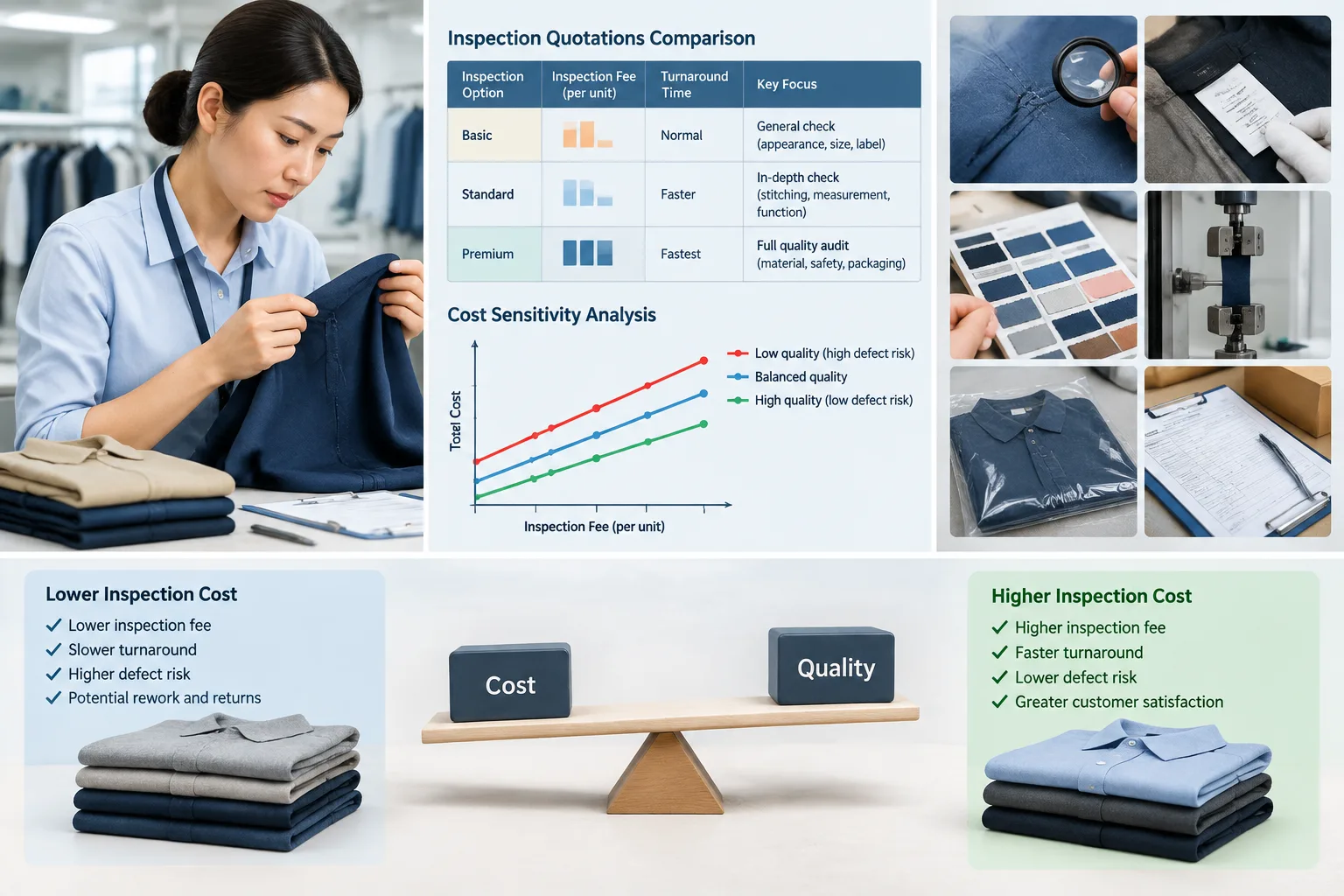
Inspection quotations are comparable only when their scopes are comparable. Build a side-by-side checklist covering the inspection type, location, duration, sample basis, reporting, travel treatment, testing, expected timing, repeat visits, taxes, and cancellation terms where those items apply. Ask each provider to identify inclusions and exclusions in writing rather than comparing headline charges alone.
A lower visible fee may exclude travel, reporting, laboratory work, document review, or a return visit that another quotation includes. The issue is not whether one billing structure is inherently better. The issue is whether the model places the same cost boundary around every option. A bundled amount should not be added again as a separate pass-through cost.
Also define how the final charge will be supported. Depending on the agreed arrangement, useful records may include the inspection report, attendance or timesheet records, travel receipts, laboratory invoices, or other approved billing documentation. These records help the buyer compare the estimate with the actual charge and identify which assumption caused a variance. They do not, by themselves, prove that the inspection was effective or that a product met every commercial requirement.
A practical comparison should weigh cost transparency, coverage, timing, provider suitability, and the commercial consequence of receiving incomplete or late quality information. Cost is one input in a quality-risk decision, not evidence of inspection effectiveness. Separate provider statements, buyer requirements, internal preferences, and Apparel Wiki editorial guidance so that a planning recommendation is not mistaken for a contractual or regulatory requirement.
Limitations, Review Triggers, and Next Steps
An inspection charges sensitivity analysis shows how the budget responds to selected assumptions. It does not establish the probability of defects, prove inspection effectiveness, measure supplier performance, or determine whether a quality plan is legally sufficient. Those questions require appropriate project records and, where relevant, current advice from the buyer, supplier, inspection provider, laboratory, or applicable authority.
Common weaknesses include inconsistent denominators, bundled charges entered twice, omitted repeat visits, stale quotations, currency movement, uncertain shipment plans, and rework or testing counted in more than one place. A model can also create false precision when an uncertain input is presented as a fixed figure. Mark each input as quoted, internally recorded, estimated, or hypothetical, and preserve the source and date beside it.
Review the model whenever the style, supplier, country, inspection location, shipment pattern, or testing scope changes. Assign an owner to each important input and record its confidence level. After the project, compare the assumptions with actual invoices, inspection records, shipment events, and documented quality outcomes. That variance review can show which assumptions deserve better evidence in the next sourcing cycle.
The next useful step is to place the model beside the purchase order or quality plan and resolve scope questions before committing to a budget. Apparel Wiki is an independent garment-manufacturing knowledge platform, not a factory, manufacturer, OEM, ODM, laboratory, certifier, or inspection provider. Its costing and production-planning resources are educational references; project requirements must be confirmed with the responsible commercial and quality parties. The Apparel Manufacturing Tools collection may help organize related planning work.
Frequently Asked Questions
What does an inspection charges sensitivity analysis show?
It shows how changes in selected inspection-cost assumptions affect a defined product, order, shipment, or program budget. It produces conditional scenarios, not a guaranteed final charge or proof of inspection results.
Which costs should be included in an apparel inspection charge analysis?
Start with the quoted inspection charge and any applicable travel, testing, reporting, handling, or repeat-visit costs. Include downstream rework, replacement, freight, or claims only when the decision requires them and the model supports their treatment.
How can I compare inspection quotations on a like-for-like basis?
Align the inspection type, location, duration, sample basis, reporting, travel, testing, timing, repeat-visit treatment, taxes, and cancellation terms. Then check every inclusion and exclusion before comparing totals.
Should repeat inspections and rework be included in the sensitivity model?
Include them as separate conditional scenarios when they are relevant to the decision. Do not present them as certain outcomes, and do not count a cost twice if it is already included in the quotation or another downstream category.
How often should an inspection cost sensitivity analysis be updated?
Update it when the quotation, style, supplier, location, shipment pattern, testing scope, currency basis, or buyer requirement changes. Compare the final assumptions with actual project records after completion.
Can a sensitivity analysis prove that a lower inspection budget is safe?
No. It can show budget exposure, but it cannot prove product quality, supplier performance, inspection effectiveness, or compliance with a buyer or legal requirement. A lower-cost option needs separate quality and risk evidence.