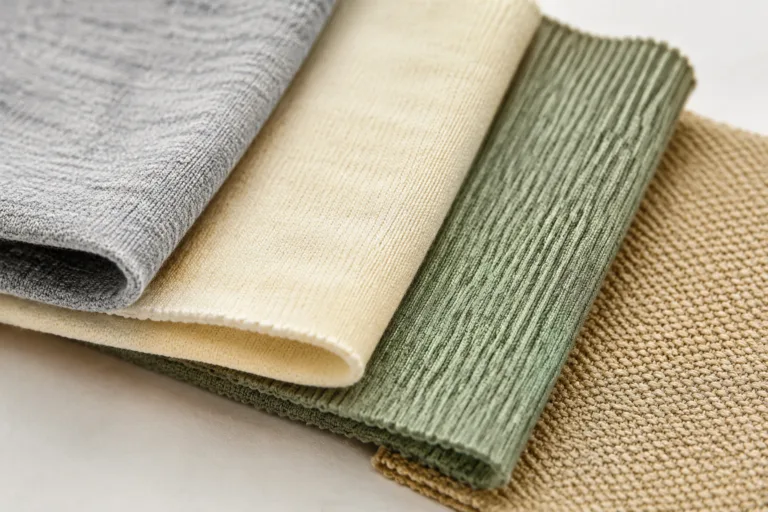
Knit structure is one of the first decisions that changes how a garment feels, moves, and holds up in production. Two fabrics can share the same fiber content and GSM, yet behave very differently if one is jersey and the other is interlock, rib, or pique. For apparel designers and product developers, that difference affects fit, edge stability, print results, seam behavior, shrinkage risk, and even how the finished garment will be graded.
If you want a quick refresher on the foundational distinction between loop-based and interlaced constructions, the article on how to identify knit vs woven fabrics and when to use them is a useful companion. It helps separate construction logic from fabric hand, which matters when you are deciding whether a jersey tee should drape softly, a rib cuff should snap back, or a pique polo needs more body.
How knit fabrics are made: the terminology that shapes performance
Knit fabrics are built from intermeshing loops of yarn rather than the interlaced yarn system used in woven fabrics. That loop structure creates inherent stretch, more give during wear, and a different response to heat, wash, and tension. In sourcing practice, the main question is not simply “what fiber is it?” but “how is the fabric constructed, and what does that structure do to the garment?” An encyclopedic overview of knitting is useful for the basic mechanics, but product teams need to translate those mechanics into garment decisions.
Four terms come up constantly in knit development:
- Wales are the vertical columns of loops. They influence appearance, stretch direction, and how the fabric tracks under tension.
- Courses are the horizontal rows of loops. They affect cover, stability, and recovery after extension.
- Single knit fabrics are formed from one set of needles and usually show different behavior on the face and back. Jersey is the most common example.
- Double knit fabrics use two sets of needles or two linked layers. Interlock is the key reference point here because it is more stable, thicker, and less prone to curling.
Two other terms are especially important in tech packs. Gauge refers to needle density, or how fine the knit is. A higher gauge usually creates a smoother, lighter, more refined surface, while a lower gauge often produces a more open, heavier look. Course length is the amount of yarn used to form a course; it influences density, width, shrinkage behavior, and the hand of the fabric after finishing. When you compare knit fabrics, these details often explain why one supplier’s “same” fabric performs better than another’s.
Key properties to evaluate before selecting a knit
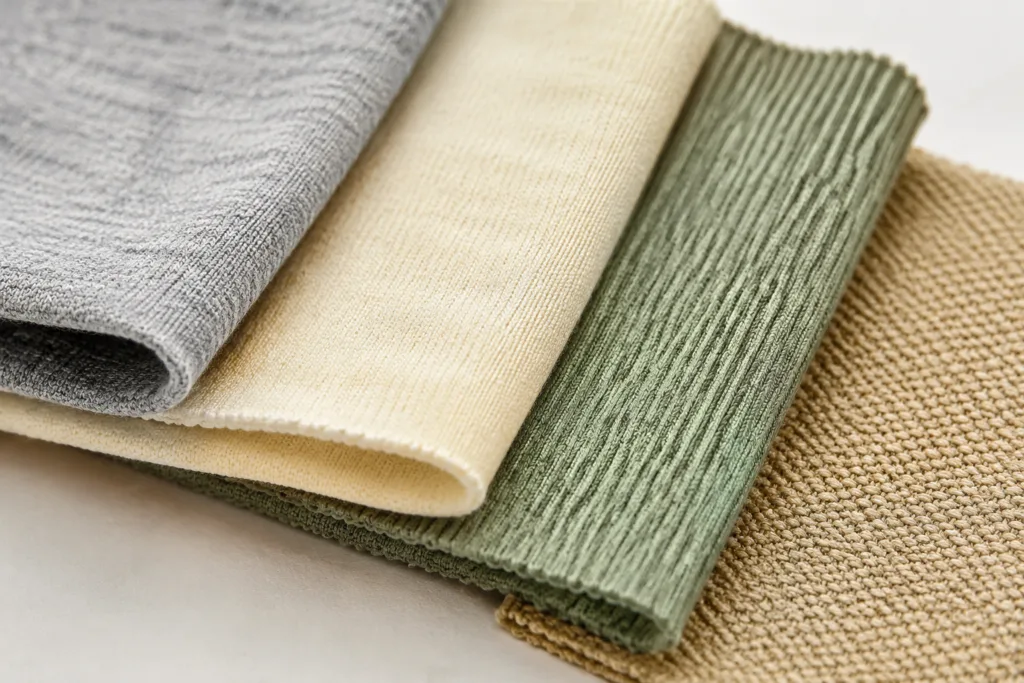
Before choosing between jersey, interlock, rib, and pique, evaluate the fabric against the garment’s function. The same knit can be excellent in one product and a problem in another. A tee body needs a different balance of drape, recovery, and opacity than a cuff, polo collar, or fitted dress.
Use these property questions early in development:
- Stretch and directionality: How much does the fabric stretch crosswise, lengthwise, and on the bias, if relevant? Does it need elastane to meet fit targets?
- Recovery: After extension, does it return close to its original shape, or does it bag out at elbows, knees, necklines, or cuffs?
- Drape: Does the fabric fall softly, or does it stand away from the body with more body and structure?
- Thickness and GSM: Is the fabric light enough for comfort but substantial enough to avoid transparency and cling?
- Thermal behavior: Does the knit trap warmth, breathe well, or support airflow in active or warm-weather wear?
- Texture and surface effect: Is the goal smoothness for printing, or a textured face for polo styling and visual depth?
- Durability and pilling: Will repeated wear, washing, and abrasion expose loops or create pills?
- Dimensional stability: How much shrinkage, spirality, skewing, or distortion appears after laundering?
- Decoration compatibility: Does the surface support screen printing, DTG, embroidery, heat transfer, or sublimation without visible distortion?
Elastane changes both stretch and recovery, so the same base structure can behave very differently after a small percentage of spandex is added; see how elastane adds stretch and recovery to knits for the mechanics. In practice, elastane is often the difference between a fabric that simply stretches and one that reliably snaps back after repeated wear.
Fiber choice also matters. If you are balancing hand feel, moisture behavior, pilling risk, and cost, the comparison of natural and synthetic fiber characteristics gives a useful sourcing lens. Cotton, polyester, viscose, modal, and blended constructions can all be knit into jersey, interlock, rib, or pique, but each fiber shifts the fabric’s thermal feel, shrinkage profile, and printing behavior.
At-a-glance comparison of jersey, interlock, rib, and pique
The ranges below are practical production starting points rather than hard rules. Fiber content, yarn twist, finishing, dye method, and elastane content can move a fabric outside the usual band. Think of the table as a decision aid, not a substitute for lab dips, swatches, and wear testing.
| Structure | Construction | Stretch profile | Recovery and stability | Typical GSM | Common uses | Sewing difficulty |
|---|---|---|---|---|---|---|
| Jersey | Single knit, smooth face, more visible loops on the back | Moderate crosswise stretch, lower lengthwise stretch | Good drape, but more prone to curl and distortion | About 120-220 GSM for most apparel; heavier variants exist | T-shirts, tops, dresses, linings, print bases | Moderate; requires control at seams and hems |
| Interlock | Double knit with two linked jersey layers | Moderate stretch with a more even hand | Better stability, less curling, smoother on both sides | About 180-280 GSM | Polos, stable tops, babywear, structured casualwear | Moderate to higher due to thickness |
| Rib | Alternating knit and purl columns, often 1×1 or 2×2 | High crosswise stretch and strong elastic return | Excellent recovery; can collapse into shape after wear | About 160-320 GSM depending on gauge and use | Cuffs, neckbands, waistbands, fitted garments | Moderate; stretch control is critical |
| Pique | Textured knit with raised surface effects such as birdseye or honeycomb | Low to moderate stretch, often more structured | Good shape retention, breathable, less drapey | About 180-260 GSM | Polo shirts, uniforms, structured casuals | Moderate; texture and collars need control |
Jersey: the most familiar knit fabrics, and why it behaves the way it does
Jersey is the default reference point for many knit fabrics because it is simple, versatile, and cost-efficient. In single jersey, the same side of the fabric shows the face loops, while the reverse side shows purl loops or the back of the structure. That asymmetry is why jersey usually curls at the edges and why it drapes more softly than double knits. It is also why jersey is common in T-shirts, casual tops, and lightweight dresses where softness and movement matter more than edge stability.
In garment development, jersey is usually specified when the product needs a relaxed hand, a softer silhouette, or easier print application. The fabric can be made from cotton, polyester, viscose, modal, blends, and elastane combinations. Cotton jersey often suits breathable casualwear, while polyester jersey is common where dimensional stability, moisture management, or color retention are more important. If the jersey is cotton-based, the article on cotton varieties and their performance in knit fabrics helps explain why long-staple cotton can improve smoothness, reduce hairiness, and support better pilling resistance.
Typical jersey behavior includes:
- Crosswise stretch: usually greater than lengthwise stretch, especially in plain cotton jersey.
- Soft drape: the fabric falls close to the body and moves easily.
- Edge curl: cut edges often roll inward or outward because the structure is unbalanced.
- Print friendliness: smooth jersey surfaces are often favorable for screen print and DTG, provided the fabric is properly pretreated and stabilized.
For many tee programs, a practical starting point is around 140-180 GSM for light to midweight shirts and 180-220 GSM for a more substantial hand or better opacity. Heavier jersey can reduce transparency and improve perceived quality, but it may also feel warmer and less fluid. The right weight depends on the brand position, fit, and target season.
Jersey sewing and production tips
- Cut with control: keep panels flat and avoid letting the fabric stretch on the cutting table, or the garment may grow unevenly after sewing.
- Stabilize shoulder seams: use stay tape or clear elastic where shoulder stretch must be controlled, especially on tees and dresses.
- Choose the right needle: ballpoint or stretch needles help avoid skipped stitches and fabric damage.
- Use stretch-aware seams: narrow zigzag, overlock, and coverstitch setups are common depending on the seam zone and machine park.
- Plan for shrinkage: prewash or test wash the fabric early, then build shrink allowance into the spec and pattern.
- Watch hems carefully: jersey hems can wave if the differential feed, tension, or stitch balance is off.
Interlock: the stable double knit option
Interlock is a double-knit structure that behaves more like a refined, balanced version of jersey. Because the fabric is formed with two linked layers, it is thicker, smoother, and less likely to curl. The face and back look similar, so interlock often reads as cleaner and more polished. That makes it a strong choice when a brand wants the comfort of knitwear but needs more body and shape retention than single jersey can usually provide.
Interlock is useful for polos, premium T-shirts, babywear, and stable tops that should not cling too much. It can also work for lightweight dresses where the design needs a little more structure. In sourcing, interlock is frequently selected when the buyer wants a better hand feel, slightly improved opacity, and fewer edge problems during sewing. It is not automatically better than jersey; it is simply better suited to specific use cases.
Common interlock properties include:
- Reduced curl: edges stay flatter than jersey, which can simplify cutting and sewing.
- Smoother surface: the fabric often looks cleaner on both sides, which is helpful in reversible or premium applications.
- Thicker hand: the fabric feels more substantial and can offer better body coverage.
- Improved stability: seams and hems usually behave better than in light jersey, though the fabric can still stretch.
Interlock sewing and finishing guidance
- Use a needle that matches thickness: a ballpoint or stretch needle is still appropriate, but needle size may need to increase compared with jersey.
- Control seam bulk: double layers can create thick intersections, so test seam allowances, pressing, and topstitch placement early.
- Choose seam constructions carefully: overlock plus coverstitch is common for knits that need comfort and clean finishing.
- Test topstitching: interlock can show stitch distortion if top tension is too high or the thread is not compatible with the fabric weight.
Rib knits: stretch and recovery for trims and fitted garments
Rib knits are defined by alternating knit and purl columns, often in 1×1 or 2×2 arrangements. This construction gives ribs a high degree of elasticity across the width and strong recovery after extension. In apparel development, rib is the fabric people reach for when the component needs to stretch and then come back into shape, such as neckbands, cuffs, waistbands, and certain fitted body garments.
Rib is especially important because it is not just a decorative structure. It is a functional one. A well-chosen rib can help a neckline sit flat, keep a cuff secure, and reduce the risk of stretching out over time. A weak or under-specified rib can create loose openings, sagging cuffs, and poor garment balance after wash. That is why rib should be treated as a performance component in the tech pack, not an afterthought.
Common rib variants include:
- 1×1 rib: more compact, often used for cuffs and neckbands where stronger recovery is needed.
- 2×2 rib: often softer and more flexible, with a slightly broader visual effect.
- Tubular rib: can reduce seam lines and support neat finishing in certain garment parts.
Rib weight varies widely. Lightweight rib can work for trims and refined knits, while heavier rib may be used for body garments or structured fashion details. When you need high stretch in a narrow component, rib usually outperforms jersey or pique. When you need a cleaner body fabric with only moderate give, rib may be too elastic unless it is carefully stabilized.
Working with rib in production
- Match stretch direction to use: orient the rib so the maximum stretch runs across the opening it must support.
- Control attachment tension: if rib is sewn too tight to a less stretchy main fabric, waves and puckering can appear.
- Grade seam allowances carefully: rib often needs controlled easing at join points to prevent distortion.
- Use machines that support recovery: overlock, coverstitch, and specific topstitch settings can all be useful depending on the application.
Pique: textured knit fabrics with structure and airflow
Pique is a textured knit structure that creates a raised or patterned surface, commonly through birdseye, dobby, or honeycomb effects. It is a familiar polo-shirt fabric because it offers more visual texture and a more structured feel than plain jersey. The surface pattern increases airflow and gives the garment a slightly more tailored presence, which is why pique often appears in uniforms, sports-lifestyle polos, and smart-casual programs.
Compared with jersey, pique usually has less drape and a bit more body. It may not cling as closely, which can be useful when the design should sit away from the body. Pique can be made from cotton, polyester, or blends, and cotton pique remains the classic polo choice. The raised structure can also help hide minor surface imperfections, though it may not always be as smooth for fine-detail prints as jersey.
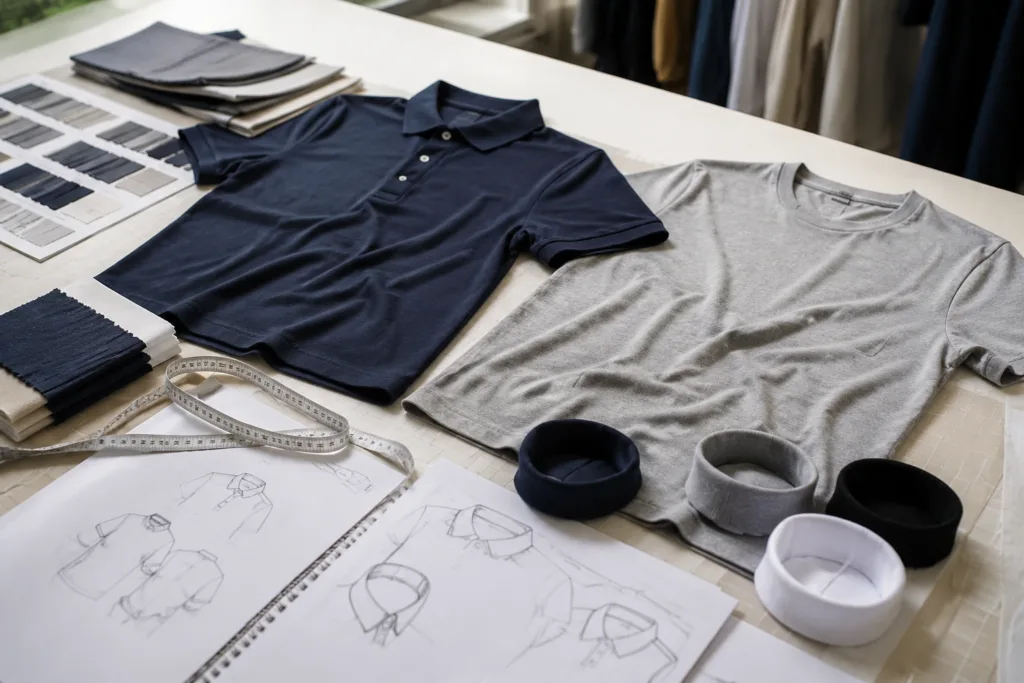
Design implications of pique include:
- Breathability: the textured structure can support airflow and comfort in warm conditions.
- Shape: the fabric often reads more structured and less fluid than jersey.
- Decoration caution: embroidery and heavy prints may need stronger stabilization because the texture can show distortion.
- Collar relationship: pique bodies are often paired with collars and plackets, so the body fabric, collar fabric, and interfacing should be matched as a system.
Pique sewing and finishing tips
- Support collars and plackets: use appropriate interfacing and test how it behaves after wash and press.
- Keep topstitching consistent: visible stitch lines are common in polos, so stitch balance and spacing matter.
- Watch seam allowance choices: thick seams can show through textured surfaces if they are not managed well.
- Test embroidery placement: do not assume the same hooping settings will work across jersey and pique.
How to choose the right knit fabrics for your project
The right structure depends on function first, then aesthetics, then cost. A tee, polo, bodycon dress, cuff, and lining all ask for different performance characteristics. Once the garment use is clear, the fabric decision becomes much easier.
Use this decision matrix as a starting point:
| Garment need | Best starting structure | Why it fits | Watchouts |
|---|---|---|---|
| Basic T-shirt | Jersey | Soft drape, efficient cost, easy print base | Edge curl, transparency, shrinkage |
| Premium tee or babywear | Interlock | More body, cleaner face and back, better stability | More thickness and heat retention |
| Neckbands, cuffs, waistbands | Rib | High stretch and recovery, secure openings | Must match stretch to main body |
| Polo shirt | Pique | Structured look, airflow, classic polo identity | Embroidery and collar construction need control |
| Fitted tops or dresses | Rib or jersey with elastane | Close fit and movement support | Bagging, distortion, seam stress |
When you are comparing a natural-fiber program against a synthetic-heavy one, the cotton varieties and their performance in knit fabrics perspective is helpful, but it should sit alongside the broader fiber decision. Cotton may improve comfort and a familiar hand, while polyester may improve drying speed, shape retention, and cost control. For a broader view of those trade-offs, the comparison of natural and synthetic fiber characteristics helps teams choose on performance, not habit.
For broader terminology and connected garment references, Apparel Wiki is useful when product teams need consistent language across fabric, fit, and construction documents.
Project planning: swatches, testing, and tech-pack fields
A knit selection should never be approved from a photo alone. At minimum, ask for the construction details, a physical swatch, and a laundered sample if the program has wash sensitivity, fit sensitivity, or decoration risk. A single swatch can hide problems that only appear after stretch, wash, or heat.
For a practical sample set, request:
- Face swatch: the front of the fabric as approved for appearance and surface feel.
- Back swatch: the reverse side, especially important for single jersey and textured structures.
- Dyed swatch: a color-approved sample that reflects the intended shade and finishing.
- Laundered swatch: a washed version that shows shrinkage, twist, hand change, and dimensional stability.
Useful tech-pack fields for knit fabrics include:
- Construction: single jersey, interlock, 1×1 rib, pique, or other defined structure.
- Gauge: if relevant, such as 24 GG, 28 GG, or another machine measure.
- Fiber content: including blend percentages and elastane percentage if present.
- Yarn type or yarn count: enough detail for the supplier to source or duplicate correctly.
- GSM: finished weight, not just greige weight.
- Finished width: open width or tubular width, as applicable.
- Stretch ratio: target stretch and recovery expectations by direction.
- Expected shrinkage: after the agreed wash or care cycle.
- Allowed tolerance: for weight, width, shrinkage, and color variation.
- Recommended finishes: such as enzyme wash, compaction, softening, anti-pilling, or brushing.
- Sample ID: so the approved swatch can be traced back to a specific lab dip or bulk lot.
At sourcing stage, ask suppliers how they control roll length, shade banding, and lot consistency. Knit fabric orders can vary in appearance across rolls if knitting tension, dyeing, or finishing drifts during production. If the fabric is destined for garments with critical fit points, specify how much stretch variation is acceptable and how the supplier will measure it.
Decoration, quality control, and common production issues
Decoration method should follow structure, not the other way around. Jersey usually offers the smoothest base for fine prints, while interlock can support a cleaner premium look. Pique can work well for embroidery and polo branding, but the texture may affect detail sharpness. Rib is suitable for decoration in some applications, but because it stretches strongly, artwork placement and hoop tension need careful control.
Use these compatibility notes as a practical guide:
- Screen printing: works well on jersey and many interlocks; stretch and recovery should be checked so print films do not crack.
- DTG: usually favors smooth, stable surfaces, so fine jersey or stable interlock is generally safer than highly textured structures.
- Sublimation: generally depends on fiber content rather than structure alone, so polyester knits are the usual target.
- Embroidery: works on many knits, but stable backing, hooping, and density control are essential, especially on textured or stretchy fabrics.
- Heat transfers: need careful temperature and pressure control so the knit does not stretch or glaze.
Quality control should include both fabric checks and garment checks. Do not inspect only the fabric roll and assume the finished product will behave the same way. Knit garments can reveal distortion after sewing, pressing, and washing even when the incoming fabric looks fine.
Key QC checks to request or run:
- GSM verification: confirm the finished fabric weight against the approved spec.
- Dimensional stability: measure length and width before and after washing to understand shrinkage and growth.
- Stretch and recovery: test whether the fabric returns close to its starting dimensions after extension.
- Pilling evaluation: check whether the surface pills after abrasion or wear simulation.
- Colorfastness: confirm the dye will not bleed or shift badly in wash, crocking, or light exposure.
- Hand and appearance: compare bulk lots against approved swatches under the same light.
Common production problems and practical fixes include:
- Curling edges: often a jersey issue; reduce handling stretch, use stabilizing seams, or move to interlock when edge control matters.
- Wavy hems: usually caused by feed or tension imbalance; adjust machine settings, hem type, or differential feed.
- Skipped stitches: often linked to wrong needle type, dull needles, or fabric distortion; use the right ballpoint or stretch needle.
- Stretched seams: can happen when the fabric is pulled during sewing; train operators and review seam construction.
- Shoulder distortion: often fixed with stay tape, stabilized seam allowances, and better pattern support.
Cost versus performance: where the price really moves
Price in knit fabrics is rarely just about fiber content. Yarn quality, gauge, finishing, dyeing consistency, and added elastane can all move cost and performance. A low-cost jersey may be fine for a promotional tee, but the same spec may fail in a premium line where shrinkage, pilling, and opacity are more visible. In most programs, the real decision is whether to spend on better yarn, better finishing, or better structure.
As a rule, tighter control and more refined materials usually improve hand feel, consistency, and lifespan, but they also increase cost. If the garment is expected to survive repeated laundering, hold shape in retail presentation, or support detailed decoration, the extra spend may be justified. If the product is short-life, highly seasonal, or highly price-sensitive, a simpler knit may be the correct commercial choice.
Quick reference checklist for selecting knit fabrics
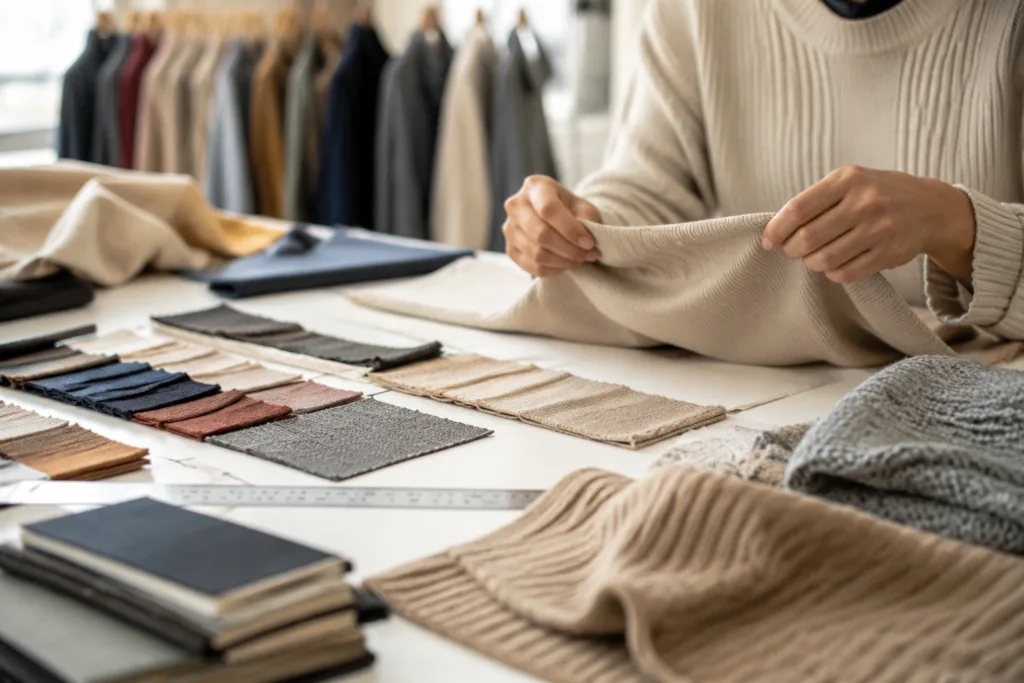
- Define the garment function before choosing the fabric.
- Match stretch and recovery to the fit target.
- Check whether drape or structure is more important.
- Confirm GSM, width, shrinkage, and tolerance in the tech pack.
- Ask for face, back, dyed, and laundered swatches.
- Test decoration on the actual fabric, not a substitute.
- Inspect seam behavior, not just fabric appearance.
- Use the same fabric under real wash and wear conditions before bulk approval.
In short, jersey, interlock, rib, and pique are not interchangeable labels. They are distinct knit fabrics with different strengths, limitations, and production implications. Once designers and sourcing teams learn to read structure as carefully as fiber content, they make better decisions on fit, cost, decoration, and quality. That is the practical value of knit development: fewer surprises, cleaner handoffs, and garments that perform closer to the original intent.
FAQs
Which knit structure is usually best for a standard T-shirt?
Jersey is the usual starting point because it balances softness, drape, and cost. If the tee needs more body, less curl, or better opacity, interlock is often the next option.
Why does jersey curl at the edges?
Single jersey is not balanced on both sides, so the loop structure wants to roll toward the tighter side. Wider hems, stable seam allowance, and prewashing help, but the simplest fix is to choose a more stable structure when edge curl is a risk.
When should I specify interlock instead of jersey?
Specify interlock when you need more stability, a smoother hand, a cleaner appearance on both sides, or slightly better recovery without moving to a woven fabric. It is common for premium tees, babywear, and stable tops.
Is rib only for cuffs and neckbands?
No. Rib is common for trims because it stretches and recovers well, but it can also be used for fitted body garments, waistbands, and fashion details when the design needs elasticity and a close fit.
Is pique harder to embroider than jersey?
Not necessarily, but the textured surface can make small details less crisp and can show distortion if the hooping is weak. Good stabilization and the right stitch density matter more than the knit name alone.
What should go in a knit fabric tech pack?
Include construction, gauge, fiber content, yarn count or yarn type, GSM, finished width, stretch ratio, expected shrinkage, allowed tolerance, recommended finishes, wash behavior, and a sample ID for each approved swatch.