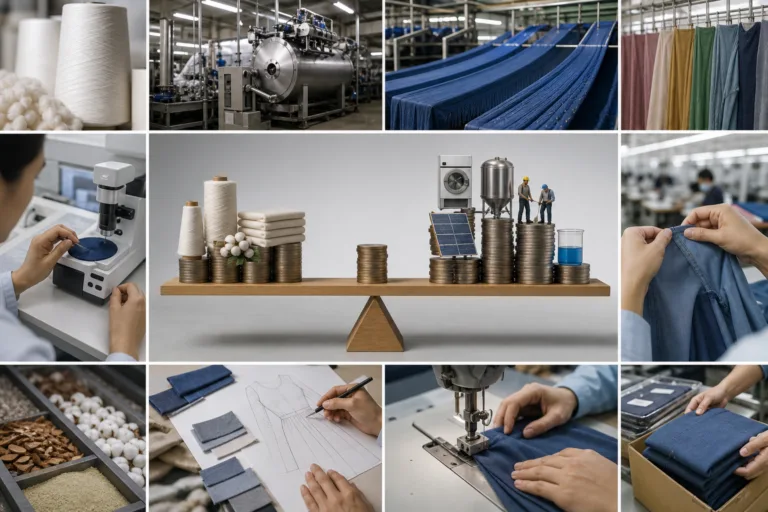
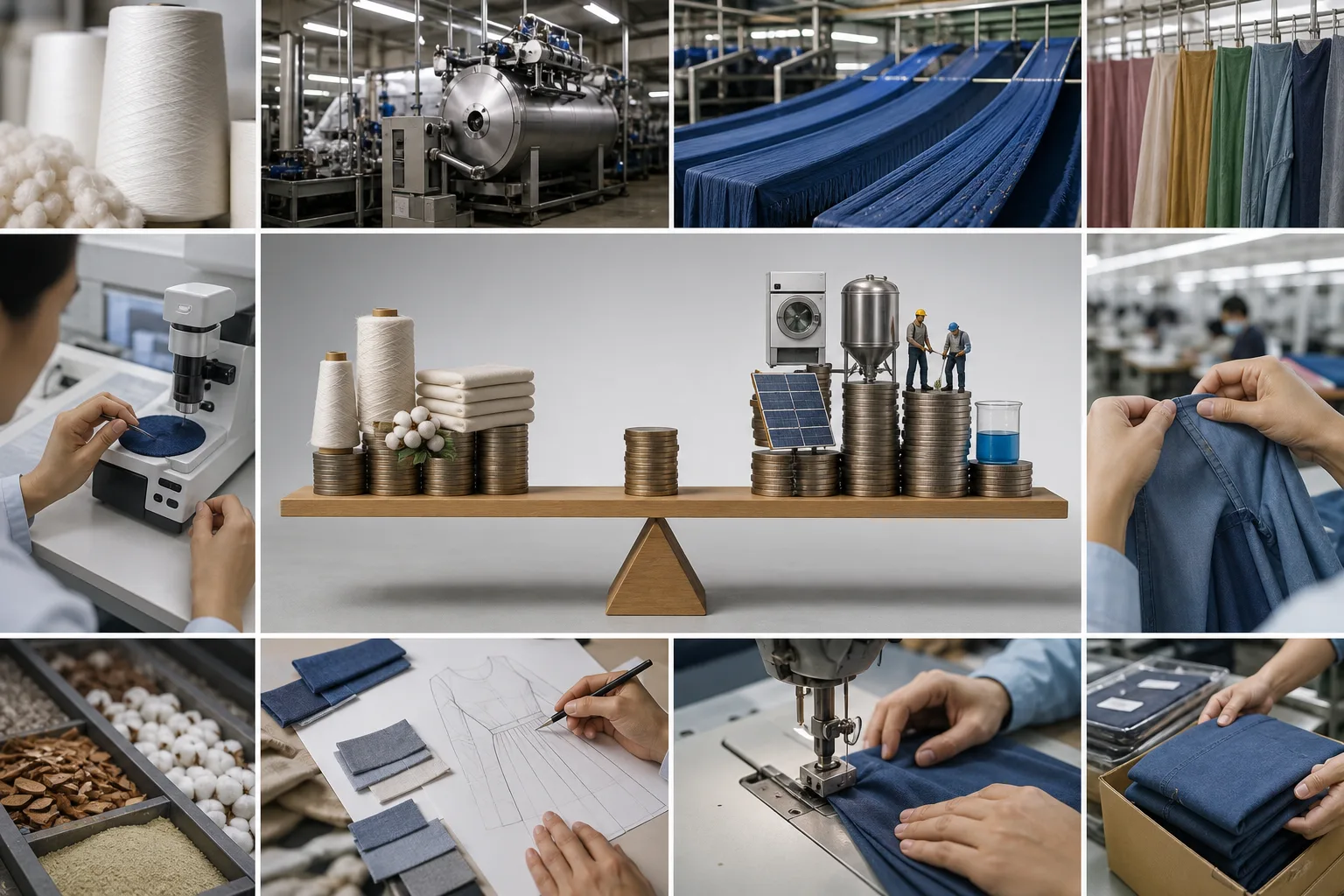
Solvent-free textile coloration can scale when it produces acceptable, repeatable quality at commercially useful throughput and at a viable total cost per accepted, saleable unit. That requires more than promising chemistry. Material use, energy, labor, maintenance, quality losses, compliance work, equipment investment, and financing must add up to a credible business case. Apparel Wiki is an independent educational publication, and its Sponsor information explains the separation between sponsorship and editorial control.
In this article, solvent-free textile coloration means a coloration process defined as operating without the solvent input specified in its technical boundary. The definition must be verified process by process. It does not automatically mean waterless, waste-free, low-energy, low-cost, or ready for factory adoption.
The central measure is cost per accepted delivery unit, not the price of one colorant, auxiliary, or laboratory batch. Commercial readiness also depends on dependable equipment, trained operators, compatible substrates, process control, customer acceptance, and enough repeat demand to justify installed capacity. Because different approaches can have different inputs and operating requirements, there is no single universal economic case.
What economic conditions does solvent-free textile coloration need to scale?
Scaling solvent-free textile coloration requires technical performance and economic performance to hold together under production conditions. The process must repeatedly meet the required shade, appearance, fastness, hand feel, and other product specifications while operating at a throughput that supports delivery commitments. Results from a carefully controlled sample are useful evidence, but they do not establish that the same economics will persist across larger lots or repeated runs.
The operating case must account for all resources needed to make accepted output. These may include colorants, binders or other auxiliaries, process water where applicable, energy, handling labor, monitoring, cleaning, waste management, maintenance, testing, and rework. Capital requirements may extend beyond the main machine to installation, utilities, ventilation or safety changes, material storage, laboratory capability, operator training, and spare parts.
Demand is another condition of scale. A process can be technically reliable and still leave equipment underused if buyers do not approve the result, repeat orders are uncertain, or the addressable product range is too narrow. Conversely, strong buyer interest does not repair poor yield, unstable quality, excessive downtime, or an unsupported maintenance system.
The economics of solvent-free textile coloration should therefore be treated as a system rather than a claim about one removed input. Apparel Wiki’s framework is an editorial method for organizing evidence, not an industry-wide threshold. Any conclusion must be tied to a defined process, product, location, production volume, quality requirement, and comparison period.
What does solvent-free textile coloration include, and what should not be conflated?
A useful solvent-free textile coloration definition begins with the process boundary. Reviewers should identify which substance is considered the solvent, where it would otherwise enter the process, and whether it is absent from all relevant production stages or only from one formulation. They should also document process water, auxiliaries, cleaning materials, energy inputs, emissions, wastewater, solid waste, and recovery loops.
Solvent-free should not be used interchangeably with solvent-reduced, waterless, low-liquor, low-water, dry processing, or closed-loop processing. These descriptions may overlap in a particular system, but they answer different questions. A process may avoid one solvent while still using water or other processing substances. Another may reduce water consumption without meeting the stated solvent-free boundary.
Removing a solvent input also does not, by itself, prove a lower total cost or environmental impact. Benefits in one stage can be offset elsewhere by greater energy demand, specialized materials, slower production, additional cleaning, lower first-pass yield, or a more difficult waste stream. Environmental comparisons require a clearly stated scope and suitable lifecycle or process evidence rather than favorable terminology alone.
Define the baseline before comparing processes
A like-for-like textile coloration process comparison should specify the incumbent process, textile substrate, product category, batch or run size, shade range, quality criteria, production location, and required delivery format. It should also state whether the comparison covers coloration only or includes preparation, washing, drying, finishing, testing, packaging, and waste treatment.
Without that baseline, an apparent advantage may come from comparing different products or operating conditions. A sample process optimized for one substrate and shade cannot automatically be compared with a factory process serving multiple fibers, constructions, colors, and order sizes. The narrower claim may still be useful, but its boundary must remain visible.
Which cost drivers determine whether the process is commercially viable?
Solvent-free dyeing unit economics should be organized around accepted output. The denominator may be accepted kilograms, meters, garments, panels, or another delivery unit appropriate to the product. The numerator should include attributable operating costs, quality losses, and capital recovery assumptions. This prevents a low input price from obscuring slower throughput, rejected production, or complex handling.
| Cost driver | Why it matters | Required evidence | Warning signs |
|---|---|---|---|
| Materials and auxiliaries | Consumption, storage, shelf life, and losses affect unit cost. | Production recipes, purchasing records, and usage data | Laboratory dosage treated as factory consumption |
| Energy, water, and waste | Utilities and treatment can shift costs between process stages. | Metered production data and documented waste routes | Claims based only on one omitted input |
| Throughput and yield | Slow cycles, rejects, and rework reduce accepted output. | Repeated run records, first-pass yield, and downtime logs | Best-run results presented as normal performance |
| Labor and maintenance | Staffing, training, cleaning, servicing, and repairs affect availability. | Task times, staffing plans, service records, and parts requirements | Operator effort or maintenance capability excluded |
| Equipment and integration | Installation and facility changes can materially affect investment. | Engineering scope, quotations, commissioning plans, and financing assumptions | Machine price presented as total installed cost |
Low wage rates alone do not establish the lowest cost per accepted textile output. Productivity, supervision, material losses, utility prices, lead time, taxes, compliance obligations, logistics, and quality performance can change the result. Numeric comparisons should use current, location-specific plant data or other authoritative primary evidence rather than generalized assumptions.
What must work beyond the laboratory before a process can scale?
Textile coloration scale-up requires repeatability across shades, lots, substrates, operators, equipment conditions, and production runs. The process must maintain recipe control, monitoring, changeover performance, cleaning effectiveness, and compatibility with existing preparation, finishing, testing, and quality systems. Maintenance demands and operator skill must also be supportable during ordinary production, not only when development specialists are present.
A maturity ladder helps separate evidence stages. A laboratory demonstration shows that a concept can work under controlled conditions. Pilot production tests larger equipment and operating interactions. Commercial supply adds repeat delivery to customers. Broader scale adoption requires sustained performance across more orders, operating contexts, and supporting organizations. A patent, demonstration, or announcement does not by itself prove any later stage.
The supporting ecosystem matters as much as the core process. Manufacturers may need reliable materials, qualified equipment, spare parts, technical service, training, test capability, documented procedures, suitable standards, and customer approval. A technically promising process can still fail commercially if any critical dependency causes unstable output, long downtime, restricted product coverage, or costs that rise at production volume.
How do demand, buyer risk, and capital conditions shape adoption?
A process can have credible unit economics and still struggle to reach regular production. Adoption depends on whether customers will approve the resulting material, whether orders are repeatable enough to support investment, and whether the manufacturer can switch without exposing existing business to unacceptable quality or delivery risk. This is the demand side of solvent free textile coloration economics.
Repeat order visibility matters because a new process may require equipment changes, training, additional testing, or parallel operation with the incumbent process. A single development order can demonstrate interest, but it does not necessarily justify permanent capacity. Procurement teams may also require specification approval, documented traceability, consistent shade results, and evidence that the process can support future orders.
The buyer benefit must be specific. Depending on the application, it may involve lower total cost, differentiated product value, support for a compliance objective, supply resilience, or reduced operational risk. A general sustainability message is rarely enough to overcome switching costs when the incumbent process is familiar, qualified, and already connected to the factory’s quality system.
The business case can therefore differ by program. A premium product may tolerate a more complex process if the buyer values a verified product distinction. A cost-sensitive, high-volume program will usually place greater weight on accepted output, throughput, consistency, and delivery reliability. A manufacturer focused on resource efficiency may prioritize operating control and compliance support, provided the process does not create unacceptable maintenance or supply dependencies. These are decision scenarios, not forecasts.
Capital timing adds another constraint. Companies may delay investment when demand is uncertain, financing is difficult, equipment service is unavailable, or legacy capacity must remain active during the transition. A credible adoption case should identify who carries the switching risk, what evidence reduces it, and which demand signal would support the next investment stage.
Which regulations, standards, and test results can change the business case?
Compliance evidence must be separated into distinct categories. Mandatory regulations depend on the applicable jurisdiction and may address chemicals, worker safety, waste, emissions, documentation, or product claims. Voluntary standards and certifications may support market access but are not automatically legal requirements. Buyer specifications and internal quality rules can be stricter, narrower, or simply different from either category.
These distinctions affect cost. A process may reduce one input while requiring new monitoring, documentation, waste handling, supplier verification, or worker procedures. Conversely, a process that supports an existing compliance need may create value beyond its direct production cost. The effect must be assessed against the actual product, factory, market, and jurisdiction rather than inferred from the phrase “solvent-free.”
Test results also need context. A useful report identifies the test method, specimen, substrate, conditioning, process history, and acceptance criteria. Without those details, a favorable result may not show that the same performance will hold across other fibers, shades, equipment settings, or production lots. An environmental or chemical claim should likewise be treated as unverified until its boundaries and supporting evidence are clear.
Before accepting a supplier or technology claim, request an evidence pack that answers five questions:
- What process boundary does the claim cover, including water, auxiliaries, energy, and waste?
- Which requirement is being addressed: law, voluntary standard, buyer specification, or internal policy?
- What test method and acceptance criteria were used?
- Were the results produced on the relevant substrate and production equipment?
- Can the evidence be reproduced, reviewed, and maintained as the process changes?
This approach keeps regulatory review, product testing, and commercial claims connected without treating one document as proof of every benefit.
How should a company evaluate scale readiness before committing capital?
Start by defining the comparison. Record the incumbent process, product category, textile substrates, quality requirements, production location, comparison unit, and evaluation period. “Lower cost” is not meaningful unless both processes are measured against the same accepted delivery requirement. The comparison should also state which assumptions are project-specific rather than general industry practice.
Next, assemble a total-cost evidence pack. It should cover material inputs, auxiliaries, labor, energy, water, waste, yield loss, rework, throughput, downtime, maintenance, quality control, compliance work, equipment integration, training, capital needs, and financing assumptions. Where data is unavailable, mark the item as an open question instead of filling the gap with an unsupported estimate. The Apparel Manufacturing Tools resource may help organize related production calculations, but it cannot replace project evidence.
A staged evaluation reduces the risk of treating an early result as a final investment case:
- Document review: Check process boundaries, evidence quality, equipment requirements, and known dependencies.
- Controlled pilot: Confirm that the process works on the intended substrates and product types under defined conditions.
- Repeatability test: Examine shades, lots, operators, changeovers, cleaning, maintenance, and production interruptions.
- Production trial: Measure accepted output, first-pass yield, downtime, serviceability, and compatibility with the existing quality system.
- Customer acceptance: Confirm that specifications, testing, claims, documentation, and delivery expectations are acceptable.
- Post-launch monitoring: Compare actual performance with the original assumptions and record corrective actions.
Decision criteria should be explicit. A company may stop, revise, or scale when evidence shows that quality is unstable, a critical input is unreliable, maintenance cannot be supported, or the cost per accepted output is not competitive for the target program. Conversely, repeat orders, dependable suppliers, serviceable equipment, stable production indicators, and verified buyer value can support the next stage. No checklist guarantees commercial success. Energy conditions, regulations, customer demand, equipment availability, and technology maturity can change the economics, so the analysis should be updated when material evidence changes.
Next step: Treat solvent free textile coloration as an evidence-building decision, not a binary technology claim. Compare one defined product and incumbent process, document the assumptions, test the operational bottlenecks, and update the business case as production and customer evidence accumulate.

Frequently asked questions
Is solvent-free textile coloration automatically cheaper than conventional coloration?
No. Removing or reducing one input does not establish lower total cost. Throughput, accepted yield, energy, labor, maintenance, waste handling, capital, and quality requirements can change the result.
What is the most important economic metric when comparing textile coloration processes?
Cost per accepted, saleable delivery unit is usually more useful than the price of one chemical or laboratory batch. It captures quality losses, rework, downtime, and productive throughput.
Can a successful laboratory demonstration prove that solvent-free coloration is ready for factory scale?
No. Laboratory evidence establishes a controlled technical result. Factory readiness also requires repeatability, equipment integration, operator capability, maintenance support, customer acceptance, and dependable supply.
Which data should a brand or manufacturer request before adopting a solvent-free coloration process?
Request process boundaries, substrate coverage, production records, test methods, quality results, input requirements, waste information, equipment needs, maintenance support, supplier reliability, and evidence of repeat customer acceptance.
How do regulations, testing, and customer requirements affect the economics of solvent-free textile coloration?
They can add testing, documentation, monitoring, traceability, worker procedures, or waste controls. They can also create buyer value when the evidence addresses a real market or compliance requirement.
Why should the economic case for solvent-free textile coloration be updated over time?
Energy conditions, regulations, customer specifications, equipment availability, supplier capability, and process maturity can change. An old business case may no longer represent current operating or market conditions.