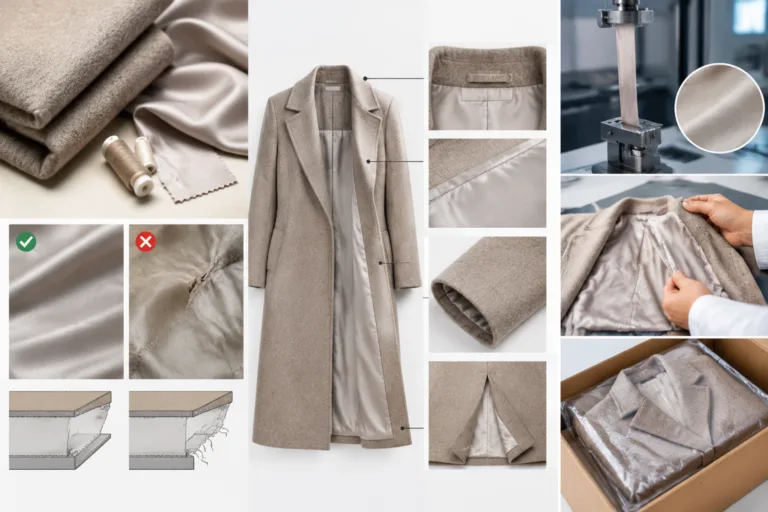
Wool coats lining durability means the lining and its attachments remain fit for the coat’s intended use, appearance, movement, and function over the expected use and care conditions. It is not a promise of indefinite service life, and it cannot be inferred from a fiber name or fabric label alone. Development teams should define the use case, identify local failure risks, and assess the complete garment. Apparel Wiki is an independent educational publication; its editorial independence is described on the Sponsor page.
In practice, durability is a fit-for-use development target. A lining may need to support smooth layering, repeated sleeve movement, pocket use, closure operation, and the intended cleaning route while remaining properly attached and visually acceptable. The requirement depends on the coat’s pattern, construction, wearer behavior, climate, expected frequency of use, and appearance expectations.
What Does Lining Durability Mean in a Wool Coat?
A wool coat lining is the inner textile assembly that covers or partially covers the shell’s inside surfaces and helps the garment move, layer, and finish cleanly. Lining durability describes how well that assembly maintains its required condition during intended wear and care. The evaluation therefore includes the lining material, its seams, hems, vents, pocket areas, sleeve joins, and attachment points.
This boundary matters because material durability is only one part of the result. A fabric may resist a particular type of wear in isolation but still develop a problem at a seam, hem, vent, or pocket opening. Conversely, a local construction problem can make a suitable lining appear unsuitable. Teams should distinguish abrasion, tearing, seam opening, distortion, snagging, puckering, slippage, and detachment rather than treating all defects as one general durability issue.
The coat category alone does not establish a performance level. A lightly worn fashion coat, a frequently used commuting coat, and a coat designed for demanding outdoor movement may share the same broad category while creating different requirements. Layering thickness, sleeve shape, closure design, pocket arrangement, climate, cleaning route, and the wearer’s movement all influence the target.
For that reason, the useful question is not “Which lining is universally strongest?” It is “Which lining and construction remain acceptable for this coat’s intended use?” Record the intended scenarios before selecting materials or acceptance criteria. This keeps the decision project-specific and avoids promising service life that the available evidence cannot support.
Which Lining Failure Risks Should Development Teams Map?
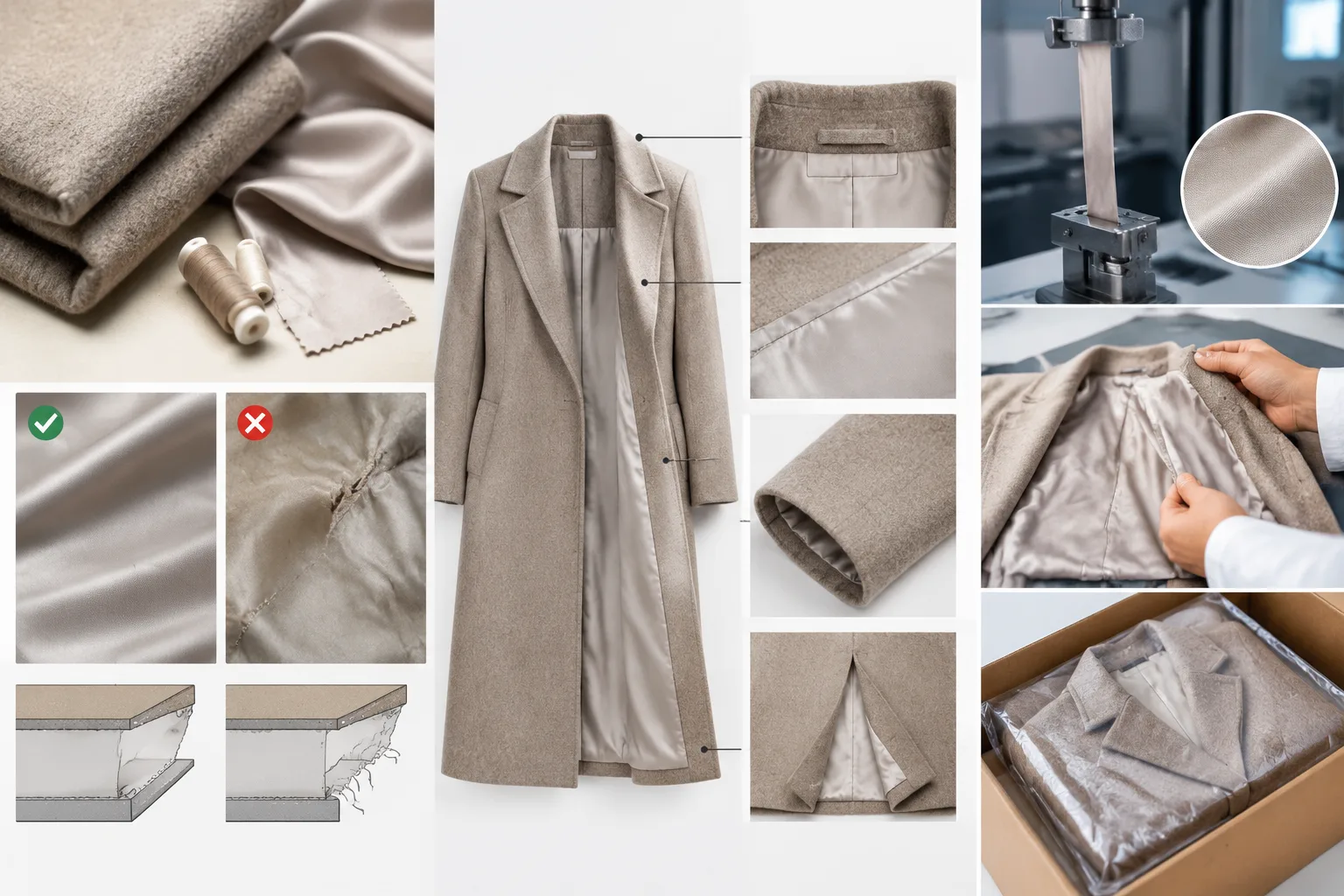
Begin with the actual pattern and construction, then map where the lining will rub, move, pull, fold, or connect to another component. Common review areas may include sleeve interiors, armholes, pocket openings and bags, vents, hem edges, front openings, closure zones, and places where the lining joins the shell. These are starting points for inspection, not universal failure locations. A different silhouette or attachment method may move the risk elsewhere.
Next, describe the failure mode rather than simply marking an area as “weak.” Abrasion concerns surface wear from repeated contact. Tearing concerns fabric rupture under a local load. Seam opening and seam slippage concern the behavior of the joined materials. Distortion and puckering may affect appearance or movement without immediately producing a hole. Snagging, edge exposure, and detachment may arise from interaction with the wearer, shell, closures, or finishing process.
A useful risk map connects each location to a wearer task or garment movement:
- Sleeves and armholes: review repeated bending, reaching, layering, and tension as the arm moves.
- Pockets: review hand entry, carried contents, pocket-bag movement, and local attachment.
- Vents and hems: review walking movement, bending, seat contact, and edge handling according to the design.
- Front openings and closures: review repeated opening, closing, pulling, and alignment of the shell and lining.
- Seams and joins: review whether the lining can move with the shell without being pulled tight or left excessively loose.
This map should also record what the lining is expected to do. It may need to provide ease of movement, allow smooth layering, preserve pocket usability, follow a vent, or stay visually controlled when the coat opens. Those functional requirements are related to durability but are not identical to mechanical strength. A lining that survives a narrow material test may still fail the product requirement if it restricts movement, catches during wear, or distorts the coat’s appearance.
Do not assume that the whole lining experiences the same stress. Local loads depend on body movement, pattern balance, seam placement, garment size, and construction sequence. A development team can use this risk map to decide which observations, samples, or controlled tests are relevant. Any measured property should be tied to a documented risk and a defined method rather than presented as proof of overall coat quality.
How Should You Choose a Lining for the Coat’s Use Case?
Choose a wool coat lining by starting with the coat’s use case, not with a fiber label or fabric price. Define expected wear, layering conditions, movement needs, cleaning route, appearance expectations, and target construction. Then shortlist candidate materials against those conditions. There is no single lining material that is best for every wool coat because the balance between stability, drape, comfort, handling, and durability changes with the product.
Compare candidates across the properties that matter to the finished assembly. These may include surface behavior, dimensional stability, strength, drape, ease, seam behavior, edge behavior, compatibility with the wool shell, and response to the planned cutting, sewing, pressing, and finishing processes. Supplier information and traceable laboratory results can inform the comparison, but they should be interpreted within the limits of the stated method and test sample.
A swatch review is useful for early screening, but it is not a finished-coat approval. The lining can behave differently after it is cut into shaped panels, joined under tension, pressed, attached to the shell, and exposed to garment movement. Shell fabric, interlinings, closures, seam treatments, and finishing can also change the interaction. Compare the final material combination and construction whenever the decision has meaningful durability risk.
Keep wearer acceptance requirements visible but separate from mechanical durability. Hand feel, static, noise, thermal comfort, and visual appearance may determine whether a lining is suitable for the product even when it performs adequately in a strength or abrasion review. Likewise, a material with attractive drape may require a different attachment approach than a more stable candidate. These are development trade-offs, not universal rankings.
The selection record should state the intended use, candidate material identity, relevant documented properties, construction assumptions, care assumptions, and unresolved risks. It should also identify whether a proposed substitution changes surface behavior, stability, drape, seam performance, or compatibility with the shell. This creates a clearer basis for sample review and helps the team evaluate the finished wool coat rather than relying only on composition or supplier swatches.
Which Construction Decisions Protect Lining Durability?
Material selection is only one part of wool coat lining durability. The pattern and assembly must allow the lining to move with the shell and the wearer without creating avoidable tension. Review ease, attachment points, seam allowances, hems, vents, pleats, sleeve joins, pocket bags, and other stress-relief details as one connected system. A lining that appears suitable as a fabric may still be vulnerable when the finished pattern gives it insufficient movement or concentrates force at one location.
Pay particular attention to places where the lining changes direction, joins another component, or must accommodate repeated movement. Sleeve construction, armhole movement, pocket access, vents, and coat openings may each create different demands. The correct solution depends on the fabric behavior, pattern shape, machinery, operator process, and intended use. Stitch choice, seam handling, local reinforcement, and finishing should therefore be assessed against the actual garment rather than treated as universal prescriptions.
The technical package should make those decisions repeatable. Connect the lining material code to construction details, measurement points, approved tolerances, revision status, and inspection requirements. Written instructions should agree with drawings and sample comments before production review. Apparel Wiki’s Apparel Manufacturing Tools can be used as a related reference point, but any project still needs its own controlled specifications and approval records.
Keep the bill of materials and cost records distinct from performance requirements. A BOM identifies what the product uses and, where applicable, how it is measured; a cost record assigns value to those inputs. Neither document alone proves lining durability. Record the material specification, supplier identity, approved substitutions, and any change that could affect surface behavior, stability, drape, seam performance, or attachment. This separation makes later failures easier to trace.
How Do You Validate Lining Durability in a Finished Wool Coat?
Validation should begin before a test is selected. Define the intended wear and care scenarios, target sizes, material versions, construction version, and acceptance criteria. This gives the review a clear basis and prevents a favorable result from being treated as approval for a different size, supplier, fabric combination, or assembly method.
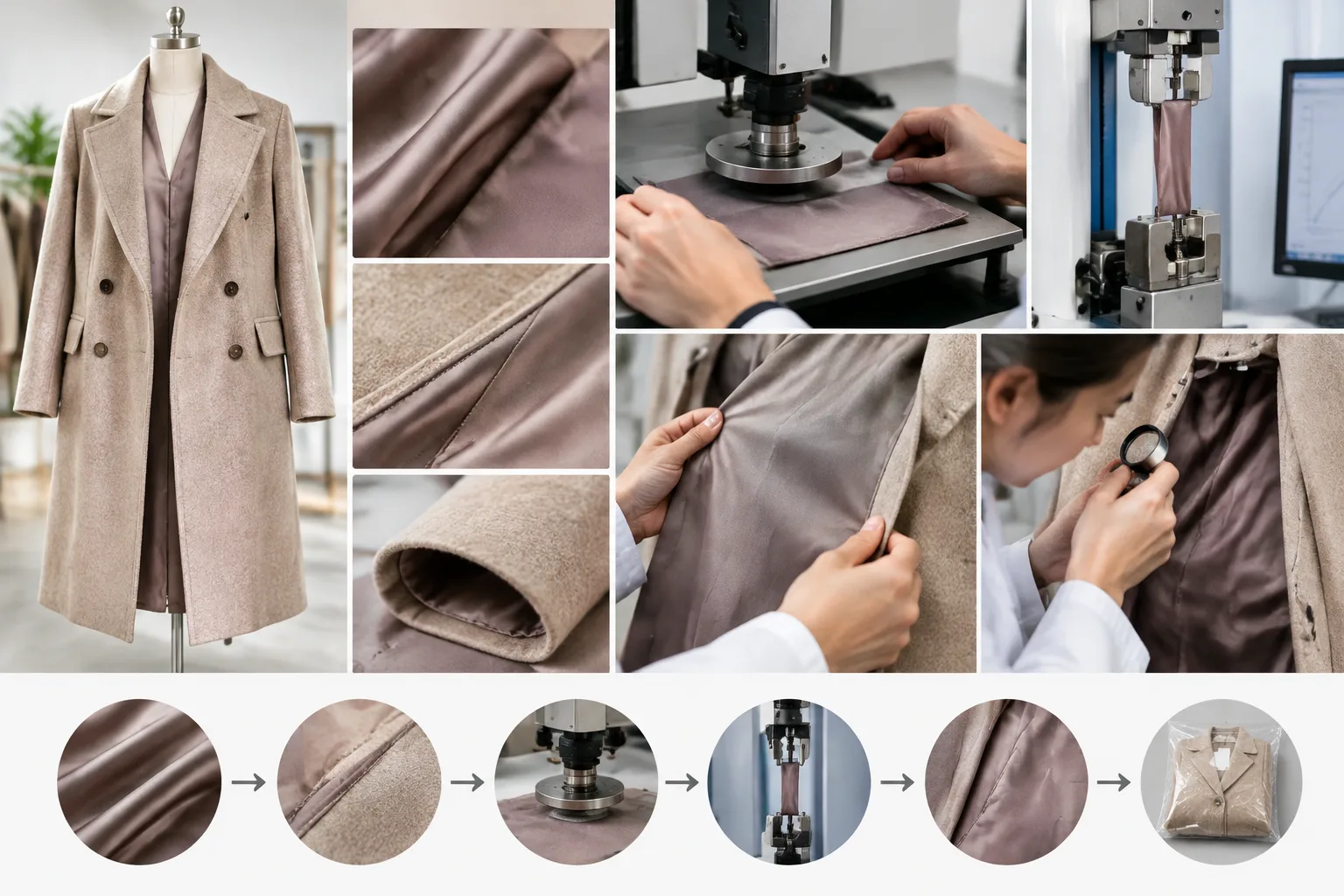
Start with a complete sample review. Inspect lining tension when the coat is at rest and during representative movement. Look for restriction, seam distortion, puckering, exposed edges, irregular attachment, and areas where the lining pulls against the shell. Review pocket use, closure operation, vents, sleeve movement, and layering if those activities are part of the intended product experience. Record each finding by location and failure mode rather than using only a general pass or fail comment.
Controlled laboratory or internal testing can add evidence when it answers a documented risk. Identify the test method, specimen or garment basis, conditioning, equipment, and result basis in the record. Do not insert a numeric threshold unless the project has an authoritative method and an agreed acceptance requirement. A fabric result is evidence about that specimen under that method; it is not automatically a finished-coat approval or a certification.
Evaluate the final material combination and assembly whenever the risk is meaningful. Shell fabric, lining, interlinings, closures, seam treatments, pressing, and finishing can interact after cutting and sewing. If a revision changes the lining, pattern, attachment, or process in a way that affects the risk, update the technical package and repeat the relevant review. Quality control at production should remain distinct from development screening, even when both examine similar failure modes.
How Should Teams Decide Whether a Lining Problem Requires Redesign?
First classify the observed problem. It may be primarily a material issue, a pattern or ease issue, a seam or attachment issue, a process issue, a care-related issue, or a combination. This classification should follow the failure mechanism, not the most convenient available correction. For example, replacing the lining may not solve a problem caused by insufficient movement allowance or an attachment that constrains the shell.
Prioritize findings that affect movement, garment usability, safety, appearance acceptance, or production repeatability. Then compare corrective options: change the lining, revise pattern balance, adjust attachment, reinforce a local area, alter finishing, improve process control, or revise care instructions where appropriate. The least disruptive change is not automatically the most durable or production-ready choice. Any proposed correction should be considered against the complete garment and the intended use.
Use a decision record that states the observed condition, review or test basis, affected size and location, construction version, proposed change, responsible owner, and verification step. Note limitations when the evidence covers only one sample, one size, one color, one supplier, or one test condition. After the change, verify the specific risk again and preserve the link between the original finding and the approved revision.
For teams working through wool coats lining durability decisions, this record provides a practical boundary between an isolated observation and a justified development conclusion. It also helps prevent unsupported generalization across sizes, colors, suppliers, or factories. A repeatable decision process is more useful than a universal claim that one lining fiber, finish, or construction detail is always best.
The next educational step is to turn the decision framework into a project checklist: define use conditions, map likely failure locations, document the construction version, review the complete coat, and assign corrective action with a verification owner. Keep source-backed test results, project requirements, and editorial recommendations clearly separated so future teams can understand what was measured, what was decided, and what remains uncertain.
FAQ
What does lining durability mean in a wool coat?
It means the lining and its attachments remain fit for the coat’s intended use, appearance, movement, function, and care conditions. It is a finished-garment performance target, not a permanent service-life promise.
Is a stronger lining fabric always the best choice for a wool coat?
No. Strength is only one consideration. Surface behavior, stability, drape, comfort, static, noise, compatibility with the shell, seam performance, and construction requirements may also determine suitability.
Which parts of a wool coat lining are most likely to fail?
Potentially vulnerable areas include sleeve interiors, armholes, pocket areas, vents, hems, openings, and attachment points. The relevant locations depend on the pattern, construction, movement, and wearer tasks.
How can a team test lining durability before production?
Define the intended scenarios and acceptance criteria, review complete samples during representative movement, and use controlled tests only when they address a documented risk. Record the method, specimen or garment basis, findings, and corrective action.
Why can a lining pass a fabric test but fail in the finished coat?
Cutting, shaping, sewing, pressing, attachment, shell interaction, closures, and finishing can change the stresses on the lining. A component result does not automatically represent the performance of the complete coat.
What information should a wool coat technical package include for lining durability?
Include material identity and specification, construction details, measurement points, tolerances, revision status, inspection requirements, approved substitutions, and relevant care or testing assumptions. Keep these requirements distinct from BOM and cost information.