Extractable heavy metal testing measures the amount of specified metal analytes released from a defined apparel sample under defined extraction conditions. It does not automatically measure every metal present in the product, certify an entire garment range, or prove compliance in every market. The result applies to the submitted sample, tested components, analytes, method, units, and conditions recorded in the report.
Apparel Wiki is an independent educational publication, not a manufacturer, laboratory, certification body, or compliance authority. Its editorial work is independent; information about sponsorship is available on the Sponsor page. The practical rule is simple: interpret the laboratory evidence first, then compare it with the specific product requirement that governs the decision.
What Does Extractable Heavy Metal Testing Measure?
In the context of apparel, extractable heavy metal testing is an analytical assessment of what can be released from a specified material or component when the sample is prepared and treated according to a defined method. Depending on the applicable method and requirement, the sample might be a textile, print, coating, trim, hardware item, or another product component. The exact scope must be verified rather than assumed from the general name of the test.
An extractable result is different from the total amount of a substance present in the material. Extraction asks a release-related question under stated conditions. A total-content analysis asks how much of the substance is present in the tested material according to its own preparation and measurement procedure. These results answer different questions and should not be treated as interchangeable.
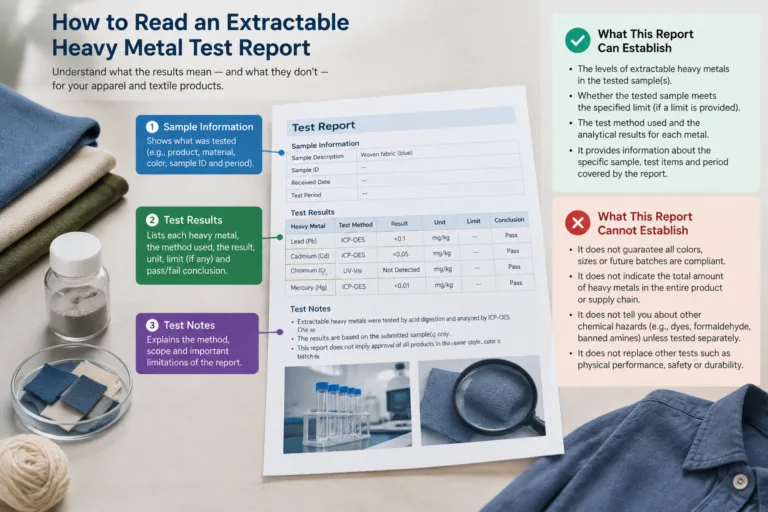
The report should establish the tested analytes, sample preparation, extraction conditions, reporting units, and basis for the result. It may also identify the sample description, receipt information, test date, and method or method version. Those details are part of the meaning of the number. Without them, a result can be difficult to connect to a garment decision or compare with another report.
A test method explains how measurement is performed. It does not, by itself, create one universal acceptable result for every apparel product. Acceptance depends on the applicable product specification, buyer requirement, or legal rule, including its product scope, analytes, method, threshold, and jurisdiction. A standard or method name should therefore not be presented as a general pass limit unless the relevant requirement has been confirmed.
What Can the Test Establish About an Apparel Sample?
A properly documented result can establish the measured extractable amount for the specified analyte or analytes in the submitted sample under the stated conditions. This is the first and strongest conclusion: it is a finding about a particular test item, not a broad statement about every product made by a brand or supplier.
The result can also support a comparison with a named requirement when the comparison is technically aligned. The sample must fall within the requirement’s scope, the tested analytes and method must correspond to the requirement, and the reporting units and acceptance criteria must be understood. A result that appears low or high in isolation does not determine compliance without that comparison.
Testing may help identify whether a material or component deserves supplier follow-up, further investigation, or restricted use while the question is resolved. For example, a result connected to a particular printed panel, dyed fabric, coated component, or hardware item may guide a sourcing team toward that component rather than treating the whole garment as identical. This is an editorial decision framework, not a substitute for the applicable technical or legal assessment.
Sample identity is central to the conclusion. The description should be consistent with the material or component actually under review, including relevant color, finish, print, coating, trim, construction, and batch information. The test date and receipt details also matter when a decision concerns production made later or under changed conditions.
A useful way to separate the evidence is:
- Measured result: what the laboratory reported for the identified analyte or analytes in the submitted sample.
- Requirement comparison: whether that result can be assessed against a specific, current requirement whose scope and method align.
- Editorial recommendation: whether the available evidence appears sufficient for the stated product decision or whether clarification and additional review are prudent.
These categories should remain distinct. An apparel heavy metal test report is evidence about received material and tested conditions. It is not automatically a blanket certification of all colors, sizes, trims, production lots, shipments, or finished garments associated with the same product name.
What Can Extractable Heavy Metal Testing Not Establish?
Extractable heavy metal testing does not automatically establish the total heavy metal content of a material. It also does not prove that an untested component, color, finish, size, production lot, later shipment, or finished garment would produce the same result. Extending the conclusion requires a defensible basis for treating those items as represented by the tested sample.
The test alone does not establish compliance in every destination market. Compliance is a separate conclusion that depends on the applicable product category, restricted-substance requirement, method, threshold, and jurisdiction. A result may be useful evidence for one defined requirement while being insufficient for another. Calling a product “compliant” without identifying that framework is therefore too broad.
Nor does an extractable result fully describe every possible exposure or risk pathway. Questions involving release, migration, ingestion, inhalation, skin contact, or other forms of exposure require the relevant method and risk assessment to address those questions. A laboratory result focused on one extraction procedure should not be converted into a general safety guarantee.
Finally, the test does not prove that unrelated chemical hazards, construction risks, or other restricted substances are absent. A negative finding for the specified analytes under the specified conditions is not evidence that every possible hazard has been examined. This boundary does not make testing ineffective; it keeps the claim proportional to the evidence.
Why Method and Sampling Conditions Change the Meaning of a Result
Two numerical results cannot be ranked reliably until their test conditions are compared. Relevant details may include the sampling direction, sample preparation, conditioning or pretreatment, extraction conditions, instrument or analytical procedure, reporting units, detection or reporting conventions, and evaluation criteria. A difference in any of these can change what the numbers represent.
Apparel construction creates additional sampling questions. A dyed fabric, printed graphic, coating, finish, metal trim, and composite assembly may not be interchangeable test items. Washing or another pretreatment may be relevant to a particular project, but whether it is required depends on the selected method, product question, and applicable requirement. It should not be added or assumed without verification.
| Review question | Sample to identify | Conditions to verify | Result to record | Requirement to match |
|---|---|---|---|---|
| What is being assessed? | Material or component, color, finish, and batch | Preparation and extraction procedure | Analyte, unit, and reported value | Product and component scope |
| Can two reports be compared? | Whether the samples represent the same item | Method, version, pretreatment, and analytical basis | Detection or reporting convention | Same acceptance criteria and jurisdiction |
Method alignment is a practical quality-control issue, not a technical footnote. Before commissioning heavy metal testing for apparel, define the material or component, intended product decision, target market or buyer requirement, and analytical question. Then confirm that the selected method and sampling approach can answer that question. This prevents a precise number from being used to support an imprecise claim.
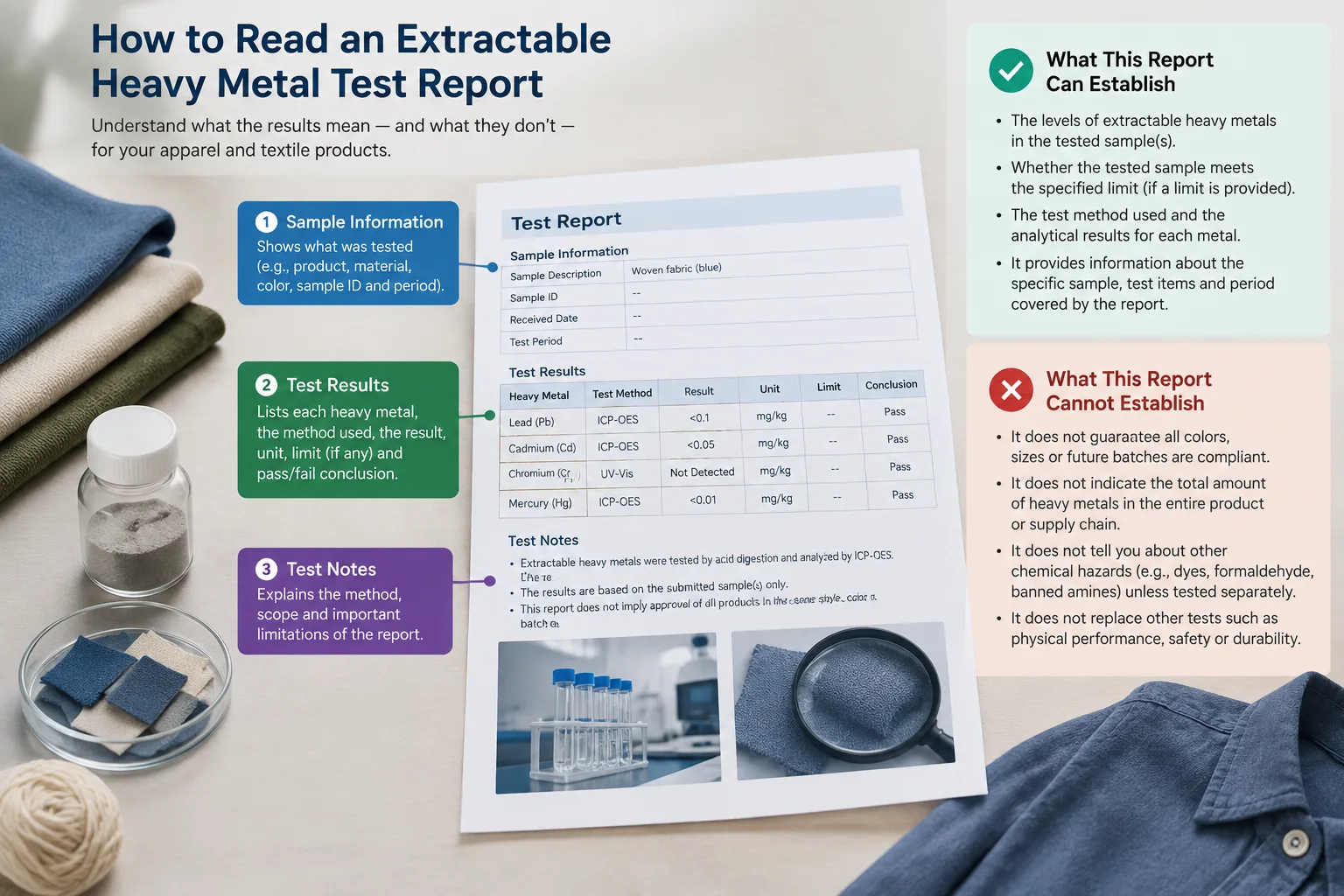
How to Read an Extractable Heavy Metal Test Report
A report should be reviewed as a chain of evidence, not simply scanned for the word “pass.” The laboratory records what it received, what it tested, how it performed the measurement, and what it found. A separate requirement determines whether that result is acceptable for the intended product and market. The following six-step checklist helps keep those facts distinct.
- Verify the report identity. Check the laboratory name, report number, issue date, page count, and any revision status. Confirm that sample receipt and testing dates are present and logically consistent. If authenticity or laboratory capability matters to the decision, verify it through the relevant laboratory or accreditation source rather than relying on a logo alone.
- Match the sample to the product. Compare the report description with the garment or component under review. Relevant identifiers may include fiber or material type, color, print, coating, finish, trim, style, supplier, and production batch. A vague description such as “fabric sample” may not establish which production material was tested.
- Identify the tested analytes. Determine which metals were included instead of assuming that the report covers every substance described informally as a heavy metal. Record whether the results apply to a combined sample, an individual material, or a separated component.
- Review the method and conditions. Note the method, version, sample preparation, extraction procedure, and any reported pretreatment. These details define the extractable heavy metal testing scope. Ask the laboratory or supplier for clarification when the method identity or extraction basis is incomplete.
- Read the units and result conventions. Check the reported units, measured values, reporting limits, and symbols used for results below a detection or quantification boundary. “Not detected” does not necessarily mean that none of the analyte is present; its meaning depends on the stated analytical and reporting convention.
- Match the result to the requirement. Locate the legal, buyer, or product-specification source used for evaluation. Confirm that it applies to the relevant market, product category, component, analyte, method, and reporting basis. A limit taken from a different scope cannot automatically convert the result into a valid pass-or-fail conclusion.
During review, label information by type. The sample description, method, units, and measured values are report facts. The applicable scope and acceptance criteria are requirement facts. Deciding whether to release a shipment, restrict a component, or request more evidence is a documented business or technical judgment. Missing information should be recorded as an unresolved gap, not treated as evidence of compliance.
When Is Additional Testing or Evidence Needed?
Additional work is appropriate when the available evidence does not answer the actual product question. This does not mean that the first report is useless. It means its conclusion should remain limited while the specific evidence gap is addressed.
| Question | Evidence available | Possible gap | Proportionate next action |
|---|---|---|---|
| Does the report represent production? | A result for one submitted sample | Different color, finish, trim, batch, or later shipment | Confirm traceability or test the relevant production variant |
| Does the test answer the required analytical question? | An extractable result under one method | The requirement concerns total content, another release condition, analyte, or component | Select evidence aligned with the stated requirement |
| Can the product enter each intended market? | A comparison with one requirement | Another jurisdiction or buyer uses a different scope or criterion | Verify current requirements for every intended destination |
| Is continuing production adequately controlled? | A satisfactory report for one batch | Insufficient evidence about materials or subsequent production | Review supplier traceability, declarations, controls, and targeted follow-up testing |
Further evidence may also be needed after a material, formulation, dye, print, coating, supplier, or manufacturing process changes. The appropriate response is project-dependent: it should reflect the product, component, intended market, applicable requirement, and significance of the change. No single testing frequency, sample count, or acceptance threshold is suitable for every apparel program.
Laboratory results can therefore be combined with supplier documentation, material declarations, purchasing records, batch traceability, and production controls. Each source answers a different question. Together they may support a more defensible release decision, but none should be assumed to compensate automatically for a test method or sample that does not match the requirement.

A Defensible Conclusion: Useful Evidence, Limited Claim
A well-supported conclusion might state: “The identified sample produced the reported extractable result for the specified analytes under the stated method. Its acceptability was evaluated against the named requirement, subject to the report’s sample and component coverage.” The wording must be adjusted to the actual report and verified requirement.
Broader statements such as “all products are safe,” “every shipment complies,” or “no heavy metals are present” exceed what one extractable test normally establishes. They extend a sample-specific measurement across untested products, production periods, substances, or safety questions.
Retain the sample identity, component and batch details, method and version, measured results, requirement source, laboratory information, review notes, unresolved gaps, and the person responsible for the decision. These records explain both the evidence used and the boundaries placed on the final claim.
As a practical next step, readers can apply this evidence structure to other apparel chemical reports: first define the product decision, then match the sample, method, result, and requirement before treating the report as decision-ready.
Frequently Asked Questions
Does extractable heavy metal testing measure all heavy metals in a garment?
No. It measures the specified analytes released from the tested sample under the stated extraction and analytical conditions. Other metals, components, or forms of content may remain outside its scope.
Does a passing extractable heavy metal result prove that the whole apparel product complies?
Not by itself. The result must align with the applicable requirement, and the tested sample must adequately represent the relevant components and production. Other chemical, construction, labeling, or market requirements may also apply.
Can two heavy metal test reports be compared if they use different methods?
Not solely by comparing their numbers. Differences in sample preparation, extraction conditions, analytes, units, reporting limits, or evaluation criteria may mean that the results answer different questions.
What sample and report details should an apparel buyer verify?
Verify the garment or component identity, material, color, finish, trim, batch, dates, analytes, method and version, extraction basis, units, results, laboratory details, and the requirement used for evaluation.
When might additional heavy metal or chemical testing be necessary?
It may be appropriate when production differs from the tested sample, the target market or buyer requirement changes, another component or analyte is relevant, or the decision requires a different analytical question, such as total content.