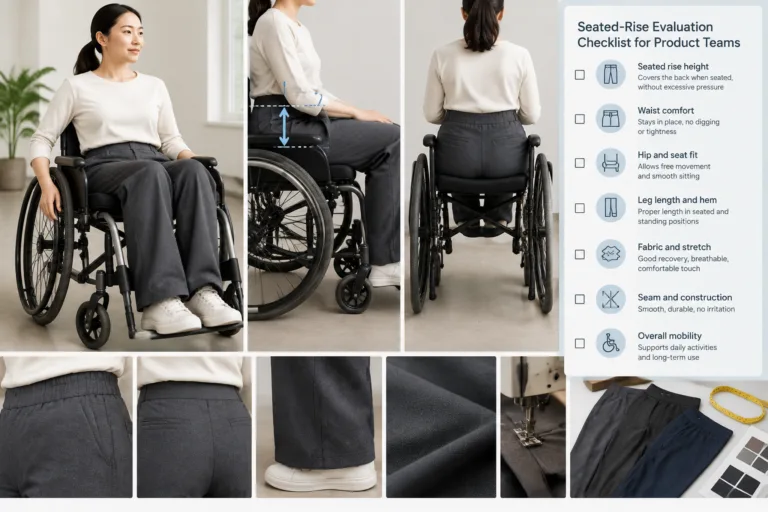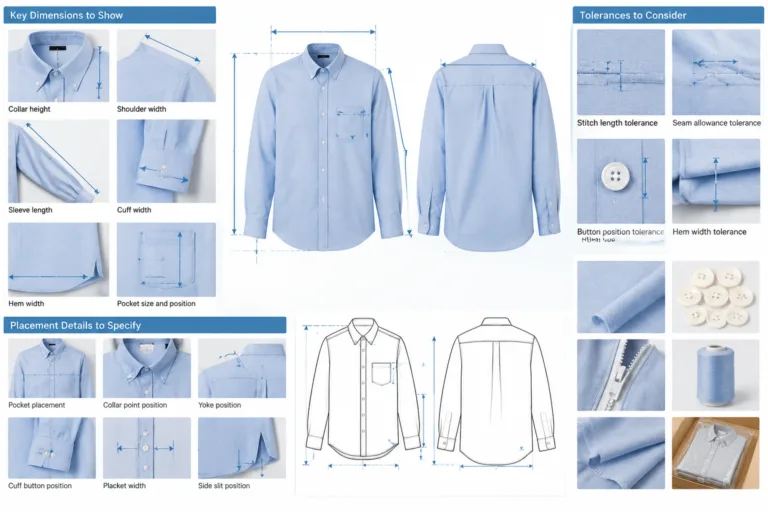
Construction callouts required information should make a garment detail understandable to the people who must develop, sew, inspect, and approve it. A construction callout is a focused instruction attached to a technical drawing or detail view. It identifies the garment feature, points to its exact location, and states the component or operation needed to produce that feature. The most useful callouts also provide relevant measurements, placement references, material identifiers, and revision information.
In practice, a callout should remove execution ambiguity without pretending to be the entire technical package. It can clarify a drawing, but it cannot replace the pattern, graded measurement chart, bill of materials (BOM), approved materials, testing requirements, or complete workmanship instructions. The required level of detail depends on the garment, material, customer, factory process, and risk of misinterpretation. Apparel Wiki is an independent educational publication; its editorial independence and sponsorship policy are described on the Sponsor page.
What information should construction callouts include?
A practical apparel construction callout answers four questions: What garment detail is being discussed? Where is it located? What must be done or attached there? What supporting information is needed to make and inspect the result? For example, a note about a pocket opening may need to identify the pocket type, point to the correct edge, name the fabric or binding, describe the finishing operation, and give a placement or finished-size reference if appearance or function depends on it.
Core information commonly includes a detail name, a clear reference to the drawing or enlarged view, the applicable material or component, the construction method, and any relevant dimensions or placement points. Units should be stated or consistently established in the project documentation. A tolerance belongs in the callout only when the project has an approved basis for using one. Revision status or a reference to the current technical-pack version is also important when similar details have changed during development.
Not every callout needs every possible field. A simple decorative topstitch may need a location, thread identity, and appearance instruction, while a stretch-sensitive waistband or load-bearing attachment may need more information about layers, reinforcement, sequence, and inspection. The goal is not to add numbers or terminology for their own sake. The goal is to give another qualified reader enough information to reach the same construction decision without relying on a personal guess.
How should a callout identify the garment detail and its location?
Start with a precise garment-part name. “Collar edge,” “left sleeve hem,” “front pocket opening,” “waistband join,” “center-front placket,” and “right side seam” are more useful than a vague label such as “detail” or “finish.” The name should match the terminology used in the pattern, technical pack, BOM, and sample comments. Consistent naming creates traceability between the drawing and the physical garment.
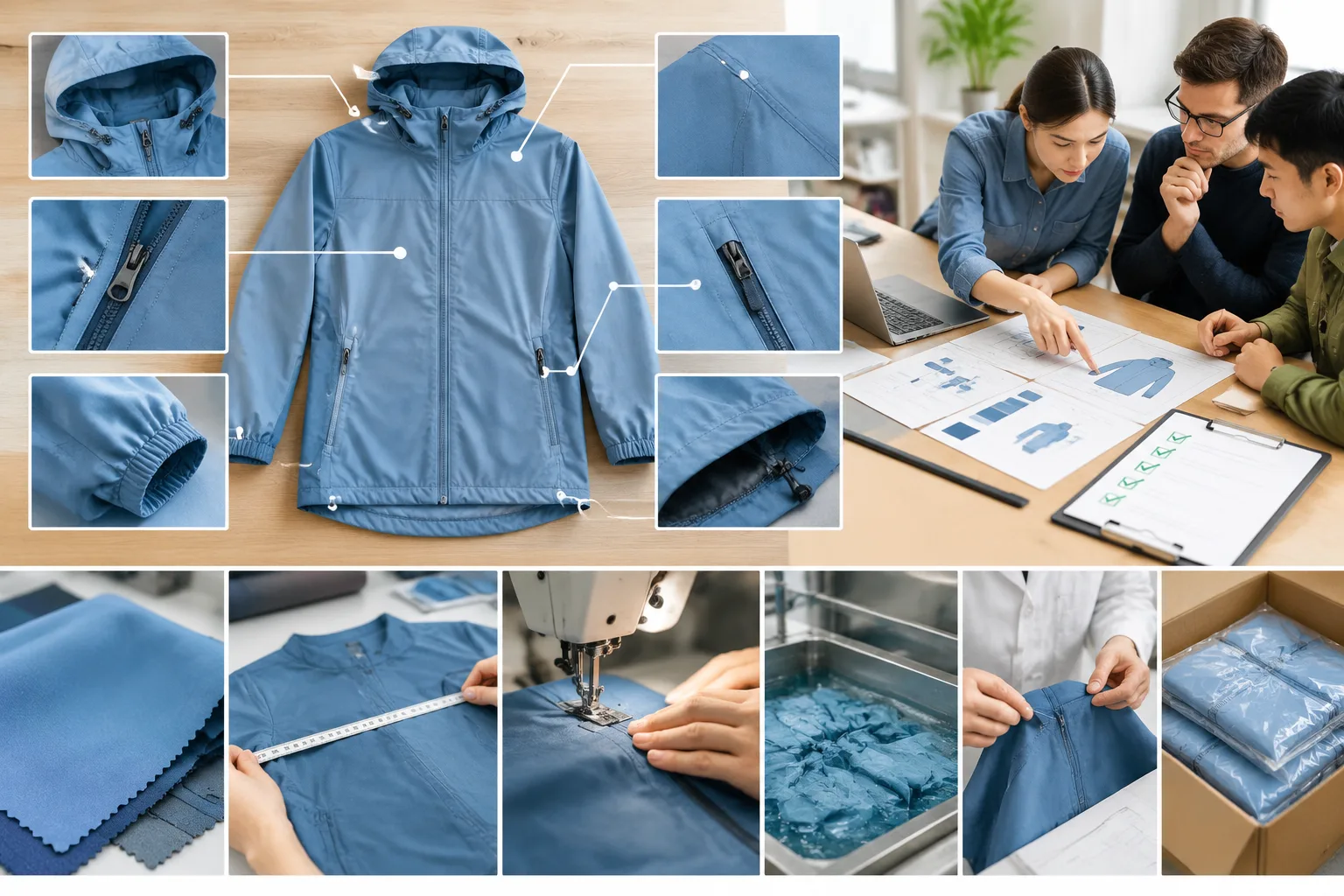
The visual reference must terminate at the intended feature. A leader line, detail bubble, section view, or enlarged view should point to the actual seam, edge, layer, attachment, or stitch being described, rather than ending near a similar feature. An attractive illustration is not sufficient when one line could be read as referring to either a seam allowance or a finished edge. When several features look alike, add a page, detail-view, piece, or revision reference.
Views and orientation also need attention. Identify whether the instruction applies to the front or back, inside or outside, wearer left or wearer right, or self fabric versus contrast fabric. State the relevant layer when a lining, interlining, binding, or reinforcement is involved. These identifiers are documentation controls, not decorative annotation. They allow a pattern maker, sample room, production team, or quality reviewer to connect the note to the same physical location.
Which materials and components belong in a construction callout?
A construction callout should identify the material or component when that choice affects execution, appearance, or the relationship between garment layers. Depending on the detail, this may include self fabric, lining, interlining, binding, elastic, tape, thread, closure, label, or reinforcement. Use the approved fabric or trim name and, where the project uses them, the relevant material or component code. Linking to the BOM is preferable to repeating a specification in several places that could later conflict.
Include a component dimension, finish, color, or supplier-specific detail only when it distinguishes the approved option or changes how the detail is made. A callout might need to state that a binding is applied around a raw edge, that an elastic is enclosed in a casing, or that a reinforcement is placed on the inside layer. It generally does not need to repeat every BOM field, such as quantity or costing information. Those records should remain separate while pointing to the correct component.
Do not assume that a visually similar substitute is interchangeable. If substitutions are permitted, the callout or connected project record should state the approval authority or conditions for using one. If no substitution has been approved, the instruction should not imply automatic factory discretion. Also separate identification from performance claims. Naming a trim identifies what should be used; it does not prove a required strength, chemical property, colorfastness result, or durability level. Such claims need appropriate supplier documentation or test evidence.
What seam, stitch, and operation details make a callout actionable?
Distinguish the seam from the stitch. A seam describes how fabric layers or garment parts are connected, while a stitch describes how the thread is formed or placed. The same type of seam may use different stitches, and the same stitch can appear in more than one construction. When the distinction affects the result, identify both rather than using one term as a substitute for the other.
Describe the operation sequence when order affects the finished detail. Folding, turning, pressing, topstitching, binding, and attaching may need to occur in a particular relationship. Identify the layer order and whether the instruction applies continuously, only between marked points, or at a defined start and end. Where applicable, the callout may also need to state the finished edge treatment, seam allowance, visible stitch placement, thread location, bartack, reinforcement, or backtacking.
These details remain project-dependent. Stitch spacing, seam allowance, and reinforcement should reflect the fabric, garment movement, expected load, appearance requirement, and approved inspection basis rather than an assumed universal value. A stronger thread alone may not prevent seam opening, fabric tearing, or yarn slippage if the fabric and construction are poorly matched. The detail should therefore be considered against its likely failure mode.
Avoid words such as “neat,” “standard,” “secure,” or “match” unless the project explains how the result will be judged. A callout becomes actionable when production and inspection teams can connect its terminology to an observable construction and an agreed acceptance decision. Construction language describes what to make; measurable or otherwise defined criteria explain how another person can determine whether the result is acceptable.
Which dimensions, tolerances, and placement details should be shown?
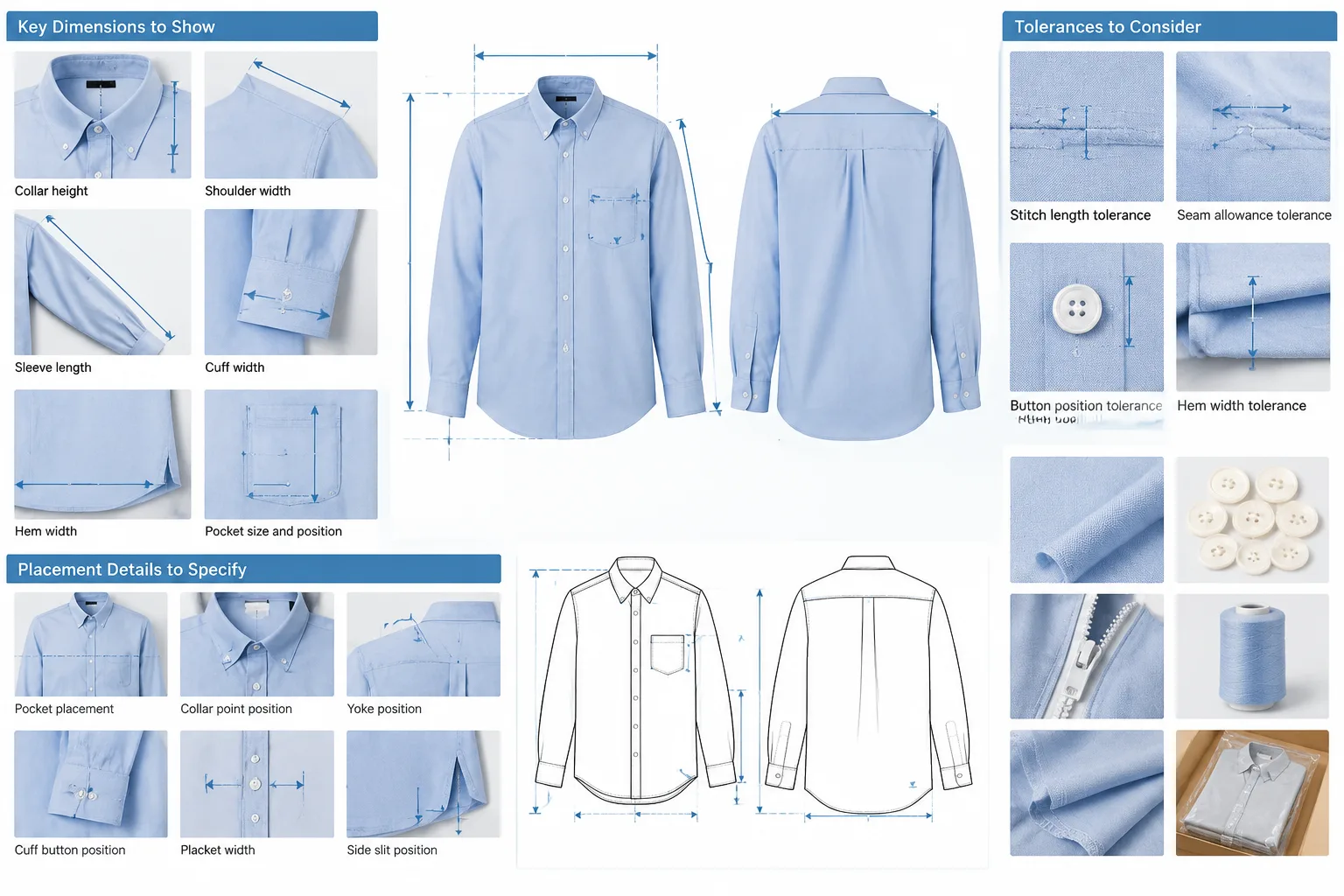
Include a dimension when the size, spacing, alignment, or position of a detail affects fit, function, appearance, or inspection. A callout should not simply add numbers to an illustration. It should explain what the number measures and why that information is needed. For example, a pocket opening, label, bartack, or topstitch may need a defined position when a small shift would change the garment’s appearance or use.
State the measurement point and its reference clearly. A position may be taken from a seam, finished edge, center front, notch, grade point, or another defined feature. The drawing should make that reference visible, especially when the nearest edge or seam could be interpreted in more than one way. For a placement-sensitive detail, a visual reference and a measurable position are usually more useful together than either one alone.
Use the approved unit system consistently, and identify whether a dimension applies before or after finishing, washing, pressing, or another relevant process. Keep construction dimensions distinct from the graded measurement chart. The callout may clarify where a detail sits or how a component is attached, while the measurement chart controls finished-garment points across sizes. These records should agree, but they serve different purposes.
Add a tolerance only when the project has an approved basis for it. A tolerance cannot repair an unclear measurement point, an undefined finished condition, or a conflicting pattern instruction. Stretch, shrinkage, and finishing effects also require product-specific consideration. They should be validated for the actual fabric and process rather than handled with a universal adjustment or by mechanically scaling the whole pattern.
How can teams review whether a construction callout is complete?
A practical review asks whether another qualified person could make and inspect the detail without relying on personal interpretation. Start with identity: can the reader tell which garment part, view, layer, and feature the callout addresses? The leader line, detail name, component reference, and drawing view should all point to the same physical area.
Next, review execution. Does the instruction identify the operation, orientation, component, and sequence needed to produce the result? Where folding, turning, binding, pressing, or attachment order matters, the callout should make that relationship clear. Then review measurement: are the location, reference point, units, and any approved tolerance defined where they affect the outcome?
Review inspection separately from construction. A complete callout should help a reviewer know what to examine on a sample or production garment, but documentation completeness does not prove that the garment performs acceptably. Relevant risks may include stretch, load, abrasion, appearance, washing, edge stability, fabric damage, or yarn slippage. The suitable review basis depends on the product and its intended use.
Finally, compare the callout with the latest pattern, BOM, measurement chart, approved material records, and sample comments. Conflicting records should become visible questions rather than informal assumptions. Unresolved issues can indicate that the sample needs revision, conditional approval, or a hold before release. A garment that looks correct is not sufficient evidence when the supporting records disagree.
How should construction callouts be revised and controlled through development?
A construction callout remains useful only when its current status is clear. When a material, pattern, dimension, or sewing method changes, record the previous value, new value, reason for the change, affected components, approval status, and the sample or production stage to which the change applies. The exact numbering and approval process may vary by project, but the decision should be traceable.
Check connected records after every meaningful change. A revised component or dimension can affect the pattern, sewing operation, wash result, testing, packaging, or delivery plan. Updating an appearance image or sending an email may communicate an idea, but it does not necessarily update the controlled technical instruction. The relevant drawing detail, BOM reference, pattern information, and sample comments should show the same approved direction.
Keep one clearly identifiable current version and retain superseded versions according to the project’s document-control practice. If only one feature changes, state what remains unchanged and identify any assumptions that still require validation. An approved change should be distinguishable from a suggestion written on a sample or an unverified production note.
Practical next step: Before release, compare each construction callout with the latest pattern, BOM, sample comments, and available inspection evidence. Resolve differences while the detail is still in development, and record any remaining uncertainty as a project decision rather than leaving production or quality teams to infer the intended result.
FAQ
What is a construction callout in apparel product development?
It is a focused technical instruction that connects a garment feature to its location, material or component, construction method, and relevant execution or inspection information.
What is the minimum information a garment construction callout should show?
At minimum, it should identify the feature, point to its exact location, describe the required construction or component, and include supporting dimensions or placement information when they affect the result.
Should seam allowance and stitch details be included in a construction callout?
Include them when they affect construction, appearance, movement, or inspection. Their values should be approved for the specific garment and materials rather than treated as universal requirements.
How are construction callouts different from a BOM and measurement chart?
A callout explains a particular construction detail. A BOM identifies the materials and components used, while a measurement chart defines approved measurement points and values. The records should link together without duplicating conflicting specifications.
Who should review construction callouts before a garment is approved for production?
Review should involve the people responsible for design, development, pattern or technical documentation, production, and quality as appropriate to the project. Each should confirm the detail from their operational perspective.
What should happen when a construction detail changes after sample approval?
Record the old and new instruction, reason, affected records, approval status, and effective stage. Then check the pattern, materials, sample comments, testing, and inspection evidence before treating the revision as ready for release.