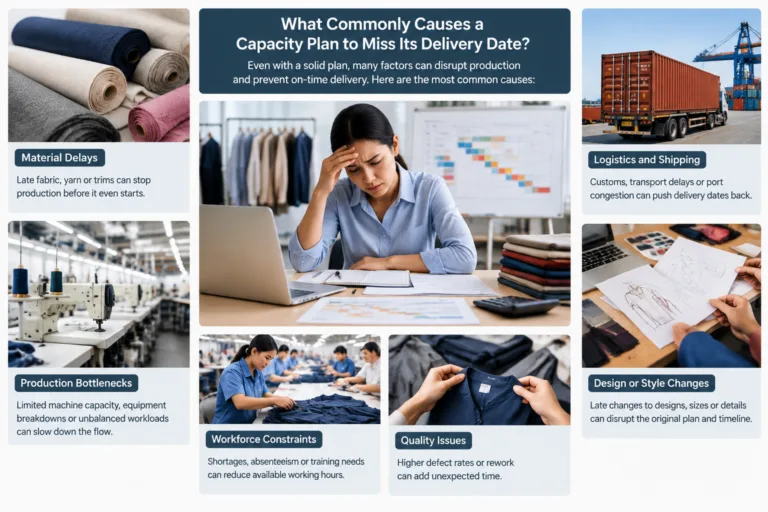
Garment production planning is the process of coordinating people, equipment, materials, approvals, quality activities, and calendar time so an apparel order can be completed by an agreed delivery date. A workable plan connects order volume with available production time, usable capacity, process dependencies, and the risks that can interrupt the sequence.
In practice, planning a clothing order means testing whether the requested date is feasible, then building a schedule around the most limiting resource or dependency. A buyer’s requested date is a planning requirement, not automatically a confirmed production commitment. Apparel Wiki is an independent educational publication, not a factory, manufacturer, laboratory, or production-service provider. Its editorial work is supported independently; see the Sponsor page for that context.
What garment production planning must balance
A reliable apparel production plan must balance four connected questions: what must be made, how much work is required, how much usable time is available, and which activities must happen before others can proceed. The order may include several styles, colors, sizes, packing formats, or destinations. Each variation can affect material readiness, line loading, inspection, and dispatch.
Capacity should also be separated into theoretical and usable capacity. Theoretical capacity describes what a resource might produce under stated ideal conditions. Usable capacity is the portion that remains after the factory accounts for locally measured constraints such as planned downtime, maintenance, changeovers, training, absenteeism, indirect work, quality losses, and other interruptions. These deductions are factory-specific; there is no universal capacity value for every garment operation.
Capacity planning is therefore a feasibility assessment, not a guarantee of output. Even a reasonable estimate can be reduced by a bottleneck operation, late materials, an approval hold, rework, or a restriction in finishing and packing. A plan should identify its assumptions and distinguish confirmed facts, provisional dates, measured results, common planning practice, and hypothetical scenarios.
The requested delivery date should be treated as an input to the assessment. It becomes a confirmed commitment only after the responsible parties review the order scope, dependencies, material status, capacity assumptions, and calendar. This distinction helps prevent a date from being repeated as if it were evidence that the production window is achievable.
Which inputs are needed before building the schedule?
Order quantity alone is not enough to assess a garment production schedule. Before allocating capacity or promising a date, the team should assemble a minimum planning dataset that covers the product, the required delivery milestone, the factory calendar, and the evidence behind each assumption.
- Order scope: Record style count, color and size assortment, quantities by variant, delivery destination, labeling, packing requirements, and whether the milestone means ex-factory dispatch, arrival, or another agreed point.
- Technical readiness: Confirm the latest specifications, patterns, bills of materials, approved samples, construction details, grading information, and any product changes that could affect work content.
- Material status: List required fabrics, trims, packaging, and components; record supplier commitments, expected availability, testing, inspection, and approval dependencies.
- Process route: Map the expected sequence from approvals and material readiness through cutting, sewing, finishing, inspection, packing, and dispatch. Note operations that cannot begin until another activity is complete.
- Factory availability: Use current information about assigned lines, shifts, skilled operators, equipment restrictions, planned maintenance, holidays, training, and other calendar limitations.
- Measurement definitions: State how available minutes, planned losses, overtime, rework, indirect work, and efficiency will be measured so figures remain comparable.
- Decision ownership: Mark fixed and provisional dates, identify the person or team authorized to approve changes, and define when the plan must be reviewed.
This input review exposes dependencies before they are hidden inside a broad lead-time estimate. For example, a sewing line may have available time while a required trim is still awaiting approval. In that case, the apparent sewing capacity does not establish that the order can meet its delivery milestone.
How to compare order requirements with usable capacity
The comparison begins with validated work-content data. A factory may use approved standard allowed minutes (SAM), another standard-minute measure, or a locally maintained work-content method. The basis must be clear, because a standard minute is meaningful only when its definition and scope are understood.
A simplified capacity-planning formula is:
Estimated production capacity = direct personnel × available minutes per person × usable efficiency ÷ standard allowed minutes per garment
For a hypothetical example, assume 10 direct personnel, 480 available minutes per person, 70% usable efficiency, and 20 standard minutes per garment:
10 × 480 × 0.70 ÷ 20 = 168 garments
This is an initial estimate, not a promised output. The example assumes that the personnel, available minutes, efficiency measure, and standard minutes use compatible definitions. The efficiency figure must also state which losses it includes. If downtime, training, or rework has already been included, it should not be deducted again without a clear reason.
The result must then be tested against the weakest required stage. A cutting restriction, specialized sewing operation, material shortage, quality hold, or packing limitation may reduce practical capacity below the formula’s result. Similarly, adding nominal personnel to one operation may not improve the delivery date if another operation remains the bottleneck.
Efficiency percentages should not be ranked or compared when their denominators differ. One team may include indirect time or rework while another reports only direct productive minutes. Use factory-specific measurements, document the calculation basis, and update assumptions from observed results rather than treating the formula as a universal apparel benchmark.
How to build a schedule around bottlenecks and dependencies
Once the capacity assessment is complete, build the schedule backward from the required delivery milestone. Start with dispatch and work toward packing, final inspection, finishing, sewing, cutting, material readiness, approvals, and finalized product information. The exact duration of each milestone depends on the project and should come from current planning data.
| Planning stage | What to verify |
|---|---|
| Delivery and dispatch | Destination, packing completion, logistics handoff, and required delivery milestone |
| Quality and finishing | Inspection timing, rework handling, pressing or finishing requirements, and release criteria |
| Production | Line assignment, bottleneck operation, work content, staffing, equipment, and changeovers |
| Pre-production | Materials, specifications, approved samples, testing, and other release dependencies |
Reserve time for the bottleneck resource before filling non-bottleneck capacity. A plan that loads cutting, sewing, or finishing independently can appear complete while the constrained operation has more work than its usable time. Staged releases or line loading can help when materials, specifications, and approvals are sufficiently ready, but they should not conceal unresolved dependencies.
Separate pre-production, production, quality, and logistics milestones so the source of a delay can be located. Add review points for late materials, failed tests, sample changes, quality holds, and possible reallocation to another line or qualified source. At each review, define the evidence that triggers a schedule revision, such as a material status change, measured output below plan, or an unresolved approval.
What commonly causes a capacity plan to miss its delivery date?
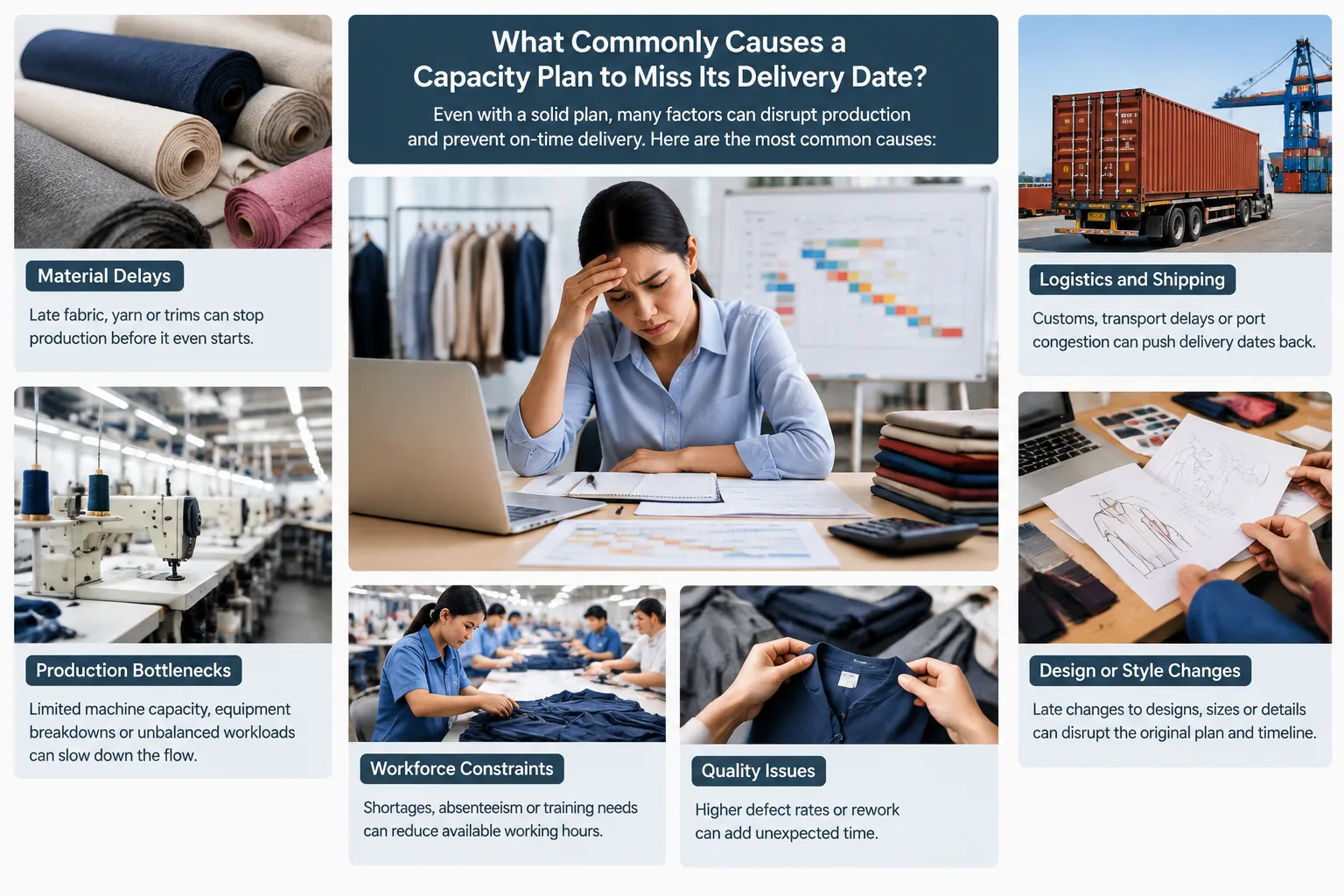
A missed date does not always mean the factory lacked enough sewing capacity. Late materials, incomplete specifications, sample changes, delayed approvals, equipment limits, or staffing changes can prevent planned work from starting on time. Compare the schedule with actual material, approval, and production records to identify where the gap began.
Track losses separately where the data allows: changeovers, downtime, training, absenteeism, rework, and quality holds do not have the same cause or remedy. A single efficiency percentage can hide these differences. Its meaning also depends on the denominator: clarify whether planned losses, indirect work, overtime, and rework are included before comparing figures across periods or teams.
Quality measures need similarly clear definitions. First-pass yield is the share of units that pass their first inspection out of the units receiving that first inspection. It answers a different question from the final pass rate after repair. Reporting first-pass results alongside rework and defect information can reveal process losses that a final pass figure alone may conceal. Use a defined inspection population and avoid counting the same unit repeatedly as a new product.
Overtime, extra shifts, subcontracting, resequencing, and order splitting may be options, but each can introduce new coordination, quality, labor, cost, or traceability risks. More hours or higher utilization should not be assumed to be the right answer; assess the operating context and relevant requirements before changing the plan.
How to evaluate a proposed production plan before committing
Review the plan as a set of linked assumptions, not just a target date and daily output figure. Confirm the order scope, material status, technical approvals, assigned resources, bottleneck operation, milestones, and accountable owners. Check that the capacity method and its measurement basis are stated clearly enough for others to interpret.
Ask what supports the calendar margin. A buffer based on observed variation, current material status, or documented process constraints is more informative than an arbitrary percentage. Compare the base plan with at least one constrained scenario, such as earlier material release, resequencing, adjusted quantities, a split delivery, or a revised date. These are options to evaluate, not guaranteed fixes.
Check quality and fulfillment milestones alongside production output: when will inspection occur, how will rework be handled, and what must be ready before packing and dispatch? Record unresolved risks, decisions still required, the evidence that would trigger escalation, and when the schedule must be reviewed again.
- Confirmed facts: approved requirements, current material status, and available factory data.
- Working assumptions: expected staffing, usable time, efficiency basis, and unresolved dependencies.
- Project choices: allocation, sequence, inspection timing, and delivery arrangement.
- Scenarios: possible responses if a material, quality, or capacity constraint changes.
This distinction helps brand-side and factory-side teams discuss the same plan without presenting estimates as commitments. Apparel Wiki is an independent educational publication, not a manufacturer or source of production capacity.

What to do when capacity cannot support the requested delivery date
First locate the shortfall. Check whether it comes from order volume, available calendar time, a constrained operation, missing inputs, quality losses, or a requested date that the current evidence cannot support. Then compare responses against quality, cost, compliance, logistics, traceability, and customer commitments.
Depending on the order, options may include negotiating a revised date, reducing or phasing quantities, releasing materials earlier, simplifying approved requirements, resequencing work, reallocating production, or considering another qualified source. A change that adds nominal capacity may not help if the bottleneck remains elsewhere, and moving work can introduce new approval or coordination needs.
Communicate any revised plan with its assumptions, milestone owners, risk triggers, and supporting evidence. After completion, compare planned with actual output and record the reasons for differences. Those measured results can inform future capacity assumptions; an unsupported promise cannot. Related Apparel Wiki resources include Apparel Manufacturing Tools.
Frequently asked questions
What is garment production planning?
It is the coordination of order requirements, people, equipment, materials, approvals, quality activities, and calendar time to work toward an agreed delivery milestone.
How do you calculate garment production capacity?
A planning estimate can use direct personnel multiplied by available minutes and efficiency, divided by standard allowed minutes (SAM). The result depends on consistent definitions and does not account for every bottleneck or dependency automatically.
What is the difference between theoretical and usable garment production capacity?
Theoretical capacity represents an idealized estimate from stated resources and time. Usable capacity accounts for locally measured constraints such as downtime, changeovers, staffing availability, quality losses, and other planned work.
How should a factory plan production around a fixed delivery date?
Work backward from the required delivery milestone, map approvals and materials through production, inspection, packing, and dispatch, and reserve time for the bottleneck. Review progress against evidence and revise the schedule when a key assumption changes.
What should a brand do when available capacity is lower than the order requirement?
Ask for the constraint and assumptions to be documented, then assess options such as a revised date, phased quantities, resequencing, or another qualified source against quality, cost, compliance, and logistics needs.
How do quality problems and rework affect a garment production schedule?
Rework uses time and can delay later operations, while quality holds may prevent release to finishing or dispatch. Track first-pass results, rework, and defects with clear inspection definitions so the schedule reflects the work still required.