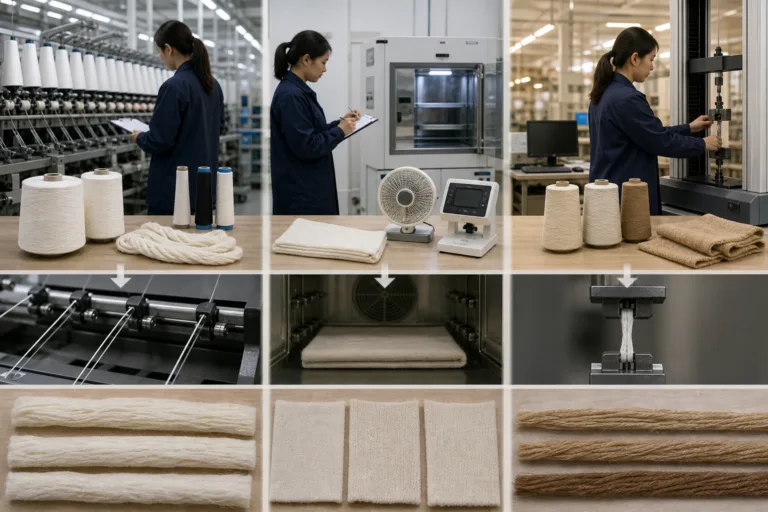

Computer vision inspection architecture is the coordinated arrangement of imaging hardware, lighting, software, decision rules, data flows, operator actions, and connected production systems used to inspect a defined material or product. In apparel manufacturing, it may support checks on fabric, cut parts, sewing output, finished garments, or packaging. The architecture is therefore more than a camera or an image-classification model: it is the complete process that turns a captured image into a quality decision and a recorded response. Apparel Wiki is an independent educational publication; its editorial independence is described on the Sponsor page.
The inspection target, defect definition, acceptance rule, and response workflow determine the appropriate design. A system labeled as artificial intelligence, automation, quality management, or manufacturing execution does not automatically provide a particular inspection function. This guide explains the main components and operating sequence so brand, sourcing, quality, and manufacturing teams can assess the technology without assuming that one computer vision inspection architecture fits every garment operation.
What Is Computer Vision Inspection Architecture?
A computer vision inspection architecture is a process-and-data-flow design for examining visual information and deciding what should happen next. It normally connects an object or material to be inspected with an image-acquisition environment, processing or model stages, decision logic, records, and human or equipment responses. The architecture can be configured around a single inspection point or connected to several production and quality activities.
For example, a fabric inspection setup may focus on continuous material presentation and visible surface variation. A sewing-output setup may instead need to identify a garment style, position a three-dimensional item, inspect selected construction or appearance features, and route uncertain results for review. These are different inspection problems even when both use cameras and software.
The distinction matters because a camera only captures data, while a model may classify an image without controlling the surrounding workflow. A general factory automation system may move, count, or route products without inspecting their visual condition. An inspection architecture combines the parts needed for a defined decision, including what counts as a defect, who owns the result, and whether a failed or uncertain item is rejected, quarantined, rechecked, or escalated.
Which Components Make Up an Inspection Architecture?
The components should be understood by responsibility rather than by product category. A robust design makes clear what enters each stage, what leaves it, and what can go wrong. The names of connected software systems do not establish their complete capabilities or data ownership.
| Component or responsibility | What it contributes | Potential consequence of weakness |
|---|---|---|
| Inspection object and presentation | Defines the material, garment, field of view, position, background, and movement conditions. | Important features may be hidden, distorted, or confused with normal variation. |
| Camera, sensor, lens, and lighting | Creates the visual input under a selected resolution, angle, illumination, and timing arrangement. | Contrast, reflections, shadows, or missing areas can make results inconsistent. |
| Triggering and image acquisition | Determines when and how images are captured as an item arrives, moves, or is positioned. | The wrong item, an incomplete view, or motion-related image change may be recorded. |
| Processing and model stages | Locates the product, identifies relevant features, detects deviations, and assigns a result. | Unclear or unfamiliar conditions may create missed detections or unnecessary exceptions. |
| Decision and response logic | Applies defect classes, acceptance rules, confidence handling, alarms, review, rejection, or quarantine actions. | A technically flagged anomaly may receive the wrong operational disposition. |
| Records and interfaces | Links identity, images, results, versions, stations, reviewers, and follow-up actions. | Teams may be unable to trace, compare, investigate, or correct a result. |
Relevant records may include style, color, size, material, lot, inspection station, image, result, and software or model version. The exact fields and their owners must be defined locally. A product-lifecycle, enterprise-resource-planning, manufacturing-execution, warehouse, quality, or reporting system may be involved, but its abbreviation does not prove that it can store every required field, preserve version identity, or recover from an integration failure.
How Does the Inspection Workflow Work on a Garment Line?
A typical workflow follows a sequence, although the physical line design and review responsibilities remain project-specific:
- Set the inspection scope. Define the product or material, inspection location, visual features, defect taxonomy, acceptance rule, and action required for each result.
- Identify the correct item and version. Confirm the style, color, size, material, or other identity information needed to select the appropriate inspection configuration.
- Present the item consistently. Position or move the fabric, cut part, or garment so that the planned field of view, background, camera angle, and lighting conditions are available.
- Capture images. Use the selected triggering method and acquisition environment to collect the visual evidence needed for the inspection task.
- Process and classify. Software or models analyze the images, locate relevant areas, identify possible deviations, and assign a result according to the defined logic.
- Route the result. A passing result may continue through the process. A failed or uncertain result may trigger an alarm, hold, quarantine, reinspection, or operator review rather than automatic rejection.
- Record and learn from the outcome. Store the result and relevant context, then use recurring findings to support process control, operator training, supplier discussion, or product-development review.
Repeatable image capture is central to this sequence. Lighting, item presentation, camera angle, background, line speed, fabric behavior, garment drape, and surface sheen can all affect what the system sees. A failed result may therefore require confirmation when the image is incomplete, the defect definition is ambiguous, or the observed pattern could be normal product variation. Automation can organize and accelerate a defined inspection task, but it does not by itself remove the need for qualified review or guarantee defect-free production.
What Variables Affect Detection and Decision Quality?
Detection quality depends on the relationship between the inspection task and the operating environment. Apparel materials can vary in texture, color, stretch, drape, sheen, and shape. Wrinkles, lint, shadows, seams, trims, prints, embroidery, and folds may resemble defects or hide them. The same garment may look different when presented flat, hanging, moving, or under a changed light source.
Defect characteristics also matter. Size, contrast, location, orientation, and acceptable variation influence whether a visual difference can be separated from the surrounding material. Image resolution, illumination, camera position, and item positioning affect the available evidence. A controlled and repeatable defect is generally a different technical problem from a rare, ambiguous, or previously unseen condition.
A visual anomaly is not automatically a commercially relevant defect. The inspection rule must connect what the system can detect with the quality decision the team actually needs to make. That connection depends on representative examples, consistent labeling, documented acceptance rules, style changes, and ongoing maintenance of rules or models. Version control matters because a changed product, dataset, or model can change the meaning of later results.
Finally, technical model performance should be kept separate from production-level quality outcomes and business value. More automation may reduce some repetitive work while adding integration, training, maintenance, review, and exception-handling responsibilities. Those trade-offs must be assessed for the specific inspection task rather than inferred from a system label or a demonstration.
How Should a Team Evaluate an Inspection Architecture?
Evaluation should begin with the decision the system is expected to support. A team may want to identify a visible defect, route an item for review, prevent a known issue from reaching packing, or create a traceable quality record. These are different responsibilities. Define the consequence of a missed defect, a delayed decision, and an incorrect rejection before comparing equipment or software.
A representative sample is more useful than a polished demonstration. Include relevant styles, colors, sizes, materials, normal variation, known defects, and difficult edge cases. The sample should also reflect how items appear at the proposed inspection point. A flat panel, a moving garment, and a partially assembled product can present different visual conditions, so the pilot should match the intended operating environment as closely as practical.
Establish a baseline using the current inspection process. The baseline may include quality outcomes, inspection time, review workload, exception frequency, record completeness, and the effort required to resolve uncertain results. The purpose is not to force every project into one financial formula. It is to provide a comparison point for judging whether the proposed architecture improves the decision that matters.
- Define the task. Document the product scope, defect taxonomy, acceptance rule, inspection location, and escalation owner.
- Test the complete flow. Check product or style selection, presentation, image capture, processing, classification, operator review, record creation, and exception recovery.
- Check traceability. Confirm that results can be connected to the product version, material or lot where relevant, inspection station, rule or model version, and reviewer action.
- Review operating requirements. Consider training, maintenance, calibration, change control, access controls, data retention, and integration ownership.
- Set a decision rule. Agree in advance whether the outcome will be expansion, redesign, narrower use, further testing, or stopping the project.
Integration should be tested as part of the inspection architecture, not postponed until after the image results look promising. A file that opens successfully may still omit or alter identity, material, size, version, or result information. Likewise, a system label such as PLM, ERP, MES, or WMS does not by itself establish what data the product can own, exchange, or preserve. Ask the responsible teams to define field ownership and recovery steps for incomplete or failed transactions.
Supplier claims are inputs to validation rather than independent evidence. A bounded pilot should use the apparel team’s samples, agreed definitions, and documented observation conditions. Compare the expected value with implementation, integration, training, maintenance, review, and exception-handling effort. The most suitable architecture may be narrower than the one shown in a demonstration.

Where Does Computer Vision Inspection Stop Being Reliable?
Computer vision inspection is limited by its defined target, available examples, physical setup, product variation, and acceptance rules. A system may be useful for a specific visual task without being a complete judgment of garment quality. Reliability is therefore conditional on what is presented to the camera and what the organization has decided the result should mean.
Some questions are visual, while others require different evidence. A camera may help identify a visible stain, hole, misplaced feature, or irregular appearance. It does not automatically establish fabric strength, wear performance, chemical properties, dimensional stability, construction integrity, or color performance under a defined evaluation method. Touch, measurement, laboratory testing, functional testing, or a qualified review may still be necessary.
A detected image pattern also does not prove root cause, customer acceptability, legal compliance, or contractual conformity. Detection identifies a possible condition. Disposition applies the organization’s acceptance rule. Root-cause analysis investigates how the condition occurred. Compliance assessment compares evidence with an applicable requirement and validated method. Keeping these responsibilities separate prevents an automated flag from being treated as a universal quality conclusion.
Operational conditions can create failures even when the underlying model or rule has been configured correctly. The wrong style or version may be selected, a lens may be blocked, lighting may drift, a garment may be positioned poorly, or a network or system interface may fail. Incomplete records can make a correct image result difficult to use. These failure modes require visible status signals, defined escalation, and documented recovery procedures.
Human review remains important for ambiguous or high-consequence decisions. Reviewers need a clear way to examine the relevant image or item, record the disposition, and identify cases that should be added to process improvement or future validation. Vision inspection can support consistent decisions while still requiring people to interpret uncertain cases and manage changes in products, materials, rules, and operating conditions.

What Should the Next Step Be Before Implementation?
Before requesting a product demonstration or committing to a pilot, write a one-page inspection brief. State the product scope, inspection point, visible defects of interest, normal variation, acceptance decisions, required records, escalation ownership, and systems that must exchange information. This brief gives the team a shared definition of the problem and reveals whether the immediate need is better data definition, process control, operator support, automated detection, or integration.
Then select representative samples and document why each sample is included. Ask any supplier or internal technology team to demonstrate the complete workflow with difficult cases, identity selection, version handling, data export, exception review, and fault recovery. Agree on the baseline, evidence to collect, change-control approach, and decision criteria before interpreting the results. After the pilot, decide whether to expand, narrow, redesign, or stop the architecture based on the defined inspection task.
What is computer vision inspection architecture?
It is the connected arrangement of imaging hardware, lighting, software, decision rules, records, operator actions, and production interfaces used for a defined inspection task. It is broader than a camera or an image-classification model.
What are the main components of a computer vision inspection system?
Typical components include the inspected object, camera or sensor, lens, lighting, trigger, image-processing or model stage, decision logic, operator review, result record, and interfaces with relevant production or quality systems.
Can computer vision inspect every type of garment defect?
No. It can support defined visual tasks, but some defects or quality questions require touch, measurement, material testing, functional testing, laboratory evidence, or expert review.
How is computer vision inspection different from manual garment inspection?
Computer vision uses configured imaging and decision logic to evaluate captured visual information. Manual inspection relies on a person’s observation and judgment. A practical workflow may combine automated screening with human confirmation for uncertain or consequential cases.
What data should an apparel team prepare before a vision-inspection pilot?
Prepare product identities and versions, relevant styles, colors, sizes, materials, normal examples, known defects, acceptance rules, inspection-location details, and ownership for review, records, and escalation.
Does a computer vision result prove that a garment meets regulatory or contractual requirements?
No. A vision result is evidence about a defined visual condition. Regulatory or contractual conformity must be assessed against the applicable requirement, evidence, and validated method.