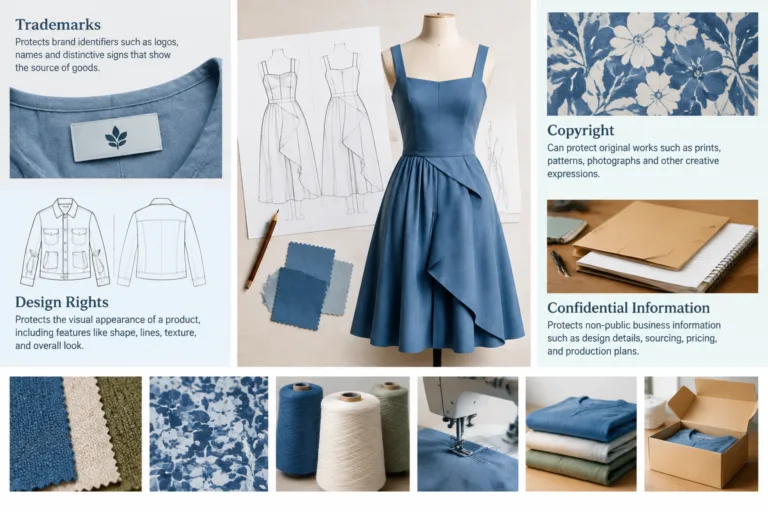
Fashion intellectual property is the group of legal rights that may apply to different assets in the apparel business, including brand identifiers, creative works, product appearance, and confidential information. A single garment can involve several separate rights, so identifying the asset usually comes before deciding how it may be protected or used.
For example, a jacket may carry a brand name or logo, an original graphic or photograph, a distinctive product appearance, and nonpublic information about its development. Those elements do not automatically receive the same protection. Rights, eligibility, ownership, duration, and enforcement depend on the asset and the applicable jurisdiction. Apparel Wiki is an independent garment-industry knowledge blog, not a law firm, manufacturer, factory, or supplier; its Sponsor information also does not change the editorial independence of its educational content.
What does fashion intellectual property protect?
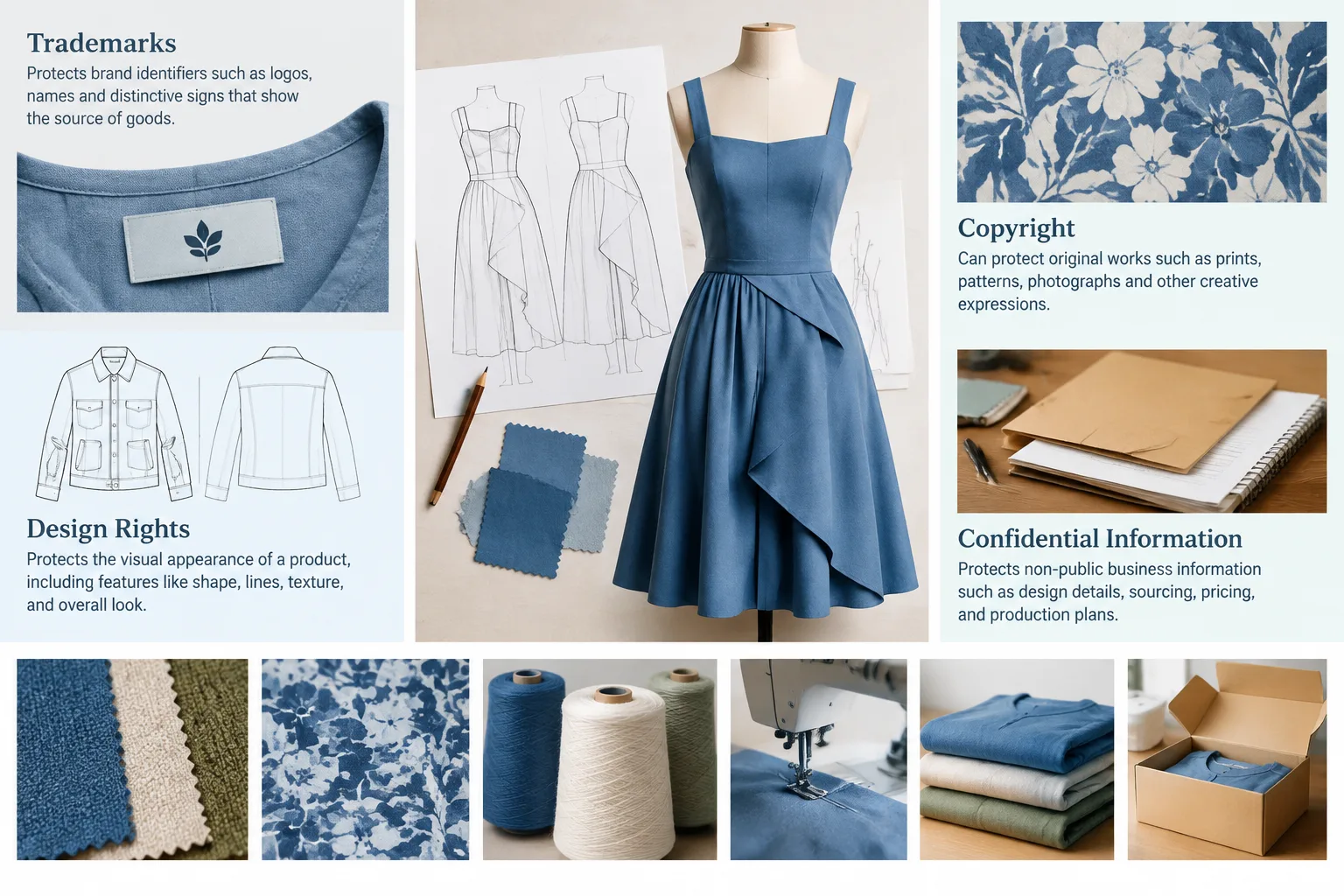
Intellectual property in fashion is best understood as an asset-identification exercise rather than a single universal protection. A clothing company may need to consider the sign customers use to recognize the source of goods, the artwork printed on a product, the appearance of the product itself, and information that remains private while a collection is being developed.
These categories can overlap in a commercial project, but they answer different questions. A trademark may concern whether a name or logo identifies one business rather than another. Copyright may be relevant to an original illustration, photograph, graphic, or print. Design protection may address aspects of a product’s appearance where the relevant law provides that route. Confidentiality may concern unreleased specifications, development files, or business information that is not publicly available.
The garment does not become fully protected simply because it is new, expensive, or commercially successful. Nor does one registration automatically cover every element, every country, or every possible use. A team should separate the assets, identify who created or supplied each one, and check the rules that apply in the territory where protection or use matters.
Ownership is also a distinct question. A designer, employee, photographer, agency, manufacturer, or other contributor may have a role in creating or supplying an asset. Agreements can affect ownership and permitted use, but their effect depends on their wording and the applicable law. Keeping source files, briefs, approvals, invoices, assignments, and licenses can make the commercial history easier to understand later.
How do trademarks apply to fashion brands?
Fashion trademarks are signs that may distinguish the source of goods or services, subject to the law of the relevant jurisdiction. In apparel, the sign may be a brand name, word, logo, label element, or another identifier. A clothing brand trademark therefore relates primarily to brand identity: it helps consumers associate a product or service with a particular source.
Not every name, logo, or visual element is registrable or protected in the same way everywhere. An assessment may depend on the sign itself, the goods or services listed, existing rights, territory, and other requirements applied by the relevant trademark office or legal system. Registration, where available, also has a defined scope and may involve continuing administrative requirements. These details cannot be reduced to one global process or one universal result.
For an apparel team, the practical task is to define the identifier precisely. Is the proposed asset a word mark, a logo, a label treatment, or another sign used in trade? In which countries will it appear? On which goods or services? Will the same identifier be used on garments, retail services, packaging, online stores, or promotional material? The answers help determine what should be checked, although they do not guarantee registration or freedom to use.
Trademark protection should remain separate from product design. A brand name may identify the source of a sweatshirt, while the sweatshirt’s shape, fabric pattern, print, or functional construction raises different questions. Trademark law is not a general ownership right over an underlying fashion idea, a category of garment, or every visual feature appearing on a product.
Searches of relevant official records can help reveal potentially conflicting identifiers, but the result depends on the database, territory, goods and services examined, search terms, and date of the search. An apparel business should preserve the scope and date of its research and obtain jurisdiction-specific professional review before relying on a consequential commercial decision.
When can copyright apply to fashion?
Fashion copyright questions commonly arise around creative works used in apparel. Examples may include an original print, graphic, photograph, illustration, artwork, or other expressive material. Whether a particular work qualifies, which rights apply, and what exceptions or limitations exist depend on the applicable jurisdiction. The safest starting point is to identify the creative work separately from the garment that carries it.
A general style, trend, theme, or idea is not the same thing as a specific creative work. Likewise, a functional garment feature may be treated differently from an artistic graphic or image. The boundary between protectable expression and unprotected ideas, methods, or functional aspects varies across legal systems, so broad claims that all clothing designs are protected, or that none are protected, are unreliable.
Possessing a reference image, buying a sample, or receiving a physical garment does not by itself establish permission to reproduce, adapt, print, photograph, manufacture, or sell the associated material. Ownership of an object and permission to reproduce a work are separate issues. A team should identify who made the work, who supplied it, and what rights were actually granted.
Commissioned and licensed creative work requires particular care. The contract may address authorship, ownership, permitted modifications, product categories, territories, sales channels, duration, credit, sublicensing, and approval rights. Those terms, together with applicable law, determine what the business may do. A purchase order or payment record may document a transaction without answering every question about reproduction or later commercial use.
Useful records include the original brief, drafts, creation dates, contributor details, agreements, invoices, written approvals, license terms, and the products or channels covered. If the asset is revised, translated, recolored, or combined with another work, record that process as well. These records do not eliminate legal risk, but they help distinguish an owned asset, a licensed asset, a supplied reference, and an unresolved permission issue before a collection reaches production.
What do design rights protect in apparel?
Design rights may address the appearance of a product, which makes them relevant to some apparel and accessory development questions. Depending on the jurisdiction, the relevant appearance may involve features such as shape, lines, contours, configuration, surface ornamentation, or the visual presentation of a component. The legal category, eligibility test, and available procedure are not identical worldwide, so a design that appears suitable for protection in one location may require a different analysis elsewhere.
In fashion, a garment’s silhouette, a distinctive arrangement of visible components, a textile surface treatment, or the appearance of an accessory may raise design-right questions. These are illustrations for identifying an asset, not conclusions that the item is automatically eligible. Functional features, excluded subject matter, prior disclosure, and other local rules can affect the result. Where registration is available or required, the relevant office and applicable law determine the process, scope, and duration.
Design rights should remain separate from other assets in the same product. A brand name or logo primarily raises a trademark question; an original illustration or photograph may raise a copyright question; an unreleased specification may be confidential information. One collection can involve all of these assets, but no single registration automatically covers every element, every country, or every type of use. Before public launch or commercial copying, the team should identify the appearance it wants to protect and check the applicable local rules, including any consequences of earlier disclosure.
How can apparel businesses manage confidential information?
Confidential information is nonpublic business information that has value because it is not generally known and is handled as restricted information under the facts and law that apply. In an apparel business, examples may include unreleased collection plans, technical specifications, grading or development information, supplier terms, costing details, samples under review, or production processes. An idea does not become legally protected merely because a company labels it confidential.
Practical management starts with deciding what information genuinely needs restricted access. A team can classify project materials, give access only to people who need it for a defined task, and keep a record of who received the information and what they were allowed to do with it. Sharing instructions should address whether the recipient may copy, modify, forward, photograph, upload, or disclose the material. These controls should reflect the actual working relationship rather than relying on a generic label.
Written agreements may help define permitted use, return or deletion expectations, and disclosure limits, but an agreement alone does not guarantee protection. Applicable law, the information’s secrecy, the circumstances of disclosure, and the conduct of the parties all matter. Confidentiality is also different from ownership and registration: it does not turn a public design into a private right, and public disclosure can affect whether information remains confidential. Teams should therefore distinguish restricted business information from a registered right, a licensed creative work, and a general concept that others may independently develop.
How should a team check rights before using a fashion asset?
A rights check is a structured way to identify possible issues before an asset is published, adapted, manufactured, marketed, or sold. It is not a universal clearance certificate. Start by describing the asset precisely: is it a brand identifier, artwork, photograph, print, garment appearance, technical document, sample, or nonpublic business record? A single product may need several entries because its label, graphic, shape, and development information can have different sources and restrictions.
Next, record the asset’s provenance. Note who created it, who supplied it, when it was received, and whether it was commissioned, purchased, licensed, or adapted from an existing reference. Keep the brief, drafts, contributor details, invoices, approvals, agreements, and license terms together. For commissioned or licensed work, record the permitted products, territories, sales channels, duration, modifications, credit, sublicensing, and any approval requirements stated in the agreement.
Document the intended use before deciding that a permission is sufficient. A license for a private presentation may not cover product packaging, online advertising, manufacturing, resale, translation, recoloring, or use in another territory. Also record whether the team will crop, redraw, combine, digitize, or otherwise modify the material. These details help reveal where the planned use exceeds the documented grant or where the source of the material remains uncertain.
- Brand identifier: Check the relevant trademark records, goods or services, territory, and status, while recognizing that database results do not answer every legal question.
- Creative work: Confirm the creator, ownership or license terms, permitted reproductions, and any limits on modification or commercial use.
- Product appearance: Identify the design features, relevant jurisdiction, disclosure history, and any applicable design-right requirements.
- Confidential information: Record access, permitted purpose, disclosure restrictions, and the measures used to keep the information nonpublic.
When appropriate, search official intellectual property databases and save the date, database or office searched, geographic scope, search terms, and results. A missing record does not prove that an asset is free to use: databases may have geographic, timing, classification, or record-coverage limits, and a search may miss unregistered rights or contractual restrictions. Important launches, disputed ownership, unclear licenses, and cross-border uses warrant jurisdiction-specific professional review.
The practical next step is to build an asset register for each collection and attach the supporting records before approval for production or publication. Apparel Wiki is an independent educational garment-industry knowledge blog, not a law firm, manufacturer, factory, laboratory, certifier, or service provider. Use this overview to organize questions and evidence, then obtain advice suited to the jurisdictions and agreements involved when the commercial consequences are significant.

FAQ
Does one fashion intellectual property registration protect a garment in every country?
No. Rights are generally territorial, and different rights may apply to different parts of a garment. Scope, eligibility, registration, duration, and enforcement depend on the applicable jurisdiction and asset type.
Can copyright protect a clothing design or fashion print?
Copyright may be relevant to original prints, graphics, photographs, illustrations, or other creative works used with clothing. Whether a garment design or feature qualifies depends on the jurisdiction, the work’s characteristics, and applicable exclusions. A trend, general style, or idea is not automatically the same as a protected work.
Does buying a sample or reference image give a brand permission to copy it?
No. Owning a physical object or purchasing access to an image does not by itself establish permission to reproduce, adapt, manufacture, photograph, or sell the associated work. The source, agreement, license, and applicable law must be reviewed.
Does an online search prove that a fashion name or design is free to use?
No. A search can identify possible records and conflicts, but databases and search methods have limits. An apparently clear result cannot establish noninfringement, the absence of unregistered rights, or permission under a private agreement.
What records should a fashion team keep when it commissions or licenses creative work?
Keep the brief, drafts, creator details, creation dates, invoices, agreements, approvals, license scope, territories, channels, duration, modification rights, credit requirements, and sublicensing terms. Also record later revisions, translations, recoloring, or combinations with other works.