Improving jet dyeing colorfastness means identifying the exact way a dyed fabric fails, correcting the most likely contributing process condition, and verifying the result under the relevant exposure. It does not mean applying one universal treatment or pursuing one colorfastness number. Apparel Wiki is an independent educational publication, and its Sponsor information explains that commercial support does not provide paid control over editorial content.
The practical starting point is to determine whether the problem involves washing, rubbing, perspiration, light, water, or another exposure. Teams must also distinguish a change in the fabric’s own shade from dye transfer or staining on another material. Once the failure is defined, the dye house or textile specialist can investigate fixation, washing-off, after-treatment, material variation, and machine records through controlled trials.
What Improving Colorfastness After Jet Dyeing Actually Means
Jet dyeing is a textile coloration process in which fabric and dye liquor circulate through a machine under controlled conditions. Fabric movement, liquor flow, dye-fiber interaction, process time, temperature history, rinsing, and subsequent treatments can all influence the finished material. However, a problem discovered after jet dyeing does not prove that the jet machine itself caused it.
Fabric colorfastness is a group of use-specific properties rather than one universal measure. Wash fastness concerns behavior under defined laundering conditions. Rubbing fastness, sometimes discussed as crocking resistance, concerns color transfer caused by dry or wet rubbing. Perspiration, light, and water exposures involve different mechanisms and evaluation conditions.
The observed result may also describe different effects. Shade change means the tested specimen changes in color or appearance. Staining means color transfers to an adjacent material. A fabric can perform acceptably for one observation and poorly for the other, depending on the test and material combination.
For that reason, the correct way to improve colorfastness after jet dyeing depends on the fiber, dye class, shade depth, fabric construction, pretreatment, finishing route, and intended use. A treatment suitable for one dye-fiber system may be ineffective or undesirable for another. Likewise, a passing wash result does not establish that rubbing, perspiration, or light fastness will also be acceptable.
Start With the Exact Colorfastness Failure
Before changing a recipe or reprocessing a lot, describe the failure as precisely as possible. Record whether the symptom is fading, bleeding, staining, dry or wet crocking, uneven appearance, or an unexplained color difference. Note whether it appears on the face or back, near seams or folds, on one component, or throughout the material.
Timing matters as well. Document whether the symptom appeared during sample preparation, after the first wash, after repeated care, during wet handling, or after contact with a light-colored adjacent material. If rubbing is involved, separate dry and wet observations. These details help prevent teams from treating unlike failures as though they share one cause.
Create a Concise Defect Record
A useful investigation record should retain the failed sample, an approved reference, and representative material from any successful comparison lot. Where available, record the lot and shade, fiber content, blend ratio, fabric construction, jet machine, loading information, dyes and auxiliaries, bath history, temperature and time history, rinsing, after-treatment, finishing, and sample-preparation conditions.
Compare physical samples under agreed lighting and evaluation conditions. A display image can document the location or general appearance of a symptom, but cameras, screens, compression, and viewing conditions can alter color. A photograph is therefore supporting evidence, not proof of either the measured difference or its root cause.
Keep confirmed observations separate from working hypotheses. Material variation, dye-fiber interaction, process execution, equipment behavior, finishing, handling, consumer care, and measurement error can produce similar symptoms. Retaining several competing explanations until records and trials narrow the field reduces the risk of reprocessing a lot on an unsupported assumption.
Check Fixation, Washing-Off, and Post-Dye Treatment
If the failure suggests loose or transferable color, review whether the dye system was appropriate for the fiber and target shade and whether the intended fixation conditions were achieved. This review should use records for the actual lot rather than the nominal recipe alone. Recorded dosing, time, temperature, pH control, and bath behavior may reveal differences between the planned and executed process.
Next, investigate whether residual unfixed or loosely held color remained on the fabric surface. Depending on the applicable fiber and dye chemistry, the process may include rinsing, neutralization, soaping, or another washing-off sequence. Insufficient removal can contribute to bleeding or surface transfer, but the appropriate sequence must be confirmed for the particular dye-fiber system.
Additional washing-off or a suitable post-dye treatment may improve the failed property, but it should be tested as a controlled trial rather than adopted as a general remedy. An after-treatment can affect shade, handle, absorbency, surface appearance, or later care performance. Improving one result does not automatically mean that the material remains acceptable in every other respect.
Compare untreated, current-process, and trial-treated samples under the same evaluation conditions, using the same retained approved standard. The dye house or textile chemist should confirm the chemical choice and process conditions, while applicable safety and handling information should be reviewed before production use. No concentration, temperature, time, or pH window should be treated as universal without material-specific validation.
Control the Variables That Change Jet Dyeing Results
Inconsistent jet dyeing colorfastness can reflect interacting material, machine, recipe, and handling variables. Begin with fiber composition, blend ratio, yarn and fabric construction, pretreatment, absorbency, contamination, and possible carryover from earlier processing. Even lots sold under the same nominal material description may not behave identically during coloration and washing-off.
Process review may include shade depth, dye selection, machine loading, liquor movement, bath history, temperature profile, pH control, dosing sequence, hold time, rinsing, unloading, and subsequent handling. These are investigation variables, not guaranteed causes. Machine capability should be considered separately from operating practice, raw-material variation, and variation introduced during sampling or measurement.
Compare a failed lot with a successful lot made for the same or a closely comparable requirement. Look beyond whether both records display the same recipe name. Differences in actual process histories, materials, finishing agents, softeners, resins, or surface treatments may explain why nominally similar batches produce different results or why a finish masks or changes measured performance.
Before making a full-lot change, define the smallest useful pilot or split-lot comparison. Change one important variable where practical, retain identified samples, and document the expected result. This approach cannot eliminate every interaction, but it provides stronger evidence than changing several conditions simultaneously and then guessing which adjustment affected the outcome.
Test the Property That Failed, Under the Intended Use
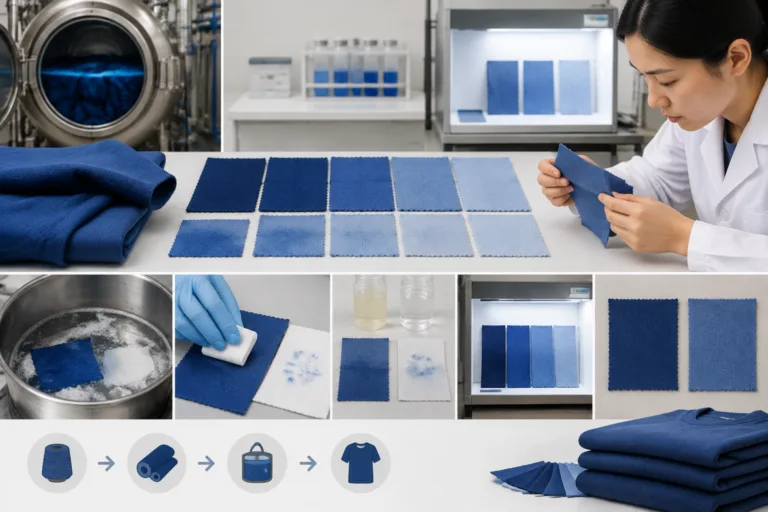
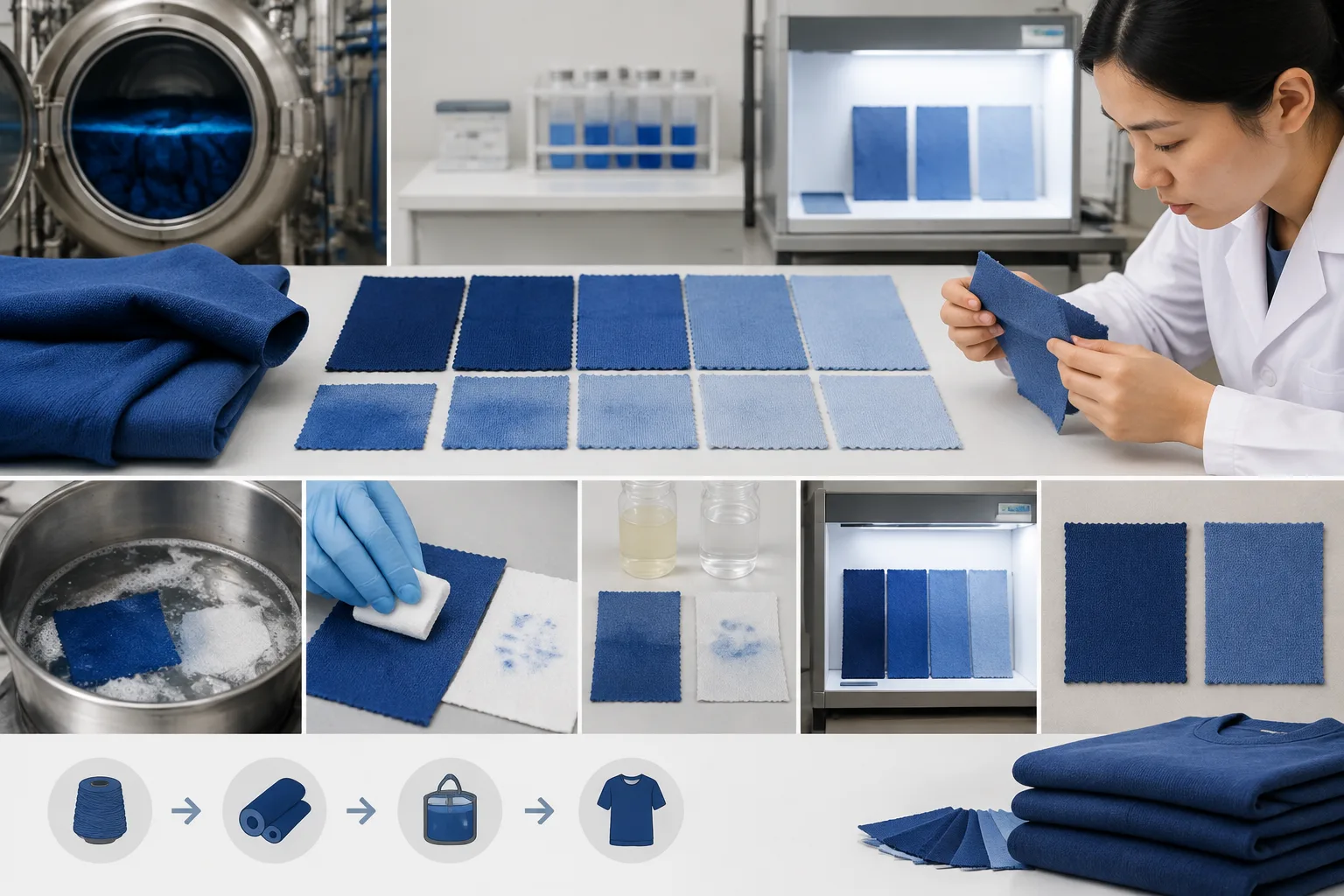
Verification should reproduce the exposure that created the commercial risk. A laundering concern calls for a relevant wash-fastness evaluation, while a fabric that transfers color during handling may require dry or wet rubbing assessment. Perspiration, water, light, and contact with adjacent materials represent different challenges. The right jet dyeing colorfastness testing plan therefore begins with the product’s intended use and the observed failure, not with a generic request to “test fastness.”
Before comparing samples, define the material set, exposure or laundering condition, rating method, and reporting format. Assess shade change separately from staining when the selected method calls for both observations. A fabric can retain a broadly similar appearance while transferring color to another material, or show shade change without causing meaningful staining. These are different findings and may require different corrective actions.
Where practical, test an untreated reference, the current production sample, and the trial-process sample together. Use retained samples and the same preparation and evaluation conditions for each comparison. Internal screening can help identify a direction, but it does not automatically replace formal customer, compliance, or release testing. When the result affects a claim, a customer requirement, a restricted-substance decision, or lot release, use an independent or otherwise qualified laboratory appropriate to the requirement.
A test result supports a conclusion only within its defined method and conditions. Passing one wash-fastness evaluation does not establish performance under rubbing, perspiration, light, or every consumer care situation. Record the method, specimen, exposure, evaluation property, and result so later decisions do not rely on an unexplained score.
Use a Practical Corrective-Action Decision Framework
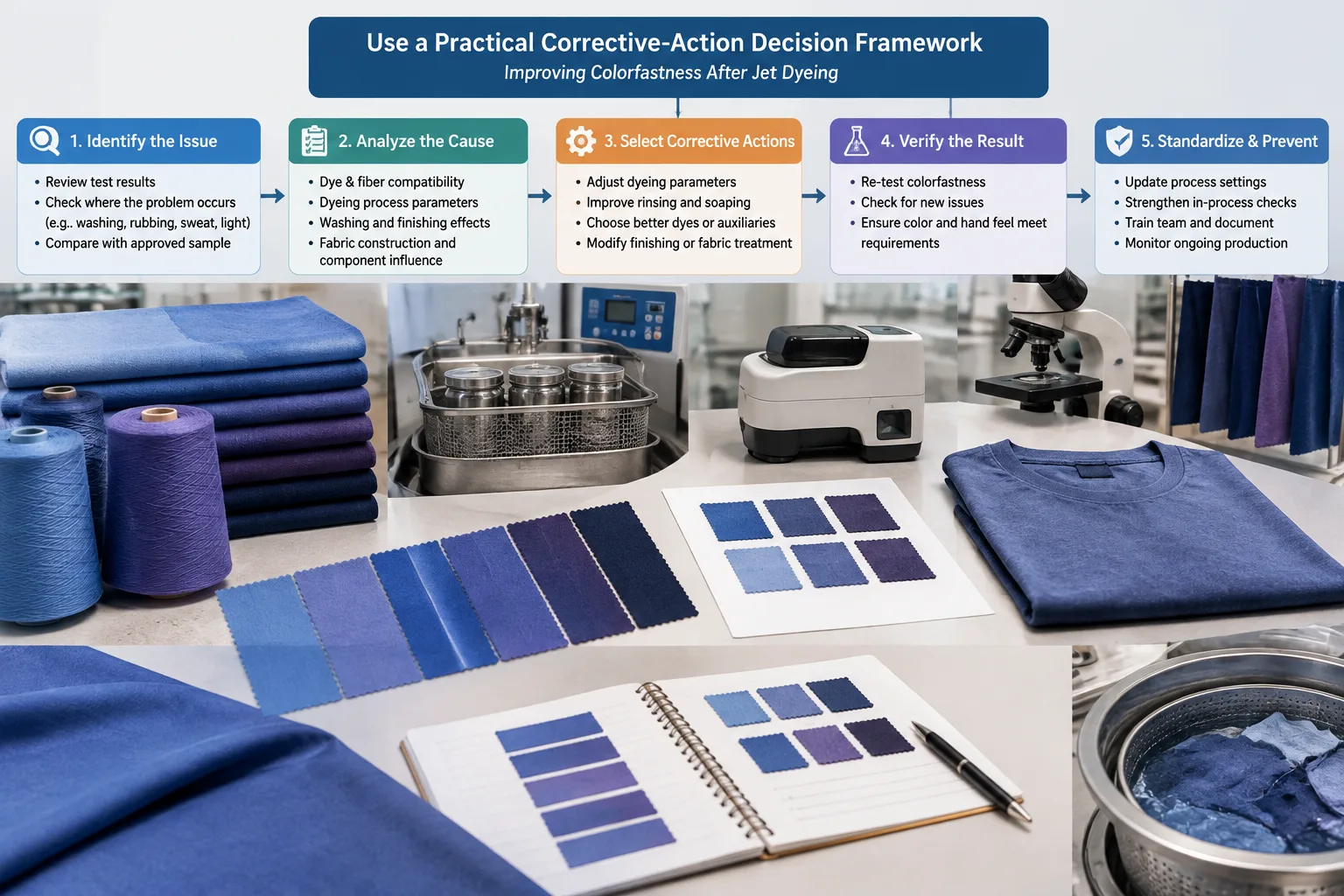
A repeatable workflow helps sourcing, quality, and production teams make a process change without confusing a plausible explanation with a confirmed root cause. Start by defining the failed property and affected lot. Then confirm the approved comparison standard, lighting, specimen preparation, and evaluation conditions. This prevents a measurement disagreement from being treated as a dyeing defect.
- Review the material, dyeing, rinsing, after-treatment, finishing, and handling records.
- List competing hypotheses involving material variation, chemistry, equipment, operating practice, care, and measurement.
- Choose the smallest controlled trial that can distinguish between the leading explanations.
- Test the specific failed property using comparable reference and trial samples.
- Approve, reject, or escalate the change based on documented evidence.
A compact decision matrix can keep the investigation focused:
| Observed symptom | Investigation direction |
|---|---|
| Surface staining or color transfer | Review fixation, washing-off, surface deposition, and finishing effects. |
| Wet or dry rubbing failure | Check surface color, fabric construction, moisture condition, and handling exposure. |
| Shade change after laundering | Review dye-fiber behavior, care exposure, washing-off, and the selected test condition. |
| Variation between lots | Compare material, loading, process history, dosing, bath control, and sampling records. |
| Light-exposure failure | Review the dye system, shade, end use, and the specified light evaluation. |
The matrix identifies useful directions; it does not prove a cause. Any correction must also be checked for changes in shade, handle, dimensional stability, appearance, absorbency, and other required properties. Record the selected change, assumptions, evidence, production scope, and monitoring plan. A controlled trial should be confirmed by the dye house or textile chemist before a full-lot adjustment.
Know When Improvement Has Reached Its Practical Limit
Post-dye correction cannot solve every colorfastness problem. The practical limit may be set by fiber-dye compatibility, a deep or difficult shade, fabric construction, previous processing damage, or the demands of the intended end use. An after-treatment may improve one property while changing handle, shade, absorbency, appearance, or later care behavior. Reprocessing can also introduce new variation, so it should be treated as a project-specific decision rather than an automatic remedy.
Separate process correction from product redesign. If repeated trials do not isolate the cause, consider whether the fiber choice, dye system, fabric construction, garment design, or care instruction needs review. Escalation is also appropriate when the required performance conflicts with appearance, hand, safety, compliance, or a documented customer expectation.
Apparel Wiki is an independent educational publication, not a dye house, manufacturer, testing laboratory, or certifier. This guide cannot establish whether a particular lot should be released or reprocessed. Retain representative samples, confirm the required test, consult the responsible dye house or qualified laboratory, validate a controlled trial, and update the production specification when the evidence supports a change.
Why can fabric have poor colorfastness after jet dyeing?
Possible contributors include fiber-dye incompatibility, incomplete fixation, residual surface color, insufficient washing-off, material variation, process variation, finishing effects, or measurement conditions. Jet dyeing may be part of the process history without being the sole root cause. The failure must be described by property, exposure, location, and lot before selecting a correction.
Can better washing-off improve jet dyeing colorfastness?
It can improve some problems associated with unfixed or loosely held surface color, but the result depends on the fiber, dye system, shade, and existing process. Washing-off is not a universal solution for rubbing, light, or every laundering failure. Compare controlled samples and verify the specific failed property before approving a change.
Which colorfastness tests should be used after jet dyeing?
Select tests that match the product risk and observed failure, such as laundering, wet or dry rubbing, perspiration, water, light, or contact staining. Define the method, specimen, exposure, rating approach, and acceptance requirement before testing. A qualified laboratory can help when the result affects a formal customer, compliance, or release decision.
Does a successful wash-fastness result prove that rubbing fastness will also pass?
No. Washing and rubbing apply different exposures and can reveal different weaknesses. Shade change and staining may also behave differently within the same evaluation. A wash-fastness result is evidence for that defined test, not proof of every other colorfastness property.
How should a failed colorfastness lot be investigated before reprocessing?
Identify the failed property, affected lot, comparison standard, and evaluation conditions. Retain samples and review material, recipe, machine, temperature, pH, dosing, rinsing, after-treatment, finishing, and handling records where available. Keep competing hypotheses, run the smallest useful controlled trial, and test the relevant property before deciding whether reprocessing is justified.
When should a dye house or textile testing laboratory be involved?
Involve specialist support when the cause remains unclear, trials conflict, chemical treatment is being considered, or the result affects safety, compliance, a customer claim, or lot release. Specialist review is also useful when improvement appears to trade off against shade, handle, absorbency, appearance, or dimensional stability.