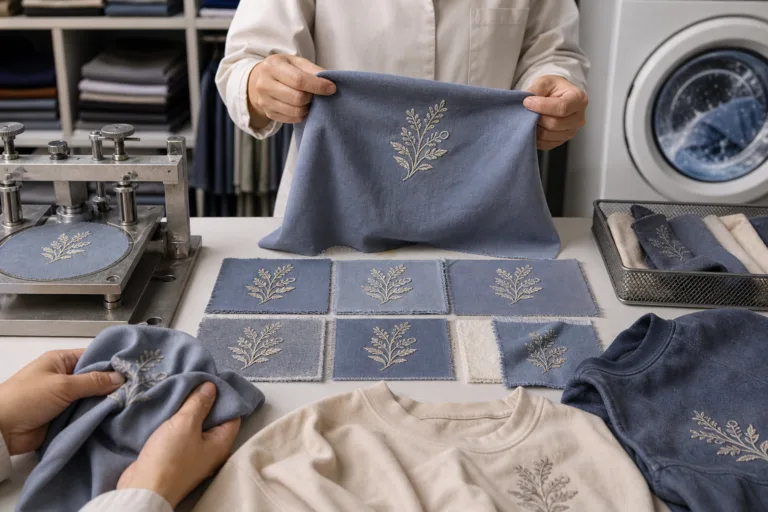
Running stitch embroidery sample approval confirms that a physical embroidery sample matches the approved artwork and is suitable for the intended garment, material, placement, and use before bulk production begins. In practical terms, running stitch embroidery uses a continuous or near-continuous line of thread to trace a design, drawing, outline, or detail. Approval is a documented production decision based on the actual sample, not simply on a digital file or attractive photograph.
Apparel Wiki is an independent educational publication, and its editorial guidance is separate from manufacturer, factory, testing-laboratory, and service-provider roles. For transparency about editorial independence, see our Sponsor information. A sample that looks appealing can still require revision if its placement, material behavior, back-side construction, comfort, or repeatability remains unresolved.
What Does Running Stitch Embroidery Sample Approval Confirm?
The approval question is whether this specific sample represents the agreed production result closely enough to authorize the next stage. Review it against the approved artwork, embroidery file revision, thread information, target garment or fabric, placement reference, and applicable buyer or project expectations.
That comparison should cover more than motif recognition. Confirm the design’s shape, proportions, orientation, color assignment, line behavior, and visible details. Then consider how the embroidery interacts with the material: whether the fabric pulls, puckers, distorts, or becomes uncomfortably stiff, and whether the reverse side creates bulk or friction.
Acceptance criteria are project-dependent. A small chest motif, a large back graphic, a detail on stretch fabric, and an embroidery placed next to the skin may require different review priorities. Approval also does not, by itself, prove durability, colorfastness, safety, regulatory compliance, or the outcome of a formal laboratory test. Where a specified test is required, the relevant method and evidence must be handled separately.
Compare the Sample With the Approved Design and Placement
Start with identity and placement before judging fine stitch quality. Make sure the sample is being compared with the correct artwork and file revision. Record the garment size, panel, orientation, and sample version so a later review does not accidentally use an outdated reference.
- Artwork: Compare the motif shape, proportions, line continuity, orientation, color assignment, and any small details or omissions.
- Placement: Confirm the intended panel, position, scale, and relationship to seams, edges, pockets, closures, or other design features.
- Material context: Review the embroidery on the actual garment panel or fabric construction whenever possible, rather than relying only on a separate test swatch.
- Reference control: Photograph or mark the approved reference so design, production, and quality reviewers share the same visual baseline.
Placement should be measured or otherwise verified using the project’s technical reference. There is no universal placement tolerance that applies to every garment. The acceptable variation depends on the buyer specification, garment construction, design intent, and end use. If no numeric tolerance has been agreed, record the observed position and obtain a project decision rather than presenting a general value as a mandatory rule.
Inspect Stitch Continuity, Coverage, and Surface Appearance
Once the artwork and placement are confirmed, inspect the front of the sample at normal viewing distance and then close up. These two views answer different questions: normal viewing shows whether the design reads correctly as a finished garment detail, while close inspection helps locate specific construction or thread problems.
Look for broken or visibly interrupted lines, unintended gaps, loose thread, skipped areas, uneven line weight, and irregular endpoints. Follow curves and corners carefully. Starts and stops should reproduce the intended drawing without obvious distortion, abrupt changes, or stray marks. Compare the thread coverage and surface appearance with the approved reference while allowing for the texture and structure of the fabric.
Use consistent inspection conditions within the project so samples can be compared fairly. The required lighting, viewing distance, and magnification, if any, should follow the buyer’s procedure or agreed quality reference. Do not assume that every gap, line variation, or thread tail is universally unacceptable; design scale, fabric, brand standard, and placement all affect the decision.
Record each observation at its location and describe the required correction. “Failed” is usually less useful than a note such as “interrupted line at the upper curve” or “loose tail visible near the lower endpoint.” A precise record helps the next sample answer the actual problem and prevents a general visual comment from being interpreted in several ways.
Check the Fabric, Support, and Embroidery Back Side
The same embroidery file can behave differently on different fabrics and garment locations. Treat the file as a production program that may need adjustment for the real material; a graphic or digitized file is not automatically a production-ready result. Sample approval should therefore retain the file revision together with the fabric or garment combination used for review.
Inspect the area around the embroidery for puckering, pulling, distortion, tunneling, unwanted holes, or other changes to the surrounding fabric. Consider the interaction of fabric stability, stretch, garment construction, hooping, support materials, needle and thread choices, and machine settings. These factors can interact, so changing one setting is not a universal solution for every visible problem.
Turn the sample over. Check for exposed or loose threads, backing edges, thread tails, bulky layers, and areas that may rub the wearer. For stretch or close-to-skin locations, handle and move the intended garment rather than judging only from a front photograph. Assess whether the embroidery remains reasonably soft, allows the material to move and recover as intended, and avoids creating an obvious source of friction or bulk.
If the sample uses a different material, support arrangement, or file revision from the intended production setup, document that difference clearly. A positive result on a test swatch may not represent the final garment. When the material interaction or reverse-side condition is unresolved, hold approval or request a revised sample before authorizing bulk work.
Evaluate Wear, Washing, and Intended Use Before Approval
A front-view inspection does not show how embroidery behaves during movement or everyday care. Where relevant, handle or wear the sample at its intended garment location. Check whether the stitched area feels unusually stiff, bulky, rough, or restrictive, and observe whether the fabric stretches and recovers as expected. This is especially important for close-to-skin areas, flexible garments, and placements that bend repeatedly.
Consider the garment’s actual use rather than applying the same review to every project. A decorative motif on a stable outer layer may need a different evaluation from embroidery on stretch fabric, sleepwear, active apparel, or a frequently handled accessory. The care instructions, finishing process, fabric behavior, placement, and buyer requirements should guide whether a practical wear review or additional evidence is appropriate.
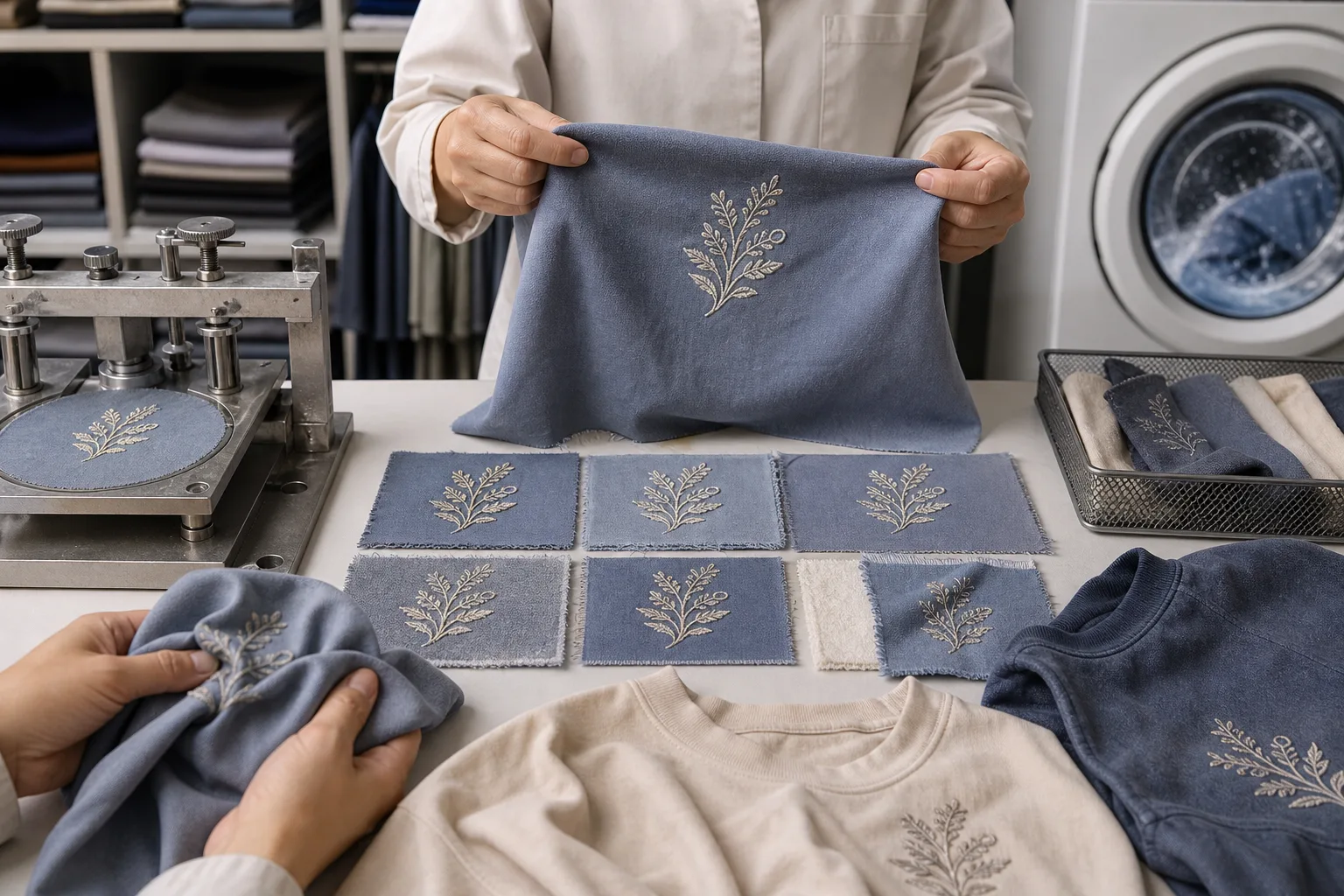
If laundering or normal use could change the embroidery or the surrounding fabric, define the relevant evaluation before bulk authorization. Record the condition of the sample before and after the review, including changes in appearance, puckering, thread condition, hand feel, movement, and surrounding material. An internal wash check can reveal a risk, but it is not automatically a formal test result, certification, or proof of compliance.
When the intended use creates unresolved questions about durability, colorfastness, dimensional change, abrasion, or safety, refer to the applicable project requirement and validated test method. Do not assume that an attractive pre-production sample demonstrates every performance characteristic needed for the finished garment. Hold approval or request a revised sample when the evidence does not match the use case.
Document Corrections and Decide Whether to Release Bulk Production
Approval should be traceable to one identifiable sample and one set of production references. Record the sample identifier, garment size or fabric, panel and placement, embroidery file revision, thread information where relevant, inspection date, and reviewer. Keep photographs or marked references with the record so later comments are compared with the same visual baseline.
Organize observations into useful categories: artwork, placement, front appearance, fabric interaction, back-side condition, wear, care, and unresolved risks. Describe each issue by location and observable condition rather than writing only “fails” or “needs improvement.” A specific note such as a distorted curve, exposed backing at a particular edge, or bulk felt at the intended wear position gives the next reviewer a workable correction target.
Correction instructions may involve the artwork path, placement, support approach, or material setup. The appropriate response depends on the design and fabric combination, so one adjustment should not be treated as a universal solution. If a correction could change the appearance, comfort, fabric distortion, or repeatability of the embroidery, request a revised physical sample before release.
The final status should be explicit. “Approved” means the sample has been checked against the applicable references and is released for the defined production purpose. “Conditionally approved” should identify the exact limits, open evidence, or agreed conditions, along with who accepted them. “Revise” means a correction and further review are required. “On hold” means bulk work should not proceed until the unresolved issue or requested evidence has been addressed.
Use the project’s technical package, approved artwork, buyer quality requirements, and applicable test requirements as the decision basis. Apparel Wiki’s Apparel Manufacturing Tools can support production learning, but an educational checklist does not replace a buyer specification, laboratory report, contractual requirement, or legal determination.
Running Stitch Embroidery Sample Approval Checklist
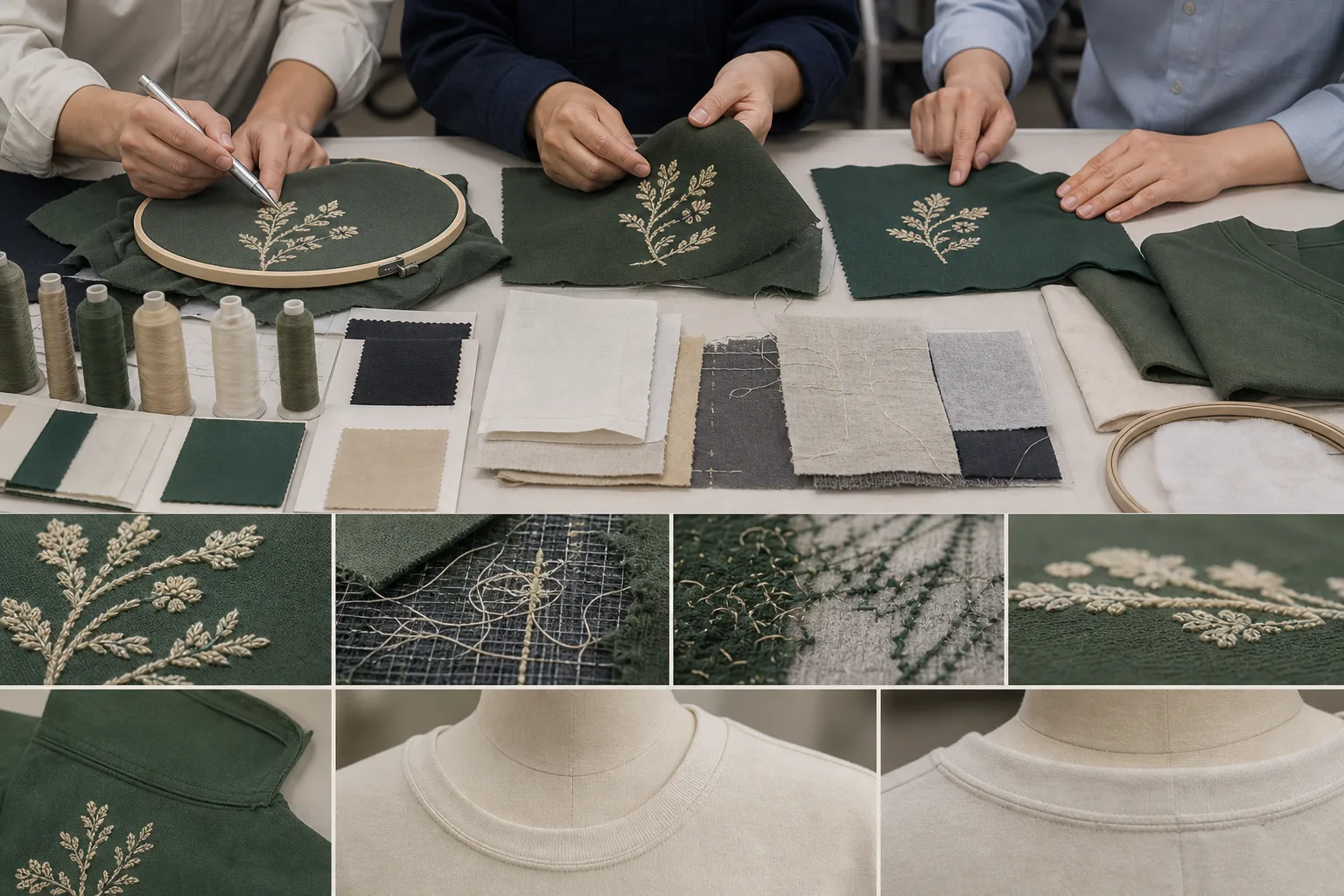
Use this checklist to structure a review, then adapt it to the garment, fabric, design, and intended use. It is a practical editorial tool, not an industry-wide certification system or a substitute for project-specific acceptance criteria.
- Design: Confirm the artwork version, motif proportions, line continuity, color assignment, starts, stops, curves, corners, and visible omissions.
- Placement: Verify the correct garment panel, orientation, location, scale, and comparison with the approved reference.
- Surface: Look for gaps, loose thread, skipped areas, uneven appearance, distortion, puckering, unintended marks, and irregular endpoints.
- Material: Review the actual garment or fabric, including stretch behavior, support, hooping effects, and changes to the surrounding material.
- Back side and wear: Check backing edges, thread tails, loose threads, bulk, friction, softness, movement, and concerns related to the intended wearer.
- Care and use: Decide whether handling, wearing, laundering, finishing, or another project-specific evaluation is needed before release.
- Evidence and decision: Save photographs, comments, sample and file revisions, correction status, re-sample requirements, and the final approval decision.
As a next step, turn the completed review into a controlled sample record that production and quality teams can use later. The goal is not to approve a picture in isolation, but to approve a defined embroidery result on a defined material, with its limitations and remaining conditions clearly understood.
Can a running stitch embroidery file be approved without seeing a physical sample?
A file can be reviewed for artwork and digitizing intent, but it does not prove how the embroidery will look or behave on the intended garment. Physical sample approval is needed when material interaction, placement, comfort, or production repeatability remains relevant.
What should be checked first on a running stitch embroidery sample?
Start with the controlled reference: artwork version, garment panel, orientation, placement, scale, and color assignment. Once those match, inspect stitch continuity, surface appearance, fabric interaction, and the back side.
Why can embroidery look correct on paper but distort on the garment fabric?
The physical result depends on the interaction between the embroidery program, fabric stability, stretch, construction, support, hooping, needle and thread choices, and machine setup. A flat graphic cannot show all of those conditions.
Should the back side of embroidery be included in sample approval?
Yes, particularly when the reverse side can affect friction, softness, bulk, movement, or the wearer’s contact with the garment. Inspect backing edges, thread tails, loose threads, and bulky areas rather than relying only on a front photograph.
When should an embroidery sample be washed or worn before bulk production?
Consider it when the garment will be worn in movement, laundered regularly, placed against the skin, or made from a fabric likely to change during use or care. The required evaluation depends on the project and should follow applicable requirements.
What does conditional approval mean for embroidery bulk production?
It means production may proceed only within clearly stated and accepted conditions. The record should identify what remains limited, pending, or required, and who accepted that status. Vague conditional approval should not conceal unresolved appearance, material, comfort, or repeatability risks.