Underwear shrinkage balance is the controlled relationship between dimensional changes in different fabric directions, garment areas, components, and care conditions. The aim is predictable fit and appearance after care—not necessarily zero change. A useful specification connects those changes to the garment’s intended fit, materials, construction, size range, and care instructions. Apparel Wiki is an independent educational publication; its Sponsor page describes the distinction between sponsorship and editorial control.
The phrase is best treated as a practical product-development concept, not a universal standard term with one industry-wide limit. Textile dimensional change can include shrinkage or growth, so a single overall figure may not reveal whether a garment remains balanced. Technical background on textile dimensional change and shrinkage measurement likewise emphasizes the relevance of specified conditions. The product team still needs to decide which changes matter for its design.
What Does Underwear Shrinkage Balance Mean?
In an underwear shrinkage specification, “balance” describes how dimensional change relates across the product. That may mean comparing length with width, one knit direction with another, or the behavior of the body fabric with that of an elastic waistband, gusset, seam, or bonded area. The relevant comparison depends on how the underwear is constructed and how it is expected to fit.
Overall shrinkage and shrinkage imbalance are related but different concerns. A fabric may change in size yet remain usable if the finished garment still meets its intended fit and appearance. Imbalance becomes a concern when changes differ by direction or component enough to distort proportions, shift seams, alter openings, or affect coverage and comfort. Stretch recovery also matters: a garment can change in use or after care without the change being captured by a simple length-and-width comparison.
There is no universal pass-or-fail percentage that defines acceptable underwear shrinkage balance for every product. A project’s requirement should reflect its fiber content, fabric construction and finishing, garment size range, care instructions, and fit target. In practical terms, ask whether the approved garment remains acceptably shaped and wearable under the care conditions it is intended to withstand.
Why Shrinkage Balance Matters for Underwear Fit and Comfort
Underwear is worn close to the body, so relatively localized changes may affect fit even if the main fabric’s average dimensional change appears acceptable. A change in body length can affect rise or coverage; a change around an opening can affect the waist or leg fit; and a shifted seam can change where the garment sits. These are design risks to check, not proof that a particular material or construction will fail.
Map the garment’s function before deciding what to inspect. A close-fitting brief, for example, may rely on the relationship between body length, leg openings, waistband, and gusset. A stretch-dependent support area may need attention to both extension and recovery. The same logic applies to other underwear styles: evaluate movement, support, coverage, and care in the context of the actual garment, rather than assuming the category name alone determines testing needs.
Pay particular attention to waistbands, leg openings, gussets, elasticated or bonded zones, and seams. The main fabric, elastic, thread, labels, tapes, and other attachments may respond differently to care or finishing. That mismatch could contribute to puckering, a pulled seam, a wavy opening, or a changed fit, but the visible symptom does not identify the cause by itself. Component tests can help screen materials; final garment behavior is the more relevant decision point.
Which Variables Should Be Included in the Specification?
A useful underwear shrinkage specification identifies the product and conditions it applies to, so a result can be traced to an approved design rather than read as a free-standing number. Before choosing targets, record the variables that may affect either the measurement or its significance:
- Material: fiber content, knit or woven structure, relevant fabric weight, stretch direction, and finishing history.
- Measurement: the applicable directions—such as length, width, course, or wale—and the garment points that matter to fit.
- Construction: size, seams, elastic type and placement, gusset, labels, tapes, bonds, and other relevant attachments.
- Evaluation setup: whether the sample is fabric, a component, or a finished garment; the specified care and drying conditions; and the measurement method and timing.
- Decision rules: project targets and, where the quality system uses them, separate alert and acceptance limits.
Care conditions should be tied to the product’s intended care instructions. The specification should also make clear whether it states a brand or buyer requirement, describes a test procedure, or sets a manufacturing control. These are connected but not interchangeable: the requirement defines what the project expects, while the test procedure explains how results are obtained. Do not treat an unverified cycle count, conditioning period, or tolerance as universal practice.
How to Evaluate Shrinkage Balance Before Production
Begin with the intended use, approved fit block, size range, and care instructions. Map the measurements that determine fit and appearance, then identify areas exposed to high stretch, pressure, friction, or coverage needs. This narrows the review to the features that matter for the specific style instead of relying on one average fabric result.
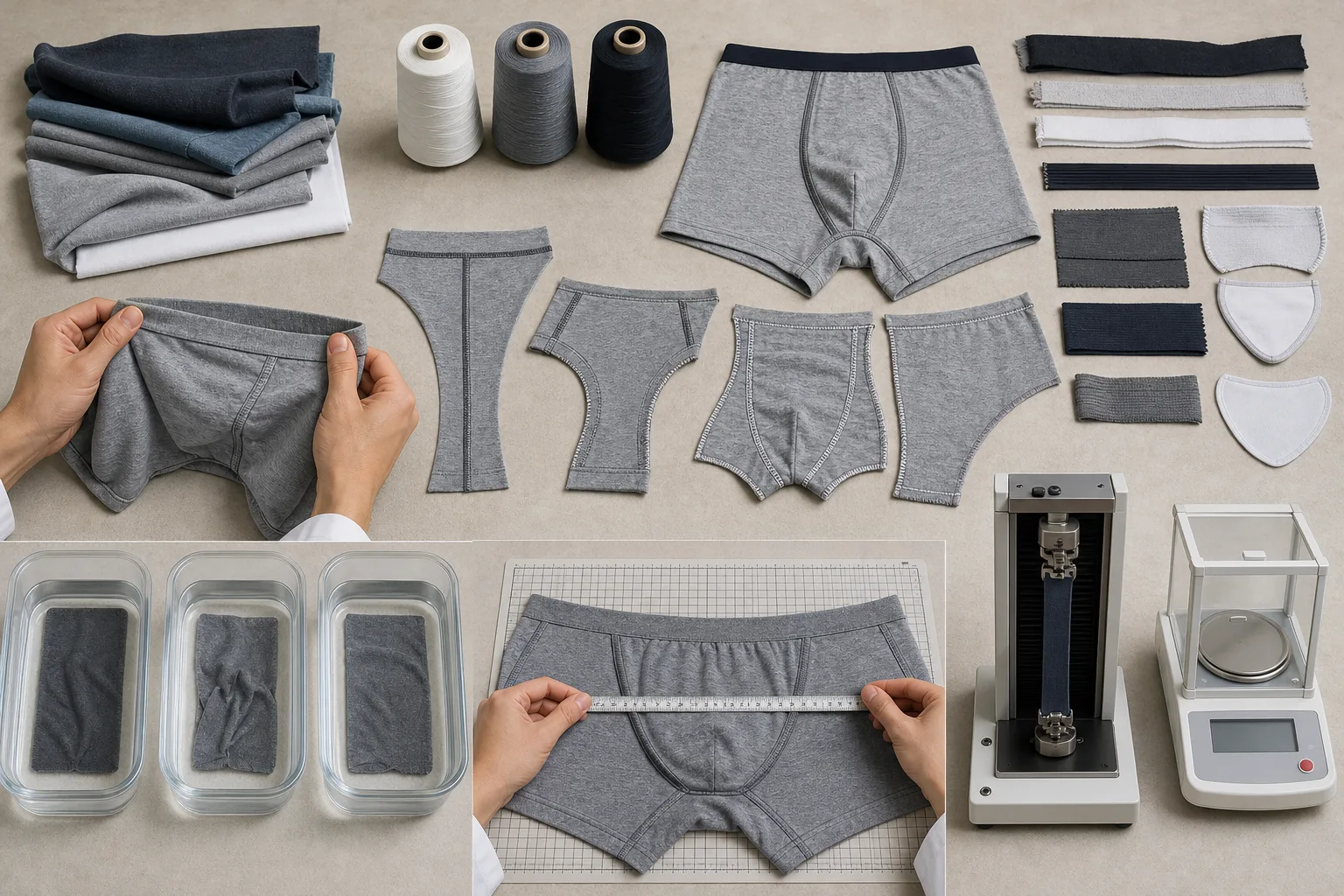
Evaluate representative material in relevant directions, then assess a sample made with the intended construction: seams, elastics, thread, labels, finishing, and other attachments. A fabric or component check can isolate a concern, but it cannot establish that the assembled garment behaves well. Where practical and appropriate to the material, compare the garment before and after the specified care process.
Review changes by direction and component, not just as one combined figure. Check critical measurements, opening dimensions, shape, seam alignment, appearance, and stretch recovery as relevant to the design. Consider fit in the intended use context as well; measurements alone may not explain whether coverage or support has changed. The suitable care setup and measurement procedure depend on material and construction, so this workflow is a development guide, not a substitute for a qualified laboratory procedure.
Repeat or expand evaluation when a meaningful input changes—for example, the material lot, supplier, finishing route, construction, or care instruction. Keep the sample identity and conditions with the results so the team can distinguish a product change from a change in how it was evaluated.
How to Interpret Uneven Results and Choose a Corrective Action
Start by locating the change: compare measurements by direction and garment area with the original sample and approved pattern. A change concentrated in the body length may affect rise or coverage differently from a change at the waist or leg opening. An overall average can conceal these differences, so interpret each result in relation to the garment feature it may affect.
Uneven results do not identify their own cause. Fabric dimensional change may be involved, but so may relaxation, loss of stretch recovery, seam or elastic behavior, finishing variation, or measurement inconsistency. Review the sample identity, care and drying conditions, measurement method, and construction before concluding that the material or pattern is responsible. If the source is unclear, repeat or extend the evaluation rather than treating an uncertain result as a confirmed diagnosis.
Possible corrective actions are hypotheses to verify. Depending on the evidence, a team might review the material or finishing route, improve control of relaxation and spreading, revise a pattern, or adjust seam and elastic construction. Pattern changes may compensate for a predictable behavior, but they do not necessarily resolve variation between lots or a mismatch between components. Any change should be checked on representative finished garments, including relevant sizes and care conditions.
Care instructions are a separate consumer-care decision, not a shortcut for hiding unresolved performance issues. Any revision must reflect the product and applicable market requirements. Keep process control, design compensation, and consumer information distinct in the investigation record.

How to Set a Practical Underwear Shrinkage Balance Requirement
Define the intended post-care fit and appearance before writing a dimensional-change target. Identify the measurements that matter to that outcome, such as body length, rise, waist opening, leg opening, or gusset dimensions, as appropriate to the design. The requirement should state how results are evaluated and which changes trigger review or rejection under the product’s own approved quality system.
Where one overall result could hide a local fit risk, specify direction- and component-specific checks. Link the requirement to the approved material, construction, size range, care route, and intended use. A close-fitting style with stretch-dependent support may need different priorities from a looser design; neither the garment category nor a single fabric result determines the appropriate target.
Keep the product requirement separate from the test procedure. The requirement describes what the project expects; the test method describes how a sample is prepared, cared for, measured, and assessed. Avoid treating a test method as proof that a particular tolerance is suitable. There is no single shrinkage limit that can be assumed to apply to every underwear product.
For traceability, record the requirement’s revision, sample and material identity, construction, test conditions, measurement points, results, interpretation, disposition, and approval authority. If the quality system uses target, alert, and acceptance limits, define each for that product and explain how the team responds when results fall outside the intended range.
Limitations, Release Checks, and Next Steps
A fabric test, one garment size, one care condition, or one production lot cannot represent every finished product outcome. Component checks help isolate questions, but they do not establish that assembled underwear will retain its intended fit. Results apply to the samples and conditions evaluated; changes in materials or construction may make prior conclusions less relevant.
Before release, confirm that the approved material and garment construction match the tested sample; critical measurements and care conditions are identified; the test record is complete; results have been interpreted against the product requirement; and any corrective action has been verified and approved. Retain the record with the sample and revision history. Review the decision when the fiber blend, supplier, finishing, elastic, thread, pattern, seam method, size range, or care instruction changes.
Apparel Wiki is an independent clothing-industry knowledge publication, not a manufacturer or testing service. For a practical next step, define the care scenario, map the critical measurements, evaluate representative finished construction, and document the decision. Readers can also explore the Apparel Manufacturing Tools directory for related educational resources.
Frequently Asked Questions
Is underwear shrinkage balance the same as zero shrinkage?
No. It describes whether dimensional changes across directions and components remain compatible with the product’s intended fit and appearance. Some change may occur without causing an unacceptable result.
Should underwear shrinkage be tested on fabric or on the finished garment?
Fabric testing can help assess the material, but finished-garment evaluation shows how the material interacts with seams, elastics, and attachments. The suitable approach depends on the question; component results alone do not establish garment performance.
Which underwear measurements are most important after washing?
Choose measurements based on the design and fit target. Common review points include body length, rise, waist and leg openings, gusset dimensions, coverage, and seam alignment where relevant.
How do elastics and gussets affect shrinkage balance?
They may respond differently from the main fabric and influence openings, fit, or local shape. Their effects should be assessed as part of the intended garment construction rather than inferred from fabric results alone.
Can pattern adjustments compensate for uneven underwear shrinkage?
Sometimes, when the behavior is understood and consistent. A pattern change may not address lot variation or mismatched components, so confirm it on finished garments after the relevant care process.
When should an underwear shrinkage test be repeated?
Review testing when a material, supplier, finishing route, component, construction, size range, or care instruction changes. Repeat or expand evaluation when existing results no longer represent the product being approved.