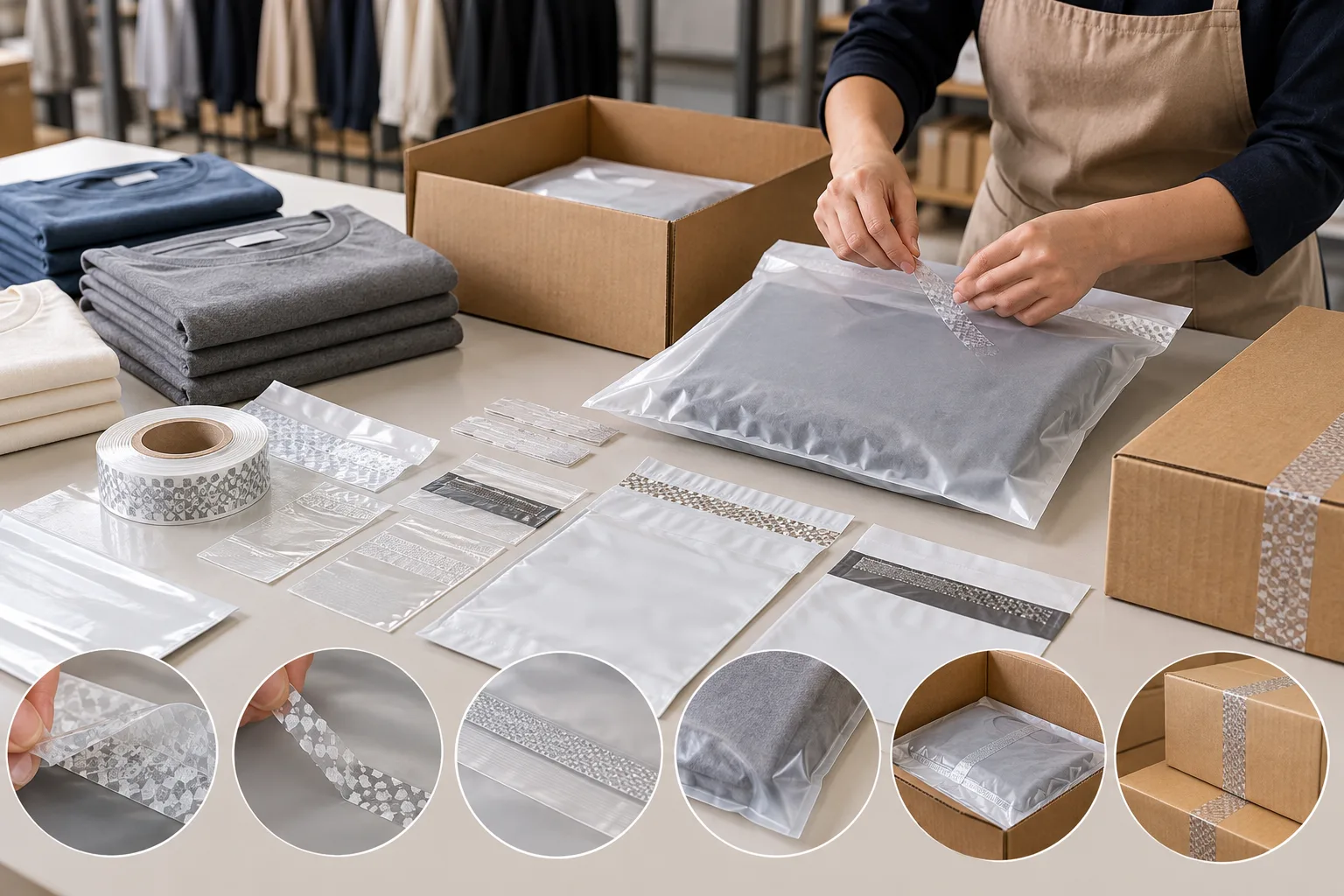
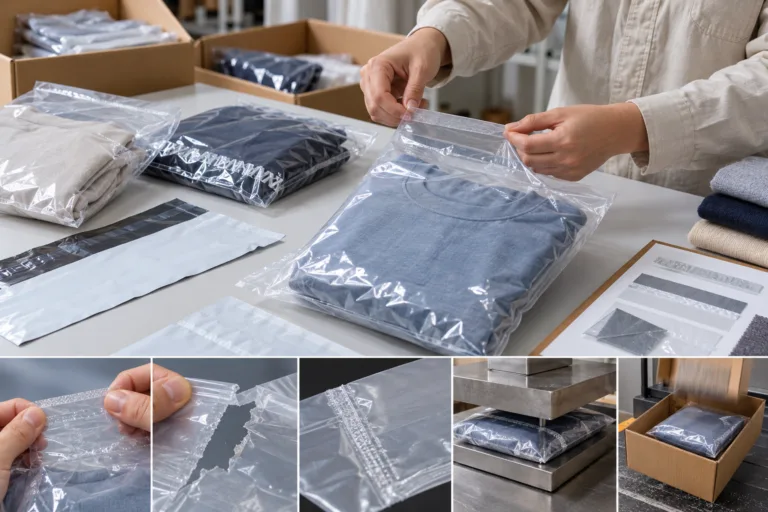
A useful tamper-evident packaging specification for apparel should define the protected item, the access or handling risk, the expected evidence of interference, the closure method, the packaging level, and the inspection process. Tamper-evident packaging is designed so that opening, removal, or interference creates visible evidence or otherwise changes the package condition. It can reveal that access may have occurred, but it does not guarantee prevention of opening, theft, substitution, damage, or contamination.
Apparel Wiki is an independent apparel industry knowledge publication, not a packaging manufacturer, testing laboratory, or service provider. Its Sponsor information should not be read as control over editorial guidance. The practical approach below is to turn a general request for tamper evidence into a documented packaging brief that connects the garment, route, handling process, and response to an observed problem.
What tamper-evident packaging means for apparel
In an apparel context, tamper-evident packaging is a package or closure intended to show that it has been opened, removed, disturbed, or otherwise interfered with. The signal might be a broken seal, a torn feature, an altered closure, visible damage, or another package change that an operator can recognize. The brief should describe the intended signal in plain terms instead of merely asking for “secure packaging.”
The distinction matters because evidence is not the same as prevention. A package may make interference noticeable after the event while still being physically openable. It may also protect a folded garment from dust or handling damage without providing meaningful evidence of access. Ordinary closure, tamper resistance, theft deterrence, child resistance, and product protection are related but separate functions. A brief should state which function is required and should not treat one feature as a complete security system.
Requirements can also be category- and market-specific. For example, the U.S. Food and Drug Administration discusses tamper-resistant packaging for certain over-the-counter drug products in its FDA guidance. That guidance is not an apparel requirement, but it illustrates why a rule for one product category should not be transferred to garments without checking the applicable market, buyer, retailer, or transport instructions.
For apparel, the required evidence depends on the garment, the packaging format, the route, the handling environment, the sales channel, and the risk being managed. The specification should therefore separate the design intent from project-specific performance expectations. Tamper-evident packaging is one control within a wider packing, inspection, inventory, and quality process.
Which risks and handling points should the brief identify?
Before selecting a bag, carton, label, tape, or other closure, the brief should identify where unauthorized opening or package damage could occur. Consider packing, storage, transport, returns, warehouse handling, retail handling, and customer-facing delivery as separate points. At each point, ask what could happen: unauthorized access, resealing, contamination, moisture exposure, abrasion, crushing, color transfer, or missing garment components.
These are risk categories to investigate, not universal claims about what will happen to every apparel order. Actual exposure depends on route and storage conditions. A lightweight folded shirt, a decorated garment with loose embellishments, a multipiece set, and an accessory pack may require different controls. Record sensitivities such as printed surfaces, attached trims, delicate finishes, visible presentation requirements, and the need to inspect labels or contents without unnecessary unpacking.
The operating process belongs in the brief as well as the package design. Identify who applies the closure, what equipment or instructions they use, who may legitimately open it, and what condition must be checked at each handoff. Define what an inspector should do when evidence is found. Possible dispositions include quarantine, closer inspection, repacking, documentation, or escalation to customer service or the quality team. The correct response depends on the buyer’s process and the seriousness of the suspected issue.
A practical risk-to-control record can use questions such as:
- Which package level is being protected, and at what point could access occur?
- What package change should indicate opening or interference?
- Who applies, checks, opens, and records the closure?
- What garment damage or contamination must be prevented or detected?
- What happens when the evidence is ambiguous, missing, or visible?
Adding more material does not automatically improve protection. Compare the intended control with application effort, inspection time, garment damage risk, disposal implications, and the possibility of creating a closure that operators apply inconsistently. The brief should document the intended process so that a package is judged as part of an operating system rather than as an isolated component.
What packaging construction and closure details belong in the specification?
The technical section should first identify the package unit covered: an individual garment pack, multipack, inner carton, shipping carton, return package, or another defined level. A request for a tamper-evident seal is incomplete if the reader cannot tell which opening is supposed to create evidence. State the closure location, closure method, and exact visible or detectable change expected after opening or interference.
Next, define the permitted opening behavior. Does the package need one-time opening? May an authorized inspector open and reclose it? Must returns use a new closure? Is resealing prohibited after the first closure? These decisions affect both the feature and the inspection record. They should be agreed before samples are compared.
Include the construction details that matter to the project: dimensions, fit or tolerance expectations, material structure, transparency or opacity, attachment method, and compatibility with the garment and packing equipment. Also state what must remain accessible, such as garment labels, size information, inspection points, or retail presentation features. Do not prescribe a particular film, adhesive, tape, label, bag, carton, or seal without a defined risk and evaluation basis.
Ask a proposed supplier or technical partner to describe foreseeable failure modes. Examples include a clean opening that leaves little evidence, partial seal contact, accidental activation, adhesive transfer, damage caused during application, or a signal that operators may not notice. The purpose is not to assume that every failure will occur, but to make the evaluation questions explicit.
Separate design intent from values that require confirmation through current technical data, controlled evaluation, or laboratory testing. A brief can say that evidence should remain visible after an authorized handling sequence; it should not invent a universal seal strength, environmental limit, or performance rating. Ease of correct application and clarity of the tamper signal are operational requirements, not merely appearance preferences.
How should identification and packaging levels map to the apparel order?
Tamper evidence is easier to use when it remains connected to the garment, quantity, and logistics information being checked. The brief should define which information belongs on the individual pack, inner packaging, and outer carton. Product identification and logistics-unit identification may serve different purposes, so retail and logistics codes should not be treated as interchangeable without verification.
| Packaging level | Information to define | Inspection question |
|---|---|---|
| Individual garment pack | Style or product identifier, color, size, and any required item reference | Can the contents be matched to the pack without hiding the tamper signal? |
| Inner packaging | Contents, quantity, grouping, and relevant order or handling reference | Does the inner unit accurately represent mixed or matching garments? |
| Outer carton | Carton quantity, shipment or purchase-order reference, and applicable logistics information | Can the carton be reconciled with packing records and shipment documents? |
For each level, specify label position, readability, scan needs, and whether the tamper-evident feature must remain visible after labeling or cartonization. The exact barcode, carton-mark, customs, or legal-label fields are buyer-, market-, and process-dependent; they should be verified from the applicable instructions rather than invented in a general specification.
Include a reconciliation step linking garment contents, package labels, carton marks, packing records, and shipment documents. Clarify how mixed sizes, mixed colors, sets, returns, samples, and partial cartons are identified. If a returned package may be reclosed, record who authorizes that action and how the new condition is documented. This mapping prevents a visible security feature from becoming detached from the item and quantity that the team needs to inspect and fulfill.
How should a buyer evaluate tamper-evident packaging before approval?
A supplier description or attractive sample is not enough to approve tamper-evident apparel packaging. The buyer should define how the package will be applied, inspected, opened, documented, and handled when the expected evidence appears. This creates a repeatable review process and makes the decision easier to explain to sourcing, quality, warehouse, and customer-service teams.
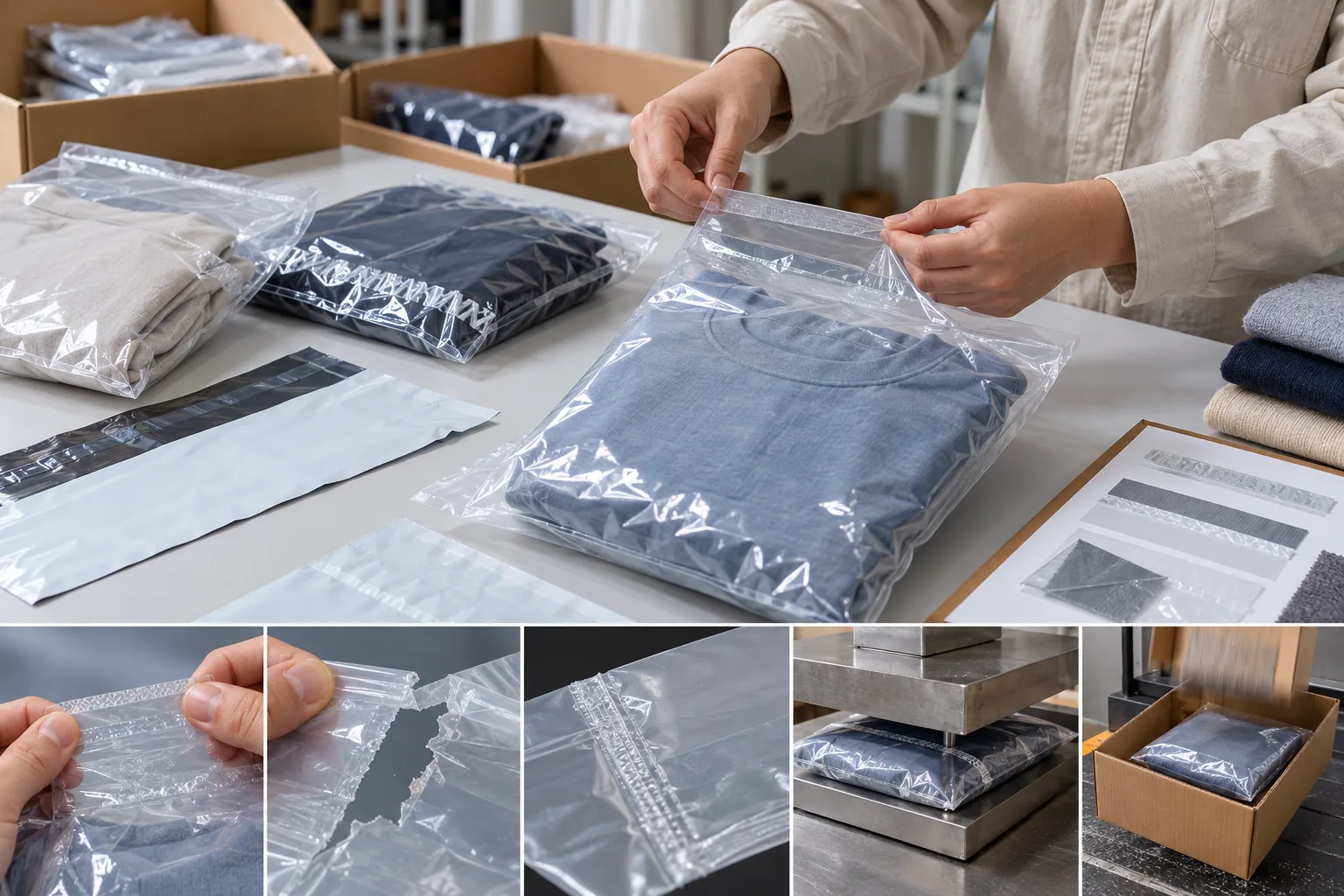
Begin with the intended operating sequence. Have an operator apply the closure to representative garment packs using the proposed instructions or equipment. Check whether the package fits the garment, whether labels and presentation details remain usable, and whether the tamper signal is visible in the closed condition. Then perform an authorized opening and record what changes, tears, separates, or otherwise becomes observable.
The review should also include an attempted opening or interference scenario that reflects the risk identified in the brief. The purpose is not to prove that the package makes access impossible. It is to determine whether the selected design produces the intended evidence and whether an inspector can recognize that evidence without relying on ambiguous interpretation. Define what happens next, such as quarantine, inspection, repacking, documentation, or escalation.
Use representative samples rather than evaluating an empty package alone. Include the actual garment format, folded dimensions, accessories, labels, inserts, and closure position where these affect application or inspection. If the route involves relevant exposure to humidity, temperature changes, abrasion, compression, or repeated handling, include those conditions in the review only when they represent the actual project. A result is meaningful within the method and conditions used; it is not automatically a universal performance claim.
Record the sample configuration, material description, application settings, storage history, operator instructions, observed failure, and final disposition. A comparison matrix can include evidence visibility, opening behavior, garment protection, application effort, inspection effort, return handling, material use, and disposal route. Keep supplier or laboratory results separate from Apparel Wiki’s editorial recommendation and from any hypothetical example used to explain the process.
What trade-offs should the brief address before final selection?
Tamper-evident packaging is a control within an apparel handling process, so the strongest-looking feature is not automatically the best choice. A brief should compare the visibility and consistency of the evidence with application speed, inspection time, package appearance, garment access, and the possibility of accidental damage or false alarms. These factors can affect warehouse work, retail presentation, returns, and customer handling.
Consider the complete route: packing, storage, transport, wholesale or retail handling, e-commerce fulfillment, inspection, and returns. One format may suit a sealed outbound shipment but make authorized inspection or reclosure difficult. Another may support returns more conveniently but require clearer documentation after the first opening. State whether separate formats or procedures are needed for different channels instead of assuming one package design serves every use.
Review how the package affects access to the garment. Staff may need to inspect labels, fold or refold the item, steam it, repair it, relabel it, or verify a returned set. The closure should not be assessed only for its security signal. The brief should also describe who may open it, whether it may be reclosed, how a changed condition is recorded, and when a package must be held for review.
Environmental claims require the same precision. Identify the exact component covered by a statement about material use, recycling, biodegradability, or disposal, along with the material composition, available facilities, and applicable region. A package with fewer components or lower weight may still create more garment damage, handling effort, or waste in a particular process. Compare those outcomes using project evidence rather than treating material reduction as proof of an improved result.
Before selection, document the decision and its assumptions. Include the route, intended package level, operational process, observed sample behavior, return scenario, and any buyer or retailer instruction that influenced the choice. This record helps prevent a later change to material, closure, label position, or application method from being treated as an equivalent change without review.
A final tamper-evident packaging brief checklist
Before requesting quotations or approving representative samples, confirm that the brief answers the following questions:
- What product and packaging level are protected: individual garment pack, multipack, inner package, outer carton, return package, or another defined unit?
- What access, interference, damage, contamination, or handling scenario is the package intended to address?
- What visible or detectable change should indicate opening or interference, and who is responsible for recognizing it?
- What are the closure construction, application method, authorized opening method, and permitted resealing rules?
- Which dimensions, materials, transparency or opacity needs, attachment method, equipment limits, and garment-compatibility requirements matter?
- Which labels, garment references, quantities, order details, carton information, and shipment references belong at each packaging level?
- Must the tamper-evident feature remain visible after labeling, cartonization, storage, or retail presentation?
- How will mixed sizes, colors, sets, samples, returns, and partial cartons be identified and documented?
- What sample procedure covers application, inspection, attempted opening, authorized opening, damage review, reclosure, quarantine, and escalation?
- What acceptance criteria, records, change-control steps, and responsible approvers apply before production use?
- Which handling, storage, transport, return, disposal, market, buyer, or retailer requirements must be verified separately?
Use the checklist as a briefing and review document, not as a universal specification for every apparel project. Mark assumptions, buyer instructions, direct-source requirements, supplier data, and editorial recommendations separately. The practical next step is to issue the completed brief, request representative samples, and approve the selected configuration against documented criteria before broader production use.
Does tamper-evident packaging prevent theft or unauthorized opening?
No. It is intended to provide evidence of opening or interference, not to guarantee prevention of theft, substitution, damage, or unauthorized access. Its value depends on the signal being created, visible, and acted upon through the operating process.
What should a tamper-evident apparel packaging brief specify first?
Start with the protected product and packaging level, the likely access or handling risk, and the evidence that should be recognized. Then define the operating response before selecting a material or closure.
Is a tamper-evident seal required on every individual garment package?
Not universally. The appropriate package level depends on the product, route, sales channel, handling process, buyer instructions, and risk being managed. A brief should justify the level rather than assume that every individual pack needs the same feature.
How can a team tell whether tampering evidence is easy to recognize?
Use representative samples and have the intended operators inspect them under normal working conditions. Record whether different reviewers reach the same conclusion and define the action required when evidence is observed.
What is the difference between tamper-evident and tamper-resistant packaging?
Tamper-evident packaging is designed to show that opening or interference may have occurred. Tamper-resistant packaging is intended to make access more difficult or controlled. They address related but different functions and should not be treated as interchangeable terms.
How should packaging labels map across individual packs, inner cartons, and outer cartons?
Assign product, quantity, order, carton, and shipment information to the level where it is needed for inspection and fulfillment. Reconcile garment contents, labels, carton marks, packing records, and shipment documents, while keeping retail identification distinct from logistics-unit information.