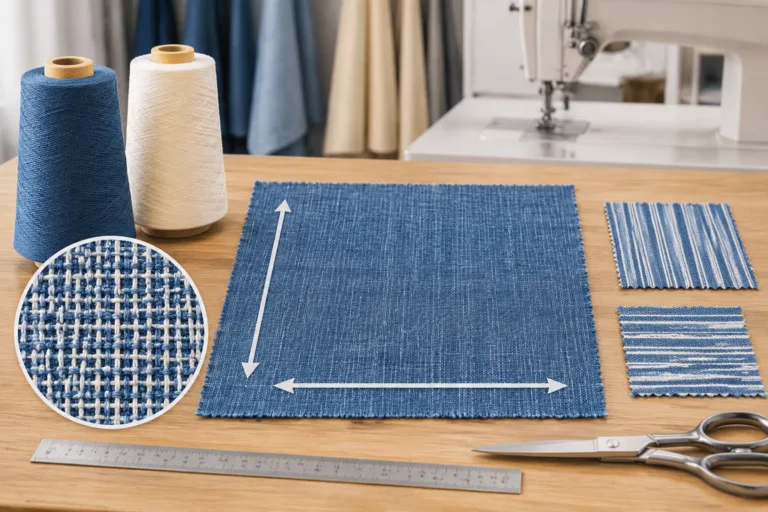
Warp and weft are the two yarn systems that interlace to form woven fabric. Warp yarns run lengthwise, while weft yarns cross them widthwise. To identify them, first look for an intact selvage, which follows the warp direction. If no selvage remains, use the known fabric length and visible yarn paths as supporting clues. A detached or finished swatch may not provide enough evidence for a confirmed answer. Apparel Wiki publishes independent educational guidance; information about publication support appears on the Sponsor page.
What Warp and Weft Mean in Woven Fabric
In woven construction, warp and weft name yarn systems and their directions. The warp is the lengthwise system. The weft is the crosswise system that passes over and under warp yarns according to the fabric’s weave. Viewed as a simple grid, warp travels from one end of the fabric length to the other, while weft travels from side to side.
These terms describe fabric construction, not fiber content. Cotton, polyester, wool, or another fiber may appear in either yarn system. Warp and weft also do not identify yarn count, yarn type, fabric weight, or a commercial fabric name. Those details belong to other levels of a textile description.
Weave and finishing are separate layers as well. A weave describes how the two systems interlace. Finishing describes treatments applied during or after fabric formation. Color, surface texture, coating, brushing, or other visible effects might make one system easier or harder to trace. They do not redefine which system is warp or weft.
The terminology applies specifically to woven fabric because weaving interlaces two directional yarn systems. Knitted fabric is formed through interconnected loops. Although a knit has identifiable production and fabric directions, treating those directions as ordinary woven warp and weft can confuse two different construction methods.
Construction can offer useful identification clues, but it does not establish performance by itself. Knowing the woven fabric directions does not prove which direction stretches more or whether the material is breathable or durable. Fiber composition, yarn properties, weave, finishing, and use conditions can all affect those characteristics.
How to Identify Warp and Weft Directions
Start with the selvage when it is present and recognizable. A selvage is the lengthwise edge formed along the sides of woven fabric. The direction running parallel to that edge is the warp direction. The direction crossing from one selvage toward the other is the weft direction.
Confirm that the edge is actually a selvage. A hemmed, sealed, trimmed, or otherwise finished cut edge can resemble one. On an irregular remnant, part of the original edge may also have been removed. An apparent edge therefore needs context before it becomes reliable evidence.
If the selvage is absent, check whether the fabric’s original roll orientation or length is known. A documented lengthwise reference indicates warp, while the width across the roll indicates weft. This clue becomes less certain after a piece has been rotated, recut, or detached without orientation marks.
Next, examine the interlaced yarn systems under enough light and magnification to follow their paths. Trace each system across the piece, then compare it with any reliable length or edge information. Do not assign direction from color alone. A stripe, yarn contrast, or surface effect can highlight a system, but appearance does not establish the original fabric orientation.
| Observable clue | Likely direction indicated | Confidence or limitation | What to check next |
|---|---|---|---|
| Recognizable selvage present | Parallel is warp; across is weft | Strong when the edge is an original selvage | Confirm the edge is not a finish on a cut side |
| Known fabric length or roll orientation | Length indicates warp; width indicates weft | Useful when the reference was preserved | Compare with selvage or documented orientation |
| Isolated cut swatch | Yarn paths may suggest two directions | Original length and width may be unknown | Seek swatch marks, roll records, or supplier documentation |
A trade name or familiar appearance cannot settle the question by itself. Fabrics sold under similar names may differ in yarns, weave details, finishing, and presentation. When clues conflict, record the orientation as uncertain and request the missing fabric context instead of assigning warp and weft by guesswork.
Warp vs. Weft: Clues and Their Limits
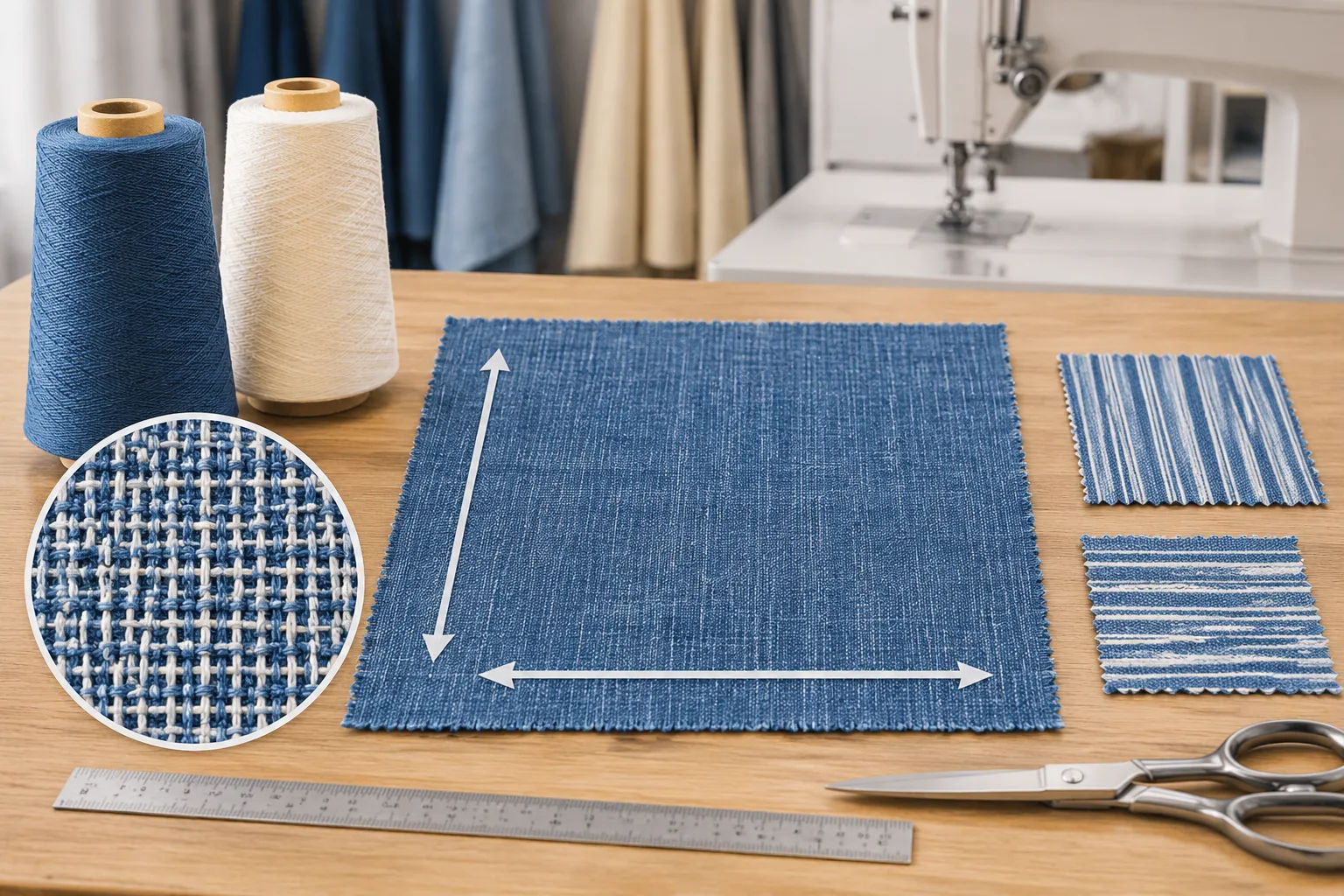
The essential difference between warp and weft is directional: warp is the lengthwise yarn system, and weft is the crosswise system. This definition does not mean warp is always stronger, tighter, smoother, or less elastic. Such characteristics vary with the yarns, construction, finishing, and other fabric details.
Selvage and known roll orientation are direct contextual clues because they connect the yarn systems to the original fabric length. Yarn appearance and spacing are secondary clues. They can help a reader trace each system when the interlacing is clear, but they cannot confirm which side of an unmarked swatch originally ran lengthwise.
A visible pattern may also assist tracing. For example, a clear line created by one yarn system can show how that system travels through the weave. However, printed artwork, surface finishing, and some woven effects can obscure or visually compete with the underlying paths. The most prominent line is not automatically the warp direction.
Stretch and hand feel are similarly limited. Pulling a swatch in both directions may reveal different behavior, but that difference is not a definitive direction test. Fiber properties, yarn structure, weave, mechanical treatments, and added finishes can influence extension and recovery. The direction that feels firmer cannot universally be labeled warp.
Small swatches create a particular problem because they may preserve construction while losing orientation context. If a piece has no selvage, roll reference, marking, or reliable documentation, examining the weave may support a plausible inference. It does not convert that inference into confirmed woven fabric grain direction.
Use wording that reflects the available evidence. “Warp runs parallel to the intact selvage” reports an identified reference. “This direction is probably warp based on the recorded roll length” states a supported inference. Where neither reference exists, name the two visible yarn systems without assigning their original lengthwise and crosswise orientation.
Using Fabric Direction in Garment Context
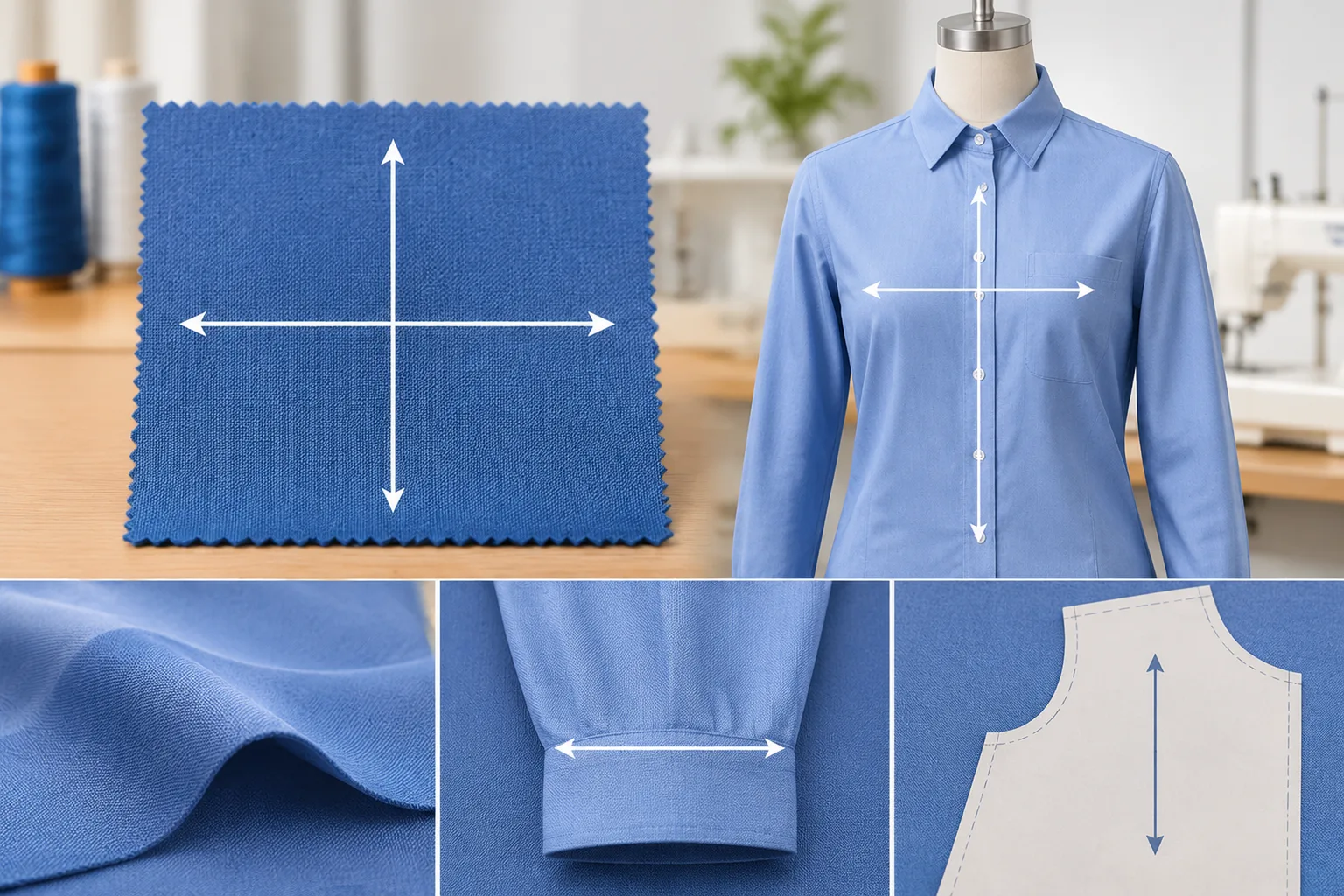
Fabric direction and garment grainline describe related but different information. Warp and weft identify the yarn systems within woven fabric. A grainline on a pattern communicates how a garment piece is intended to align with the fabric. It may follow the warp direction, but the terms are not interchangeable.
Keeping those layers separate makes instructions easier to interpret. First identify or infer the fabric’s lengthwise and crosswise references. Then state how the pattern piece should align with those references. This order avoids using “grainline” as an imprecise substitute for an observed yarn direction.
For example, suppose woven fabric arrives with an intact, recognizable selvage. The direction parallel to that selvage provides the lengthwise reference, corresponding to warp. The direction crossing from selvage to selvage corresponds to weft. Establish those references before evaluating pattern placement. A design feature, visible motif, construction requirement, or fabric-specific instruction may call for a different placement, so identifying warp does not by itself prescribe the final cutting orientation.
When orientation matters, mark it before separating a swatch from its context. A simple arrow labeled “lengthwise/warp” can preserve the reference. Add a crosswise mark when both directions need to be discussed. On a specification or swatch record, useful information includes:
- whether the selvage was present and recognizable;
- which edge or arrow represents the recorded fabric length;
- whether the direction was observed directly, supplied in documentation, or inferred;
- how the relevant pattern grainline is intended to align with that reference.
Use precise wording when the evidence has limits. “Warp direction confirmed from intact selvage” communicates a direct reference. “Probable lengthwise direction based on the marked roll orientation” reports an inference. A detached swatch with no reliable context should not acquire a confirmed label merely because one direction looks more prominent.
This documentation is especially useful when several people handle a fabric during design, pattern development, sampling, or review. The mark should remain attached to the specific swatch or specification it describes. If the piece is rotated, trimmed, or replaced, preserve enough context to keep the reference meaningful.
When Direction Is Unclear
A small, finished, rotated, or detached swatch may retain two visible yarn systems while losing the context needed to name them confidently. Before assigning warp and weft, recheck whether an original reference survives. A finished edge is not automatically a selvage, and a straight cut edge does not prove fabric length.
Inspect any labels, arrows, roll notes, pattern records, or other reliable documentation that accompanied the material. If visibility allows, trace the interlaced yarn paths and compare them with that context. Yarn spacing, appearance, stretch, and hand can support an interpretation, but none should create certainty when the original orientation is unknown.
A concise review sequence helps separate evidence from assumption:
- Check the edge. Decide whether it is a recognizable selvage, a cut edge, or a finished edge of uncertain origin.
- Look for context. Find a recorded roll-length direction, orientation arrow, swatch label, or fabric documentation tied to the same material.
- Trace the construction. Follow both yarn systems where they are visible, without assigning direction from color or prominence alone.
- Compare the clues. Note whether the physical evidence and documentation agree, conflict, or leave the orientation unresolved.
- Record the result. Distinguish what was observed, what was inferred, and what remains unknown.
For instance, a swatch may have one neat edge and show less extension along that edge. Those observations do not establish that the edge is a selvage or that its direction is warp. The edge may have been trimmed or finished, while fabric structure and finishing may affect extension. Without another reference, the result remains uncertain.
Uncertainty should be carried into the next decision rather than hidden. A swatch note might state, “Two woven yarn systems visible; original lengthwise direction not confirmed.” That description preserves useful information without turning a plausible interpretation into a production instruction.
If orientation affects pattern placement, motif direction, cutting instructions, or another consequential garment decision, compare the swatch with the applicable fabric documentation or ask the responsible technical contact for the original roll reference. Until the conflict is resolved, avoid treating either direction as confirmed.
Key Takeaway: Identify the Reference Before Applying It
In woven fabric, warp is the lengthwise yarn system and weft is the crosswise system. Apply that distinction through the strongest available reference, preferably a recognizable selvage or documented fabric length, rather than appearance alone. Preserve that reference on working swatches, label any inference clearly, and document unresolved direction. Before using the orientation for a garment decision, compare the fabric information with the relevant pattern or specification. This keeps the observed fabric direction separate from the intended garment-piece alignment.
Frequently Asked Questions
Does warp always run parallel to the selvage?
On an intact woven fabric, a recognizable selvage provides the lengthwise reference associated with warp. However, a swatch edge may be cut, trimmed, or finished rather than selvage. Confirm what the edge represents before relying on it.
Can I identify warp and weft if a fabric swatch has no selvage?
Sometimes, if reliable roll orientation, labeling, or documentation remains available. Visible yarn paths can support the assessment. Without an original lengthwise reference, the result may be only a plausible inference, not a confirmed identification.
Are warp and weft the same as a garment pattern’s grainline?
No. Warp and weft name yarn systems in woven fabric. A pattern grainline indicates the intended alignment of a garment piece on that fabric. The grainline may align with warp, but it communicates a pattern instruction rather than fabric identity.
Can stretch tell me which direction is warp?
Not reliably by itself. Fiber properties, yarn structure, weave, and finishing can all influence extension and recovery. Compare stretch observations with stronger evidence, such as recognizable selvage, documented roll length, or a preserved orientation mark.
Do warp and weft describe knitted fabric?
Warp and weft describe the interlaced yarn systems of woven fabric. Knitted fabric is constructed from interconnected loops, so woven direction terminology should not be transferred automatically to knitted construction.
What should I do when the direction clues on a woven fabric conflict?
Record each clue and its limitation, then mark the orientation as uncertain. Compare the material with its fabric documentation or obtain the original roll reference from the responsible technical contact before applying a direction to a consequential garment decision.