When you choose fabric for clothing brand projects, you are not just picking a material that looks good on a swatch card. You are deciding how the garment will fit, feel, hold shape, survive washing, and sit in your target price range. For a first clothing line, that decision matters even more because fabric mistakes usually show up later as fit complaints, sampling delays, shrinkage issues, or margins that do not work.
For founders who are still building their first range, the most useful support is often not a single fabric answer but a structured way to compare options. The fabric sourcing and production tools hub is useful here because first-time brands usually need more than a material name. They need a way to think through composition, GSM, sampling, costing, and production timing together. That is the real job of fabric selection in a first line.
Why fabric choice matters for a first clothing line
Fabric affects almost every part of the product. It changes how the garment drapes, whether it feels soft or firm, how much it stretches, how transparent it looks, and how easy it is to sew at the factory. It also affects the buyer’s experience after purchase. A T-shirt that feels great on the hanger but twists after washing creates a problem that no logo or hangtag can fix.
For a first collection, the goal is not to use the most advanced fabric. The goal is to use a fabric that fits the garment type, the intended customer, the expected price point, and the factory’s ability to produce it consistently. That is why the same design concept can succeed in one fabric and fail in another.
Good fabric choice also reduces development risk. If the material is easy to source, stable in production, and familiar to your supplier, your sampling path is usually smoother. If the fabric is custom-developed too early, the project can become expensive before the market has even validated the product.
Start with the product, not the fabric
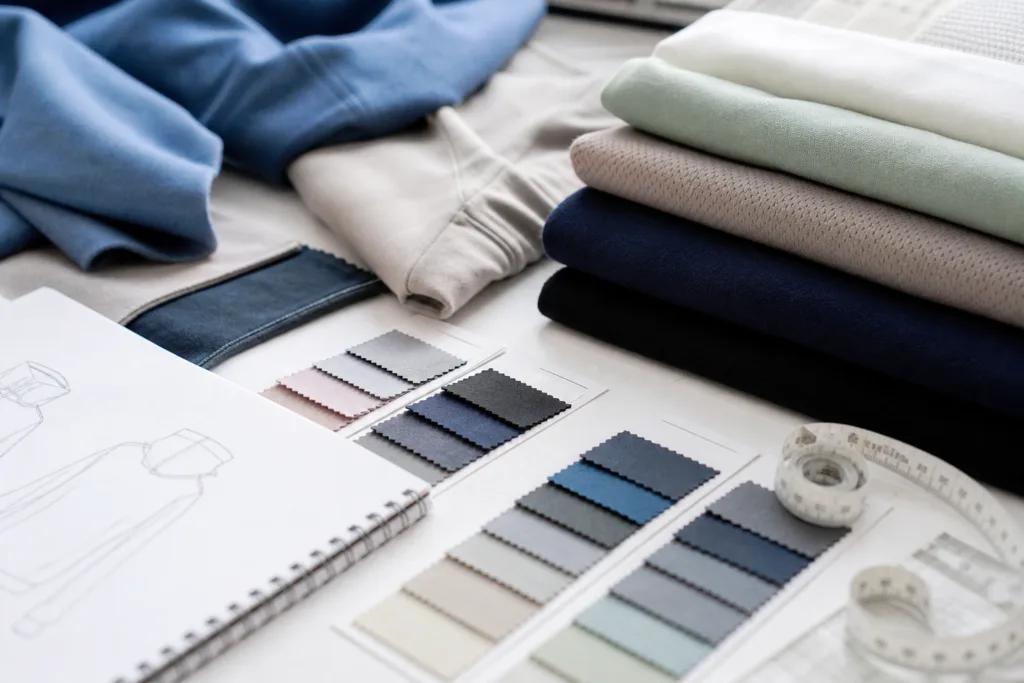
New brands often begin by asking, “What fabric should I use?” A better question is, “What is the garment supposed to do?” That means defining the product category, the user, the season, and the wearing context before comparing materials.
Define the garment category and use case
A relaxed cotton T-shirt, a heavyweight hoodie, and a fitted activewear top do not need the same fabric logic. A tee needs comfort, printability, and wash stability. A hoodie needs body, warmth, and enough structure to hold shape. Activewear needs stretch, recovery, and moisture management. If you begin with the use case, the fabric decision becomes much clearer.
This is where basic garment construction knowledge helps. If you are still deciding between structured and flexible fabric families, it is worth reviewing knit vs. woven fabric differences. For first-line basics, this distinction often determines whether the product will feel casual and forgiving or crisp and structured.
Think about your target customer
A brand aiming at premium everyday basics may choose a softer, heavier hand feel. A brand focused on entry price may need a simpler, stock-supported fabric with predictable availability. A youth-focused streetwear line may prioritize oversize silhouettes and a more substantial knit, while a performance brand may need technical stretch and faster drying.
In practice, the fabric should match the customer’s expectations, not just the design mood board. If the customer expects a premium fit and feel, a thin fabric will usually read as low value even if the print is strong.
Common fabric types for beginner apparel brands
For a first collection, most brands work with a relatively small set of fabric families. That is not a limitation. It is usually the smartest way to control complexity.
| Fabric type | Typical use | What beginners should know |
|---|---|---|
| Cotton jersey | T-shirts, base layers, casual tops | Soft, breathable, easy to understand, but quality varies a lot by yarn and GSM |
| French terry | Lightweight sweatshirts, joggers | Comfortable and versatile, with visible looped back structure |
| Fleece | Hoodies, sweatshirts | Warm and familiar, but pile quality and shrinkage control matter |
| Polyester knits | Activewear, performance basics | Stable and durable, but feel and breathability depend on finish and construction |
| Cotton blends | Tees, fleece, basics | Useful when you need better recovery, lower shrinkage, or lower cost |
| Rayon or viscose blends | Drapey tops, soft fashion basics | Good drape and hand feel, but can be less stable if not balanced well |
If you are comparing fiber families at a basic level, the article on natural and synthetic fiber comparison is helpful. The core question is not which one is better in general. The question is which one supports the garment’s function, price, and washing behavior.
For many first lines, cotton and cotton blends remain the simplest starting point because they are easy to explain to customers and easier for suppliers to source consistently. But the right answer still depends on the product category.
Knit vs woven: which construction fits your product concept
Fabric construction affects how the garment behaves before you even get to fiber content. Knits are loop-based and usually stretch more naturally. Wovens are made from interlaced yarns and usually hold a more stable shape. A beginner brand should understand this difference early because it changes both fit and sourcing options.
Most first clothing lines built around tees, hoodies, sweatshirts, joggers, and casual basics use knits. They are easier to wear, more forgiving in fit, and generally better suited to soft casual silhouettes. Wovens make more sense for shirts, structured tops, trousers, and outerwear where shape retention matters more than stretch.
Apparel Wiki explains the basics of common knit structures and best uses because knit type matters almost as much as fiber. Jersey, rib, interlock, fleece, and French terry can all feel very different even before you change the composition or GSM.
One practical rule for first-time brands: if the garment depends on comfort, movement, and casual wearability, start by exploring knits first. If it depends on structure and clean lines, test wovens or stable knit constructions with more body.
Understanding fabric composition
Composition tells you what the fabric is made of, but it does not tell you everything. A 100% cotton tee and a 100% cotton tee can still behave differently because yarn quality, knit structure, finishing, and GSM all change the result.
Cotton
Cotton is common because it is familiar, breathable, and easy to communicate to customers. It works well for tees, fleece, and many basics. The main issues are shrinkage, wrinkling, and sometimes softness variation if the yarn quality is not consistent.
Polyester
Polyester adds strength, stability, and often better color retention. It is widely used in activewear and blended basics. On its own, it can feel less natural than cotton, so surface finish and construction matter if comfort is a priority.
Rayon or viscose
Rayon and viscose can create a softer drape and a smoother hand feel. That makes them useful for more fluid fashion pieces. The trade-off is that they may need more careful handling in production and testing because they can be less forgiving than cotton or polyester.
Spandex or elastane
Spandex is not usually the main fabric. It is added in small percentages to improve stretch and recovery. If you want a garment to move with the body without bagging out, this can help. But too much stretch can create fit issues, opacity issues, or long-term shape loss if the base fabric is not stable.
For a clearer explanation of stretch behavior, see how elastane affects stretch and recovery. This matters because stretch is not just about comfort. It also affects pattern fit, sizing tolerance, and how the garment behaves after repeated wear.
In sourcing practice, blends are often the most realistic choice for a first line because they balance comfort, performance, and cost. A cotton-poly blend can reduce shrinkage. A cotton-spandex blend can improve fit recovery. A polyester-spandex blend can suit activewear. The point is to match the blend to the job.
How to evaluate GSM, weight, thickness, and drape
GSM means grams per square meter. It is one of the most useful numbers in fabric sourcing because it gives you a rough sense of weight and body. It does not describe everything, but it helps you compare options on a more objective basis than hand feel alone.
As a simple guide, lower GSM usually means a lighter, more breathable, and often more translucent fabric. Higher GSM usually means a heavier, warmer, and more substantial fabric. But thickness and GSM are not identical. Some fabrics feel dense without being overly thick, while others feel bulky without being very heavy.
Drape describes how the fabric falls and moves. A fabric with soft drape will hang closer to the body. A fabric with more body will stand away more and create a firmer silhouette. This is why the same pattern can look relaxed in one fabric and boxy in another.
| Product type | Common GSM range | Decision focus |
|---|---|---|
| Light tee | 140–180 GSM | Soft feel, breathability, and print quality |
| Midweight tee | 180–220 GSM | Better opacity, better shape, more premium feel |
| Hoodie | 280–400 GSM | Warmth, structure, and wash durability |
| Sweatshirt | 240–350 GSM | Body, comfort, and silhouette balance |
| Activewear top | 150–220 GSM | Stretch, recovery, and moisture handling |
Do not choose GSM by instinct alone. Ask for a fabric spec sheet and compare the actual result after washing. A fabric that seems fine on day one may become too thin, too loose, or too stiff after laundering.
Stretch and recovery: when elasticity helps and when it causes problems
Stretch can improve wear comfort, fit tolerance, and movement. That is why many modern basics and active garments include spandex or rely on stretch-knit structures. But stretch is only useful when recovery is strong enough to bring the garment back to shape.
For a first clothing line, too much stretch can create hidden issues. The garment may fit well on a sample form but grow out after wear. Seams may ripple. Necklines may lose shape. Prints may crack if the base fabric stretches too much under stress.
A practical approach is to ask whether stretch is solving a real product problem. If the garment is a relaxed tee, a small amount of stretch may help without changing the look. If the garment is a performance item, stretch and recovery become core performance requirements. If the garment is meant to be structured, extra stretch may work against the design intent.
Shrinkage, pilling, breathability, and durability
These are the performance factors beginners often underestimate because they are not obvious in a showroom sample. They matter because customers wash garments, wear them often, and judge quality after use, not just at purchase.
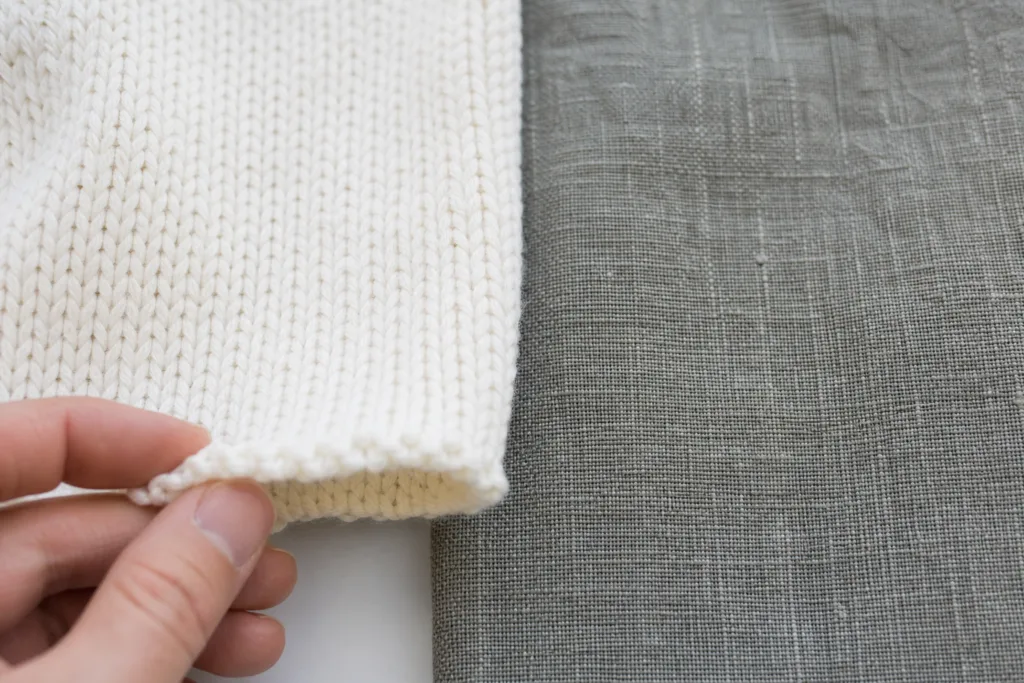
Shrinkage affects sizing consistency. If shrinkage is high, you may need to adjust pattern measurements or prewash the fabric. Pilling affects surface appearance, especially on knits and blends with short fibers. Breathability affects comfort, especially for tees and everyday wear. Durability affects how well the garment survives repeated abrasion, washing, and general wear.
If you want to test fabrics more formally, the standards overview from fabric testing standards for durability and breathability shows the kinds of technical methods used to assess air permeability, pilling, tearing, abrasion, and breaking strength. You do not need to run every test on every style, but it helps to know that serious fabric evaluation goes beyond visual inspection.
For first-time brands, the practical message is simple: approve fabric based on how it performs after laundering and wear, not just how it feels on the sample table.
Stock fabric vs custom-developed fabric
Stock fabric is already produced and available in established options. Custom-developed fabric is created or modified for your brand, often with specific yarn, construction, color, finish, or performance targets. Both can work, but they serve different stages of brand development.
Stock fabric is usually the safer choice for a first line because it lowers cost, shortens lead time, and reduces development risk. It also makes sampling faster because the supplier can often show you a real material sooner. Custom fabric can be useful when you need a signature hand feel, unusual performance, or a distinct brand identity that cannot be achieved with standard options.
The main risk of custom development is that it can increase minimums, extend sampling cycles, and add uncertainty. If your brand is still testing the market, you may not need that complexity yet. Start with stock-supported options unless the product concept truly depends on a unique material.
How fabric choice affects cost, MOQ, lead time, and sampling risk
Fabric choice is not only a design decision. It affects sourcing structure. Some fabrics are easy to buy at lower quantities. Others require larger minimums, special dyeing, or more time for knitting, finishing, or testing.
A more complex fabric may increase MOQ because the mill needs to justify production runs. A more specialized finish may add lead time. A fabric that seems affordable per meter may become expensive if it requires repeated sampling, higher defect risk, or more waste during cutting and sewing.
If you are trying to understand order size and production trade-offs, the guide on what MOQ means for your first order is a practical next step. MOQ is directly tied to fabric sourcing because the fabric plan often sets the floor for what you can reasonably produce in bulk.
Brands should also keep an eye on development timing. Fabric sampling, lab dips, shade approval, wash tests, and bulk booking all take time. For a practical planning view, the article on typical lead times for fabric and sampling helps you understand why fabric decisions should be made earlier than many founders expect.
A simple fabric selection framework for first-time brands
When you need to choose fabric for clothing brand development without getting lost in too many options, use a simple filter.
- Start with the garment purpose. Is it casual, structured, performance-based, or fashion-led?
- Choose construction first. Knit or woven should fit the product concept.
- Check fiber behavior. Cotton, polyester, rayon, and spandex each solve different problems.
- Set a GSM target. Decide the weight range before you review samples.
- Review stretch and recovery. Confirm whether the fabric must move or hold shape.
- Ask about shrinkage and wash behavior. This affects sizing and returns.
- Confirm MOQ and lead time. The fabric must fit your launch timeline and budget.
That process is simple, but it prevents a lot of mistakes. Many first-time brands start with the sample that looks nicest and only later discover that the fabric is difficult to source consistently or does not support the intended fit.
Recommended fabric logic by product type
T-shirts
For tees, cotton jersey is the most common starting point. A midweight GSM often works well because it improves opacity and reduces the “too thin” problem. If the fit must stay stable, a small amount of stretch or a cotton blend can help. If the brand wants a premium streetwear look, a heavier jersey may be more suitable.
Hoodies and sweatshirts
For hoodies and sweatshirts, fleece and French terry are the usual starting points. These fabrics need enough body to hold the silhouette and enough consistency to survive repeated washing. Brushed fleece feels warmer, while terry can feel lighter and more versatile.
Activewear
Activewear usually needs engineered stretch, good recovery, and some level of moisture management. Polyester-spandex blends are common because they balance movement and durability better than many simple cotton options. Fit testing matters here because a small difference in stretch can change the entire sizing range.
Basics and everyday layering pieces
For simple basics, aim for a fabric that is comfortable, easy to source, and stable in production. The best choice is often not the softest sample but the one that stays consistent across size grades and bulk lots. That is where product development discipline matters more than trend language.
For brands building a broader material strategy, the Apparel Wiki homepage can be a useful starting point because it connects fabric terminology, garment construction, and sourcing decisions in one place. That helps when you need to compare more than one product type at the same time.
Questions to ask suppliers before approving fabric
A fabric swatch is not enough. Ask your supplier clear questions so you understand what you are approving.
- What is the exact composition and yarn type?
- What is the GSM and how is it measured?
- What is the expected shrinkage after wash?
- How does the fabric behave in colorfastness, pilling, and abrasion?
- Is this stock fabric or custom-developed fabric?
- What is the MOQ for this option?
- What is the lead time for sample yardage and bulk?
- Will the same fabric be available for reorders?
- What finish or treatment has been applied?
- Is the fabric suitable for printing, embroidery, or washing processes?
These questions may seem basic, but they prevent misunderstandings. In many projects, the issue is not that the supplier gave a bad fabric. The issue is that the brand approved the wrong option without enough technical detail.
Common fabric selection mistakes new brands make
One common mistake is choosing fabric only because it looks premium in a sample card. Another is choosing the same GSM for every product category, which usually ignores actual garment function. A third is overlooking shrinkage, which creates sizing problems after wash.
New brands also sometimes select a fabric that is too difficult for their first factory to handle. Even a good material can cause problems if it frays too much, distorts during sewing, or needs special finishing the supplier is not set up to manage.
Another error is trying to develop too many fabric variations in the first line. That creates confusion in sourcing, pricing, and inventory. For a launch collection, it is usually better to use fewer well-chosen materials and execute them consistently.
Beginner fabric sourcing checklist for your first order
Before you approve bulk fabric, make sure you have confirmed the following:
- Garment type and use case
- Target customer and expected price point
- Fabric construction: knit or woven
- Composition and blend ratio
- GSM or fabric weight
- Stretch and recovery requirement
- Shrinkage expectation
- Breathability and opacity needs
- Pilling and durability risk
- Print, embroidery, or finishing compatibility
- MOQ and reorder availability
- Sampling and bulk lead time
- Wash test or wear test results
If you are still building your supplier communication process, the article on step-by-step guide to finding a manufacturer is useful because fabric approval and factory selection usually happen together, not separately.
Choosing the right fabric is really about reducing risk
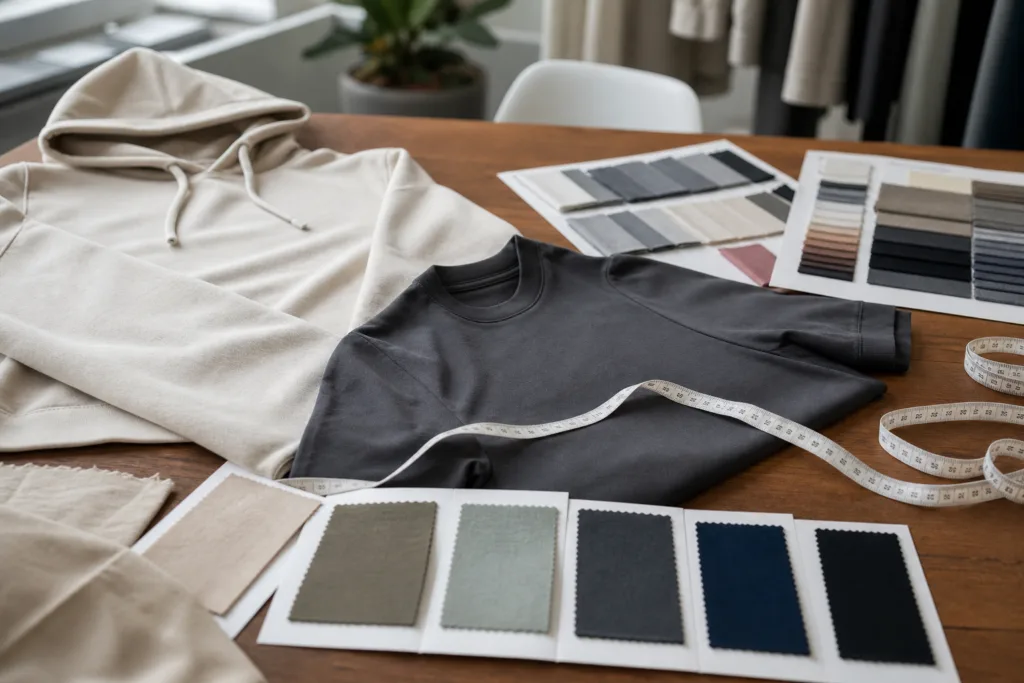
The best first-line fabric is not the trendiest one. It is the fabric that fits the product, the factory, the budget, and the customer expectation with the least amount of avoidable risk. That means making your decision with both design and production in mind.
If you choose fabric for clothing brand development carefully at the start, you usually save time later in sampling, fitting, production, and quality control. You also give your first collection a better chance of feeling consistent, wearable, and commercially realistic.
In apparel sourcing, that is the real goal: not just a fabric that looks good once, but one that performs well through development, bulk production, and actual use.
FAQs
What is the easiest fabric for a first clothing line?
For many beginner brands, cotton jersey is the easiest starting point because it is familiar, comfortable, and widely available. It also works well for common products like T-shirts and casual basics. The key is not just choosing cotton, but choosing the right GSM, shrinkage level, and quality standard for your product.
Should I choose knit or woven fabric for my first collection?
If your first line includes T-shirts, hoodies, sweatshirts, or joggers, knit fabric is usually the more practical choice because it is softer and more flexible. Wovens are better when your product needs structure and a cleaner shape. The right answer depends on the garment design, not just personal preference.
How do I know what GSM to use?
Start by looking at the product category and the feel you want. Lightweight tees need lower GSM, while hoodies and sweatshirts usually need higher GSM for body and warmth. Ask suppliers for fabric specs and compare samples after washing, since the real feel can change after finishing and laundering.
Is 100% cotton always the best choice?
No. 100% cotton is useful, but it is not always the best option. Cotton can shrink more than blends and may not recover shape as well as fabrics with a small amount of spandex or polyester. For some products, a blend will perform better and be easier to manage in production.
How much stretch should a beginner brand use?
Use stretch only when the garment needs it. For a relaxed tee, a small amount may help comfort and fit. For activewear, stretch and recovery are essential. If the garment is meant to stay structured, too much stretch can create shape problems and reduce the perceived quality.
What should I ask a supplier before approving fabric?
Ask for composition, GSM, shrinkage, stretch, durability, pilling, lead time, MOQ, and reorder availability. Also confirm whether the fabric is stock or custom-developed. These details help you judge whether the fabric can support your design, budget, and timeline without surprises later.